Features

I crashed Rupert Murdoch’s birthday party

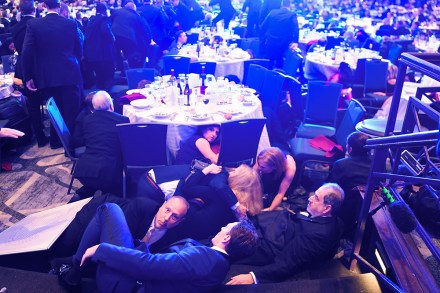
“This one is kinda dirty. Let’s see what the other one looks like.” Less than two hours before the guests started arriving for Rupert Murdoch’s 95th birthday party and a manager at the high-end Manhattan chophouse had spotted a stain on the welcome mat. It turns out they keep not one but two back-up red carpets at the Grill. I’d arrived hours earlier, accompanied by my photographer after receiving a tip-off the great and good of Murdoch-world would be descending on the venue. My plan – having learned every tabloid trick in the book from an early career at the Sun – was to have my snapper hose every Murdoch exec, editor and prominent person while I shouted a few questions. I would then publish the photo haul in a special edition of my newsletter, Breaker.

rupert murdoch
eu

Revealed: Keir Starmer’s new plan to get closer to the EU

A Labour MP, reflecting on the problems UK Prime Minister faces over the war in Iran, observed: “Keir got it right, but things keep going wrong.” His point was that Starmer kept Britain out of the Israeli-American air strikes, a position popular both with the parliamentary Labour party and the electorate, yet the impact of that conflict has laid bare three serious problems at the heart of the British state. First, there has been a fracturing of relations between Starmer and Britain’s defense chief, Air Chief Marshal Sir Richard Knighton. Second is the vulnerability of the economy to energy price shocks. Third is Ed Miliband’s net-zero crusade, which has put further pressure on the cost of living, Starmer’s biggest domestic problem.

Why Iran will hasten MAGA’s demise

Readers may disagree with the cover line of this issue. Pronouncing “the end of Trumpism” feels somewhat similar to declaring “the end of history” – a provocative, albeit less grandiose, statement that risks being mocked in the near future. We should start by saying we hope that we are wrong. Trumpism, as this magazine understands it, has been a boon to America. As Christopher Caldwell argues, the rise of Donald Trump was a healthy democratic response to a fetid political system. On many fronts, the Trump administration, now in its second and more dynamic term, has made great progress. It has fought illegal immigration with vigor.

The disembodied brain cells playing video games

In a suburban Melbourne industrial estate, hidden in a clutter of brutalist buildings and parked trucks, tomorrow’s world is taking shape. Here, an Australian tech start-up called Cortical Labs has caused an internet sensation. More than 40 million people have watched a clip of disembodied human brain cells playing the 1990s video game Doom. These cells are kept in petri dishes, wired up to computers and trained to do whatever the researchers want. “Right now, the cells play a lot like a beginner who’s never seen a computer,” says neuroscientist and Cortical Labs’s chief scientific officer, Brett Kagan. “But they can shoot, they can spin, they can seek out enemies and, while they die a lot, they are learning.

How we wage war in space

Operation Epic Fury marks a turning point in the art of war. The key to 20th-century battles was air power. In the past, space and cyber activities have traditionally played supporting roles as so-called force multipliers. But this is no longer the case. In this conflict they have become mainstream, carving out new fronts for the wars of the future. The use of space is no longer something that is just nice to have, because everything from comms to intel to navigation uses space and cyber assets. Along with the National Reconnaissance Office, which manages US spy satellites, the US Space Force uses a global sensor network of ground-based telescopes and radar on every continent except Antarctica.

Dinner in Tehran, anyone?

Who wants to join me for dinner in Tehran or Havana? I suspect that both will be open for business very soon. I suppose we could even go to Caracas. As I write, the American flag has been raised at the American Embassy there for the first time in seven years. Amazing, isn’t it? And in Cuba? In mid-March, protesters were setting fire to the office of the Communist party in the town of Morón in the Ciego de Ávila province. Elsewhere across the island, protesters were in the street shouting, “Down with communism!” The nervous Cuban government released dozens of political prisoners. Since Donald Trump cut off its supply of Venezuelan oil, much of the country has been without electricity. This saddened Greta Thunberg.

The end of Trumpism

Having Donald Trump as President probably resembles being a heroin addict: you undergo regular episodes of sweating terror and mortal danger, the end result of which is to get you – at best – back to normal. A year ago, the Liberation Day tariffs nearly caused the American economy to seize up, before China mercifully let the matter drop. Then came the even more reckless decision to join Israel in bombing Iran’s Fordow nuclear installation; Iran agreed to halt hostilities just as it was figuring out how to penetrate Israeli airspace with its missiles. But now the President has pressed his luck. He has joined Israel in a campaign of aerial assassination and bombardment against Iran – this time of an almost incredible violence – and has wound up trapped.

gay press

Why is the ‘gay press’ so cowardly on Iran?

Sometimes the obvious is so obvious that people forget to state it. So let me observe one small footnote among recent obvious things. At the end of February, Donald Trump killed the Ayatollah Ali Khamenei and most of the senior leadership of the Islamic Revolutionary government in Iran. There are many things to be said against the Ayatollah and his friends. Since 1979 they have repressed the population of Iran and hurtled one of the great civilizations backward by a millennium. From the start of the revolution they have murdered their domestic opponents by the thousands. They have shot students in the head when they came out onto the streets in protest. They have massacred, raped and tortured prisoners. They have exported terror around the world.

How to master the left-wing brag

No one likes a blatant boaster. So, as adults, we learn that if we want to boast, we must be subtle about it. The way to show off without being loathed is to drop small details about your life into your conversation and your prose, to signal your taste, education, career achievements and social status. Doing this is tricky enough for right-wing people, who need to come up with subtle ways of letting others know, for example, that they can afford private school fees, went to Oxbridge, shop at Waitrose, own at least one home and go on holiday in Provence or Tuscany. Words and phrases such as “exeat,” “scraped through my Prelims,” “perfectly ripe avocados,” “basement kitchen” and “bumping up through the olive grove” do the work.

My addiction to playing the piano is driving everyone mad

From time to time, I’ve given some famous pianists a bit of a kicking in the arts pages of this magazine. You may be a Bach specialist, but that’s no excuse for sleepwalking through all six keyboard partitas in a marathon recital. Your -Beethoven Diabelli Variations may be renowned, but don’t expect a rave review if you trap me in an intimate concert venue while you pound the keys like a pneumatic drill. You’d think, though, that a journalist who snipes at world-class soloists would have the sense to keep his own amateur playing to himself. And if he’s idiot enough to post a recording on social media, he should learn to take what he dishes out. Alas, I never learn. I have the ears of a connoisseur but the fingers of an arthritic pub pianist.

Kim Jong-un’s sister or daughter? Only one can survive…

As a birthday treat, a good father might take his ten-year-old daughter to the ballet or a Disney movie. Three years ago, North Korea’s ruling dictator Kim Jong-un (“Brilliant Comrade”) took his ten-year-old daughter Kim Ju-ae to the launch of an intercontinental ballistic missile. It was her first public outing. Subsequent kiddie treats have included visits to the mausoleum that houses the bodies of her grandfather, Kim Jong-il (“the Dear Leader”), and great-grandfather, Kim Il-sung (“the Great Leader”). She also got to stand at military parades, inspect nuclear facilities and make an official visit to Beijing. In the North Korean media, Kim Ju-ae is referred to as the Supreme Leader’s “beloved” or “precious” daughter.

How the poor survived in ancient Rome

Those for whom the welfare state does not provide as much welfare as they would like might care to reflect on the plight of the Romans, for whom there was no such thing as the welfare state. A superb monograph by Kim Bowes, Surviving Rome: The Economic Lives of the Ninety Percent, drawing on papyrus and other finds from across the Roman and Egyptian worlds, shows in fascinating detail how the poor survived. She defines the poor as the c. 90 percent who “worked with their hands,” most of whom were farmers renting their farms (rents were not cheap). One Soterichos rented a number of small, scattered plots, with small yields, and died in debt. His wife and children budgeted carefully and started breeding farm animals (very profitable).

Those who believe in liberalism must now fight for it

I’m conscious that, just as the easiest way to lose an argument is to mention Hitler, so the easiest way to lose journalistic credibility is to invoke the 1930s. Yet the similarities to our own dismal decade are now too numerous to ignore. There is the same collection of morbid symptoms: the rise of strongmen, the collapse of the political center, the intellectual organization of political hatreds. Even more worryingly, there is the same sense of hurtling toward global conflagration. The similarities begin with the disintegration of the international order.

Greek tips on how to beat Iran

In 500 BC, Persia (modern Iran) was the most powerful state in the known world, ruling an area of more than two million square miles from the Balkans and Egypt to central Asia (nearly half of the world’s population). In 499 BC, Athens and a number of other Greek states rebelled against its empire and incredibly defeated it in the ensuing Persian Wars (390-379 BC). The Greek historian Herodotus (d. c. 425 BC) wrote up those wars after traveling extensively around the whole region. He was as fascinated by different cultures as he was by the war itself, contrasting the Persian way of life with the Greek. For example, he said that Persians did not put up statues or temples or altars, or treat their gods as human in nature, as the Greeks did.

neocon

I spent 25 years fighting neocons. Then Trump became one

Like everyone, I’m glued to the news coming out of Iran. I’m experiencing some depression, as one might, upon realizing that much of what one has worked on for 25 years has suddenly gone up in smoke, destroyed when Donald Trump discovered he was pretty much a neocon after all. Like everyone else, I have no idea what will happen in Iran, whether Trump’s bombing and perhaps breaking apart a very unpopular regime will lead to something better, or just chaos, a failed state spitting out a cohort of embittered men.

el mencho

El Mencho is dead. What’s next for Mexico?

For as long as there has been a Mexico, there have been cartels. Geography is not always destiny, but in Mexico’s case it has been stubbornly close. For centuries, states have tried to impose order on Mexico’s northern frontier. None have succeeded. Power in Mesoamerica always radiated outward from the Valley of Mexico. The Aztecs built their empire there. The Spanish consolidated their rule there. The modern Mexican state governs from there. To the north lies a harsher landscape – arid, mountainous, thinly populated and historically resistant to centralized control. Deserts and mountains provide space. Space creates autonomy. Autonomy, in weakly governed regions, creates opportunity for dissent, for rebellion, for smuggling, for criminal enterprise.

Could Labour lose London?

After Gorton and Denton, where next? The scale of the Green triumph in Manchester has sent shockwaves through Sir Keir Starmer’s party. Much has been written about looming losses in Cardiff and Edinburgh. But the Greens – with their appeal to urban professionals, young Muslims and the economically disaffected – pose a threat in the place that many took to be Labour’s strongest heartland: London. "We have almost as many MPs there as Scotland and Wales combined," notes one aide. "Some are getting a bit nervy." Jitters are understandable. For ten years, Labour has ridden a wave of post-Brexit cosmopolitan feeling to boast ever-greater gains and now has 58 MPs in Greater London. At London’s last local elections, Labour won 62 percent of council seats.

labour london
britain

If only Britain was as important as Iran thinks it is

I am becoming rather fond of Prime Minister Starmer’s major foreign policy announcements. In early January, after US forces swooped into Venezuela and took President Maduro to New York to face trial, Keir Starmer was keen to get straight out in front of the cameras. There he said that he wanted to stress that "the UK was not involved in any way in this operation." As though the whole world had been expecting to hear that the British armed forces were indeed central in snatching the narco-terrorist from Caracas. This week it was again Starmer’s turn to stand behind a podium, British flags behind him, and deliver another statement that absolutely no one thought necessary. Speaking about the US-led strikes on Iran, he announced solemnly: "I want to set out our response.