More from Books

Unhelpful issues

It would not have been so easy to describe what Joanna Trollope’s early novels were ‘about’ in a few words, but recently she has been writing what the Americans call ‘issue books’, and they can be more readily encapsulated. It would not have been so easy to describe what Joanna Trollope’s early novels were ‘about’

A dramatic streak

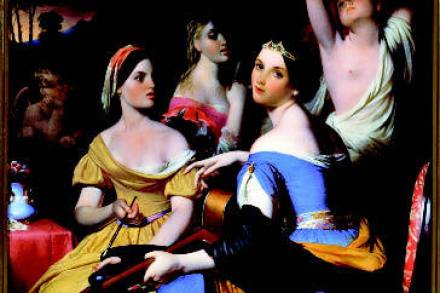
Late in the 19th century, archaeologists digging in the Roman Forum discovered a lime kiln. It had been built to incinerate marble into an aggregate for the mortar for the new structures of the Middle Ages. Inside were statues of six Vestal Virgins, stashed together like firewood. Their arms had been snapped off. The image

Weighed in the balance

We sanctify some expressions, and in the process empty them of meaning. ‘Democracy’, ‘freedom’ or ‘equality’ are all used in ways that beg more questions than they answer. As Orwell pointed out, those who reject the concepts have a habit of appropriating the words. And so it is with the ‘rule of law’. At a

Before she was a novelist

‘It’s hard in letters quite to hit the mean between being earnest and sounding damn silly’ — as Iris Murdoch admits on page 205 of this book. ‘It’s hard in letters quite to hit the mean between being earnest and sounding damn silly’ — as Iris Murdoch admits on page 205 of this book. It

A slave to her past

It is to Andrea Levy’s credit that for this, her eagerly-awaited fifth novel, she adopts a narrative approach strikingly different from that of the best-selling, prize-winning, televised Small Island. It is to Andrea Levy’s credit that for this, her eagerly-awaited fifth novel, she adopts a narrative approach strikingly different from that of the best-selling, prize-winning,

An affable tour guide

In mentioning Heinrich the Fowler, 10th-century King of the Germans and one of the many obscure figures who appears in his book, Simon Winder describes a painting in the Hall of Electors in Frankfurt. A product of the historicising 19th century, it is part of a series of German monarchs stretching from Charlemagne to 1806,

It happened one summer

For those unfamiliar with Martin Amis’s short story, ‘What Happened to Me on My Holiday’, written for The New Yorker in 1997, it was a purist exercise in autobiographical fiction; not even the names were changed. For those unfamiliar with Martin Amis’s short story, ‘What Happened to Me on My Holiday’, written for The New

An institution to love and cherish

Books about marriage, like the battered old institution itself, come in and out of fashion with writers, readers and politicians, but never quite die away. These two, from the latest crop, are by women in early middle age, both experienced journalists with several books behind them; but Elizabeth Gilbert, a chirpy American describing herself as

A couple of drifters

Paul Torday was 59 when his first novel, the highly acclaimed Salmon Fishing in the Yemen, was published in 2006. Since then, he can barely have stepped away from his keyboard. The Hopeless Life of Charlie Summers is his fourth novel and it represents a return to the comic tone of Salmon Fishing. Or at

Bank-bashing with a vengeance

Over the decades of (relative) macroeconomic stab- ility in the second half of the 20th century, profit-seeking com- mercial banks and state-owned central banks worked together to lower the cash-to-asset ratios in the banking industry. An understanding grew that profitable and well-capitalised commercial banks should be able to borrow cash from the central bank if

Writing of, or from, yourself

‘All literature is, finally, autobiographical’, said Borges. ‘Every autobiography becomes an absorbing work of fiction’, responded H. L. Mencken, though not, you understand, directly. Certainly the fictional element in autobiography is evident; Trollope thought that nobody could ever tell the full truth about himself, and A. S. Byatt has said that ‘autobiographies tell more lies

Double vision | 30 January 2010

Thomas Babington Macaulay’s early essays in the Edinburgh Review were an immediate success, and soon made him a respected figure in Whig society. Thomas Babington Macaulay’s early essays in the Edinburgh Review were an immediate success, and soon made him a respected figure in Whig society. In 1830 Lord Lansdowne offered him a seat in

Adventure with a difference

Probably my opinion of this bold book is worthless. Peter Carey, having decided to write a novel about Alexis de Tocqueville’s visit to the United States in 1831-2, read, among many other works, my biography of Tocqueville, which was published two years ago in, he says, ‘the nick of time’. He is kind enough to

Recent crime novels | 30 January 2010

Blue Lightning (Macmillan, £16.99) is the fourth novel in Ann Cleeves’ excellent Shetland quartet. Blue Lightning (Macmillan, £16.99) is the fourth novel in Ann Cleeves’ excellent Shetland quartet. It is just as good as its predecessors. Cleeves has found a way to serve up many of the pleasures of the traditional mystery in an unusual

The grandest of old men

Mr Gladstone’s career in politics was titanic. Mr Gladstone’s career in politics was titanic. He sat for over 60 years in the Commons, was in the cabinet before he was 35, was four times prime minister, almost solved the Irish question, set new standards for the conduct of public business and of foreign policy, and

Paris of the gutter

Port-au-Prince, the Haitian capital, lies on a marshy bay encircled by mountains. It was founded in 1749 by the colonial French and named after a vessel, Le Prince, which anchored there about 1680 (and not, as the dictator ‘Papa Doc’ Duvalier apparently liked to believe, after The Prince by Machiavelli). Thousands subsist in shanties built

Array of luminaries

In November 1660, on a damp night at Gresham College in London, a young shaver named Christopher Wren gave a lecture on astronomy. In the clearly appreciative audience were 12 ‘prominent gentlemen’, who in discussions afterwards, possibly over a drink or two, decided they would meet every week to talk about science and perform experiments.

Elder, but no better

William Pitt the Elder, Earl of Chatham was hailed by Victorian schoolboys as the man who made England great. He was the patriot leader, the minister who steered the country through the Seven Years War, climaxing in the Year of Victories of 1759. General Wolfe heroically captured Quebec, British troops helped Frederick the Great of