More from Books

Why did Penelope Fitzgerald start writing so late? 

‘Experiences aren’t given us to be “got over”, otherwise they would hardly be experiences.’ The opening sentence of the first draft of The Bookshop, published in 1978 when Penelope Fitzgerald was 62, didn’t survive in the finished version, but its author had found her voice, and, in a way, her subject. She had learnt how

Why Jeremy Paxman’s Great War deserves a place on your bookshelf

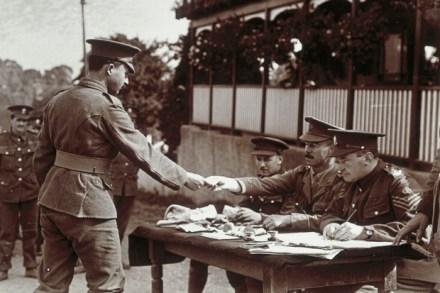
The Great War involved the civilian population like no previous conflict. ‘Men, women and children, factory, workshop and army — are organised in one complete unity of social resistance, to defend themselves both by offence and by ordinary defence,’ said Ramsay MacDonald. Geoffrey Studdert Kennedy, the popular army padre nicknamed ‘Woodbine Willie’, declared ‘There are

Village life can be gripping

Black Sheep opens biblically, with a mining village named Mount of Zeal, which is ‘built in a bowl like an amphitheatre, with the pit winding gear where a stage would be’. It is divided into Lower, Middle and Upper Terrace, the last-mentioned known by the locals as Paradise. If, like many bookshop browsers, you judge

‘If I can barely speak, then I shall surely sing’

A few weeks ago, I was wandering with a friend around West London when our conversation turned to the reliable and inexhaustible topic of Morrissey. We were discussing his gestures, in particular when he augments the percussive spondee that opens ‘Sheila Take a Bow’ with two magnificent jabs of his right elbow. So back we

My dear old thing! Forget the nasty bits

There can be a strong strain of self-parody in even the greatest commentators. When Henry Blofeld describes the progress of a pigeon in his inimitably plummy tones, or greets a visiting Ocker to the commentary box with a jovial ‘My dear old thing!’, he is impersonating himself as surely as Rory Bremner has ever done.

Clash of the titans

This is an odd book: interesting, informative, intelligent, but still decidedly odd. It is a history of the Victorian era which almost entirely eschews wars and imperial adventures and concentrates instead on the social, political and intellectual climate of the times.  This is still a vast spectrum. Simon Heffer concludes that he must decide which

Italo Calvino’s essays, Collection of Sand, is a brainy delight

The Japanese are sometimes said to suffer from ‘outsider person shock’ (gaijin shokku) when travelling abroad. Recently in London we had a lodger from Hiroshima who wanted to practise his karate routines in our back garden. Concerned to see him chopping at our apple tree in full combat gear, a metropolitan police helicopter hovered in

#Onyourmarks! What is the formal name for the hashtag? 

One day there simply won’t be any strange byways of the English language left to write quirky little books about. Happily that day hasn’t arrived yet. Keith Houston’s Shady Characters (Particular Books, £16.99, Spectator Bookshop, £13.99, Tel: 08430 600033)) ventures into the previously untrodden territory of punctuation marks, and not the obvious ones either. Full

Was Bach as boring as this picture suggests?

What, one wonders, will John Eliot Gardiner be chiefly remembered for? Perhaps, by many who have worked with him, for his notorious rudeness to performers and colleagues. At one point in his marvellous new book on Bach he refers to the master ‘losing his rag with musicians’ (as a corrective to the ‘Godlike image’ of

A is for Artist, D is for Dealers

‘S is for Spoof.’ There it is on page 86, a full-page reproduction of a Nat Tate drawing, sold at Sotheby’s in 2011 for £6,500. A sum which, it is added, with all due respect to [William] Boyd’s ability as an artist, probably proves the point about promotion being more important than talent. It’s always

‘Bauklotzartigewortzusammensetzung’

Mark Twain had a notoriously thorny relationship with German, a language he gamely tried to conquer. His main beef was with its knotty grammar: ‘Whenever the literary German dives into a sentence, that is the last you are going to see of him till he emerges on the other side of his Atlantic with his

The Labour education secretary who could have been Britain’s first woman PM

Decent, clever, charming, eloquent, hard-working, conscientious and terribly, terribly nice, Shirley Williams is one of Britain’s best-loved politicians. Mark Peel’s admiring biographybegins in Chelsea in 1930. Shirley, as he matily calls her, was the eldest daughter of the political philosopher George Catlin and the bestselling author Vera Brittain. Life at home was affluent, comfortable and

When ‘drop-dead gorgeous’ women actually dropped dead

No one watches Antiques Roadshow for the antiques. Instead we’re hanging on the punter’s reaction to his three-grand valuation. ‘It was very precious to Aunt Mabel; we’d never dream of selling it,’ says the mouth. ‘Fortnight in Barbados,’ say the eyes. The Antiques Magpie by the Roadshow’s Marc Allum exhibits the same preference for stories

Helen Fielding has lost her touch

To understand quite how disgruntled the reviews of the latest Bridget Jones diaries have been, you have to recall quite what she meant to her readers first time round. It wasn’t just the way she seemed to sum up the female condition for unmarried women in their thirties — indeed, she put a name on