Features

The supernatural is as British as fish and chips

We’re all accustomed to stories about credulous Americans; as an American living in Britain I am constantly asked to defend the 43 per cent of my compatriots who believe in creationism. We’re all accustomed to stories about credulous Americans; as an American living in Britain I am constantly asked to defend the 43 per cent of my compatriots who believe in creationism. Naturally, I can’t begin to; they’re the same people who voted for Bush, after all, which I find a far more mind-boggling proposition. But before British readers get too cocky, let it also be remembered that last year a poll showed that 22 per cent of Britons believe in creationism; 43 per cent believe in telepathy and 36 per cent believe in ghosts.

Meet the shadow minister for militant Islam

The biggest risk to David Cameron’s leadership to date has been his appointment of Sayeeda Warsi as the shadow minister for community cohesion. Warsi’s rise makes Cameron’s ascent from freshman MP to leader in four years look almost sedate. In just two years she has gone from failed parliamentary candidate to being responsible for, perhaps, the most sensitive portfolio in opposition politics. Add in her history of making injudicious statements about anti-terror laws, talking to extremists, and Iraq — combined with some distinctly unCameroon views on homosexuality — and you have a pretty volatile cocktail. Especially as having staked his reputation on her judgment, Cameron cannot sack her.

Moral panic is the right reaction: we are afraid of our young

Some things don’t change in Britain: the teddy bears and CCTV pictures, for example. First come the teddy bears. A princess dies in a sordid drunken accident, a child is abducted in Portugal, two girls are brutally murdered in Soham, a child is shot accidentally-on-purpose and you can’t open a newspaper without seeing a photograph with a teddy bear in the foreground among the gladioli. The legitimate grief of the people most directly involved is swamped by the maudlin tears of strangers who muscle in on it; and the stuffed toy becomes for us what black-plumed horses were for the Victorians. I look forward to the day when the lions in Trafalgar Square are replaced by teddy bears, as being more consonant with the new, improved British national character.

No more Mr Nice Guy

Smile and shoeshine get you only so far in any business, says Irwin Stelzer. But Labour is still vulnerable if the Tory leader produces solid conservative policies David Cameron is confused. Understandably. For two reasons. First, those who are urging him to abandon policy-lite in favour of more heft are the very same who favour policies that would lead to disaster at the polls. The result is confusion between the need to reject the specific policies they propose, and the need to offer voters something more than a smile and shoeshine, to borrow from Arthur Miller. There are, after all, policies and there are policies. There are policies based on Euro- paranoia, and policies that reflect a healthy scepticism of the emerging European superstate.

We blondes face prejudice every day of our lives

It is time someone spoke out against the vicious discrimination casually meted out to blonde women in all areas of life. Attractive blonde women are especially liable to be subject to open and unapologetic abuse in the most ordinary of circumstances. Somehow, in this dark corner where the exposing floodlight of feminism has yet to shine, it is still acceptable to make sexist ‘jokes’ and it is still acceptable to state that a person’s appearance makes them unsuitable for the job. Blonde humour is the last bastion of the Bernard Manning (may he rest in peace) –style sexism that women have fought against for so long. Anyone so much as dimly aware of the work of Sigmund Freud knows that there is no such thing as ‘just a joke’.

Don’t waste time courting ‘moderate’ Muslims

Enlisting the help of ‘moderate’ Muslims is pointless Funny the difference a few weeks can make. When I went away for an extended holiday, the subtle but unmistakable consensus on the threat to life and limb was more or less as it had been for some years: that jihadists are rotten fellows, but only small in number when compared with the ‘vast majority’ of ‘moderate Muslims’ who are, of course, not culpable. At all. Of anything. Ever. When I came back, the consensus had shifted. Now, it appears, they might be a teeny bit worthy of blame after all — not for the violence itself, but for failing to keep their hotheads in line.

I want three years’ paternity leave for each of my children — backdated

I am presently mulling over the idea of taking the next three years off from this journalism lark and spending the time instead on ‘paternity leave’. This is a new proposal by some Tory think tank so I am assuming that a) Cameron will win the next election and b) adopt the idea and c) have the grace to backdate it to the birth of my daughter, Emmeline, two years ago. Better still, he could backdate it to cover the birth of my two sons as well, thus giving me a total of nine years’ paid leave, which should comfortably see me through until the old liver packs up.

Climate camp: next year we’ll go for longer

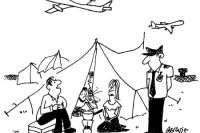
It is 11 p.m. on Saturday night and I am way out of my comfort zone. With my husband, two young children and dog, I have spent the day with 1,300 climate campaigners, none of whom I knew before, in a sodden field near Heathrow’s second runway. Now the five of us are squeezed into a three-man tent, rain seeping through the sides, listening to the roar of planes taking off and landing. It’s not exactly summer camp. And yet I feel strangely elated. The irony is that we nearly didn’t come to climate camp — because of the weather. At home in Wiltshire on Saturday morning, with a nice dry house full of chores and entertainments, the idea of camping in the rain seemed particularly unappealing. Like eating cold baked beans, or stepping barefoot on worms.

What the courtiers saw: the inside story of the great royal fightback

It is almost exactly a decade since the death of Diana, Princess of Wales, transformed the country into what Private Eye would call a ‘cellotaph’: grottos everywhere, great and small, full of cellophane-wrapped bunches of flowers, teddy bears, candles, the scenes of unrestrained emotion and group trauma the like of which had never been seen before. The mood of the week preceding the Princess’s funeral shook the ancient institution of monarchy to its foundations. Ten years on, it is easy to forget how volatile and eerie those days seemed. And yet the institution and the royal family have endured and prospered. Charles and Camilla, so vilified in the immediate aftermath of the Princess’s death, are now happily married.

The curious case of the spy who fell to his death

When a man falls to his death from a balcony, some cynics wonder: was he pushed? When that man happens to be the most infamous spy in the history of the modern Middle East, it’s the first question on everyone’s lips. On 27 June the body of Ashraf Marwan was found on the pavement below his flat in Carlton House Terrace, one of London’s most expensive streets, which overlooks the Mall and St James’s Park. Marwan was an astonishingly well-connected Egyptian, the son-in-law of the late Gamal Abdel Nasser, the Egyptian president and hero of pan-Arabism, and the consigliere of Nasser’s successor, Anwar Sadat.

The last Tommy says: ‘It was a waste of time’

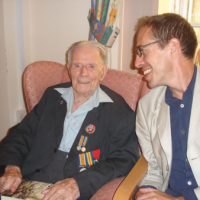
Harry Patch, 109, recalls his career in Kitchener’s army Two years ago, when he was a mere spring chicken of 106, the last surviving Tommy, Harry Patch, was invited to inspect the Lewis guns at the museum of his old regiment, the Duke of Cornwall’s Light Infantry, in Bodmin, Cornwall. To help jog his memory, a young major in his party fumblingly demonstrated how to change the magazine. ‘I said: “Major, you’d have to be quicker than that in action,”’ recalls Harry in his soft Somerset burr. ‘I said: “Here. Give me the Lewis gun and set your watch.” So I took the magazine off and put a new one on. “There. Now how long was that?” I said. “Two seconds,” they said.

How will the BBC save £2 billion? Axe the journalists, of course

A short while after becoming director-general of the BBC, Greg Dyke gathered a whole bunch of staff together at some warehouse near the City Airport to thrash things out and to deliver unto them his vision for the corporation. There was an air of trepidation among those gathered; Greg had very recently flexed his muscles at Television Centre by banning biscuits.

Can working men’s clubs survive the smoking ban?

Reactions to the smoking ban at a working men’s club I pressed the buzzer on the wall of the darkened doorway of the Custom House Working Men’s Club in east London. It wasn’t clear whether the shabby building was open for business or not. I pressed again and waited. In the early 1970s there were over 4,000 working men’s clubs in Britain. Today that number has halved to about 2,000. Recent hikes in the cost of gaming and drinking licences and loss of custom owing to the comparative cheapness of supermarket beer means that many of those that remain are struggling to make ends meet.

Bush’s exit strategy: cut and run – but not too far

More than four years after the American-led invasion of Iraq, there are signs that George W. Bush is preparing to call it quits. When the Americans disbanded the Iraqi army in 2003 and left the borders wide open they sowed the seeds of disaster. Neither the ‘coalition of the willing’ nor even the recent ‘surge’ could put Humpty together again. That, at least, is the conclusion I have reached after intensive interviews with senior Iraqi politicians and Western experts for a book that I am writing on the imbroglio. Whatever gloss General Petraeus applies to his report to Washington next month, he is unlikely to be the bearer of good news.

‘Some say Bill Clinton’s running for a third term’

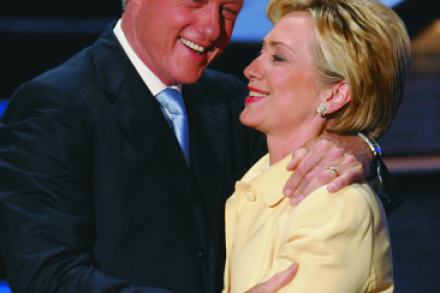
Washington insiders on America’s first couple When you enter the offices of the Great and the Good in Washington — or even the Not so Great and Not so Good — you always find an Ego Wall. Senator Trufflebacker’s Ego Wall will have photographs of himself at Nasa with the astronauts, a signed photograph with President Ronald Reagan and perhaps a framed pen used by President Bush to sign the bill authorising Senator Trufflebacker to give millions of taxpayers’ dollars to the corn farmers in his native state. Congressman Mudpie, on the other hand, might be pictured with Angelina Jolie, have a citation for his honorary degree, and perhaps even the first paycheck he ever earned for a very small amount as a miner in West Virginia.

Why we are in Afghanistan for the long haul

The phrase ‘think global, act local’ originated in the environmental movement. It can be a glib substitute for serious attention to large problems. But it can also be a telling rejoinder to the temptations of top-down, big-government solutions. I believe it is relevant to our challenge in Afghanistan. The potential problems emanating from that country are global in scope. Afghanistan is at the centre of international terrorism and the drugs trade. But the solutions need to be local — in tune with the needs and circumstances of the people. This was brought home to me on a trip there in July. I decided that my first visit as Foreign Secretary outside Europe should be to Afghanistan, followed by Pakistan.

Now we know: Brown is a European, not an Atlanticist

There is little doubt, as Matthew d’Ancona and others have pointed out, that Gordon Brown is secure in the thought that he has established himself as what is called these days a ‘change agent’, cutting the ground out from Tory cries that ‘It’s time for a change.’ If you want change, go for the experienced clunking fist rather that the PR tyro. Unfortunately, not all change is in Britain’s interest. Which brings me to the by now, or at any rate soon to be, forgotten visit of the Prime Minister to President Bush’s retreat at Camp David.

Shambo’s revenge: this is what happens when you mess with the gods

It took some of our farmers less than 24 hours after the first outbreak of foot-and-mouth disease (FMD) last week to demand an immediate and comprehensive culling of Britain’s ramblers, dogs, badgers, Defra vets, tourists, van drivers, biochemists, etc etc. It is not enough that we should subsidise our farmers once over; when misfortune occurs we should then further compensate them — and suffer in silence as they demand that footpaths be closed, wildlife exterminated and so on. They have not yet gathered, or do not care, that the meat industry is of minuscule importance to the economy compared to the tourism and leisure sectors; still less that the land upon which they rear their cattle is heavily supported by the taxpayer.