Features

Jew and non-Jew: Unity Mitford and aristocratic anti-Semitism

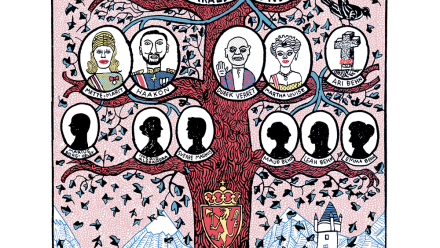
I was touched but not surprised that, despite his illness, the King attended the 80th anniversary of the ‘liberation’ of Auschwitz-Birkenau this week. His paternal grandmother, Princess Alice of Battenberg, was a rescuer. She hid the Cohen family in her house in Athens and is honoured as a ‘righteous’ gentile at Yad Vashem in Jerusalem, where she is buried on the Mount of Olives. A less friendly aristocrat was Unity Mitford, whose views were probably a more accurate reflection of her class. Her newly published diary describes her friendship with Adolf Hitler. Here is a typical entry: ‘Lunch Osteria 2.30. THE FüHRER comes 3.15 after I have finished lunch. After about ten minutes he sends the Wirt [owner] TO ASK ME TO GO TO HIS TABLE.’ She sounds like Bridget Jones.

Peter Mandelson’s rocky path to Trumpworld

The muddle about who’s to be the next British ambassador in Washington has been only a small part of the grandiose confusion which surrounds Donald Trump’s assumption of power. Sir Keir Starmer announced that Lord Peter Mandelson would bring ‘unrivalled experience to the role and take [the Anglo-American] partnership from strength to strength’, apparently without checking first that President Trump would be willing to accept him. The US President’s campaign manager, Chris LaCivita, said Mandelson was ‘an absolute moron’ who should ‘stay home’. He did nothing to improve his prospects when he described Trump as ‘reckless and a danger to the world’ How ambassadors get appointed is a mystery to most people. Why do we waste the money on them anyway?

Why don’t we know how many people are in Britain?

How many people live in Britain? You would think there would be a straightforward answer, but it eludes some of the nation’s brightest statistical minds. The problem of undercounting has worsened in recent years, largely because of high post-Brexit migration This week the Office for National Statistics (ONS) projected that our population will grow by some 4.9 million people over the next seven years, bringing Britain’s official population to over 70 million. The bulk of that population growth will come from immigration – nearly ten million people. But can these projections be trusted? Never mind how many people will live in Britain in seven years, we do not know how many people are living here now.

My neighbour has kidnapped my beavers

My beavers have been kidnapped. A few months ago there were five of them living on my family’s farm on Bodmin Moor. Now there are none. I know where they are and I have received proof of life from their kidnapper, but he will not release them back to me or allow me to collect them and bring them home. I miss them and often walk along their stretch of river and past their dams with a tear in my eye. I miss them and often walk along their stretch of river and past their dams with a tear in my eye I was quite early to the beaver game.

Cornwall’s gypsies face eviction

‘Don’t use our real names,’ says the teenage gypsy. ‘Other gypsies will laugh at us.’ Even in a tracksuit, the girl is crazy beautiful, and strangely remote. She is talking to me because her mother, whom I call Susan, has been ordered to remove her caravans from a council site in the West Country. If Susan, mother of five, and carer to two grandchildren, is evicted by Cornwall council, her family will be scattered to the winds. It’s a peculiarly awful fate for gypsies. They are tribal, and family is everything to them. It is the first eviction of a gypsy from a council site in this county. The site is silent and dour: rows of caravans, ugly piles of rubbish, though Susan’s part is neater than most.

How Pierre Poilievre led Canada’s Conservatives back from the wilderness

Ottawa For the past fortnight, Canada’s parliament has been empty. When Justin Trudeau resigned as Liberal leader, he announced a prorogation so his party could focus on a two-month succession battle rather than the business of governing. Excited Tories see the empty assembly as symbolic of the void in national leadership. They are confident their party will soon fill it. If they do soon manage to end a decade of Liberal rule, it will chiefly be thanks to Pierre Poilievre, who has been Conservative leader since 2022. There are few party leaders who excite British Conservatives more: both Kemi Badenoch and Robert Jenrick have visited Canada to try to learn from his playbook.

There’s nothing sexy about a sex party

‘Sorry sir, the rules clearly state that all single men must be accompanied by a woman.’ As the frustrated guest is ushered off the premises, my female companion and I are welcomed into a grand reception room where the organised sex party is being held. A barmaid offers us some complimentary condoms and a handful of Quality Street, along with some fluorescent orange punch served in plastic cups. Should we be engaging in small talk or ripping each other’s clothes off? No one seems to know The organisers of tonight’s paid event claim they cater for the world’s ‘sexual elite’ but there’s something disarmingly ordinary about the snaggle-toothed mid-lifers trooping in behind us – hardly the glamour models I’d been expecting.

The Trump resistance is dead

The special relationship is dead, long live the special relationship. On Friday, at a ‘Stars and Stripes & Union Jack Celebration’, British and American right-wingers mingled gladly atop the Hay-Adams hotel, which overlooks the White House. Nigel Farage and co smoked cigarettes with their Republican brethren and shared Trump war stories. Dolled-up American girls took selfies with Liz Truss. And Steve Bannon showered Lord Glasman, the Labour peer, with admiration. The horseshoe theory has gone full circle. I bumped into Truss at the bar. ‘You’re a Gove shill,’ she told me, in that delightful, easygoing manner of hers. How did she think Kemi Badenoch was getting on, I asked, trying to change the subject. ‘Kemi is a Gove plant,’ came the firm reply.

Unmade in Britain: we’re becoming a zero-industrial society

The French sociologist Alain Touraine coined the term ‘post-industrial society’ in 1969. By the 1980s it had become shorthand for the kind of services-based, individualistic economies most major developed nations had created. Today, the UK is moving its economy beyond that. We are creating what might be called a ‘zero-industrial society’. Climate change targets, soaring energy prices and rising taxes on employment are killing off Britain’s small and vibrant industrial base. Last week, Ineos closed its ethanol plant in Grangemouth, Scotland, with its chairman Sir Jim Ratcliffe warning of ‘the extinction of our major industries’. The previous month, Airbus announced it was cutting 500 jobs.

Energy prices are shattering Britain’s remaining potteries

The ceramics industry of Stoke-on-Trent is one of the great survivors of the Victorian era. At its height, some 70,000 people were employed by the likes of Wedgwood and Spode to work in the potteries. Despite the Clean Air Act of 1956 – which banned coal-fired kilns – the deindustrialisation of the 1980s and the struggle to compete against the rise of cheaply made Chinese goods, the industry lives on and still employs around 7,000 people, manufacturing everything from teapots to tiles for the London Underground. In 2022, some companies saw their six-month energy bills rise tenfold Stoke can at times seem like it’s living in the ruins of its past – but while the ceramics sector is no longer a large industry, it is still hugely important to the city.

Charities are swapping altruism for activism

Charity no longer begins at home. It starts with a thunderous denunciation of western sins, promotes an excoriation of this country’s past and then advocates the dismantling of white privilege – all paid for by you. Welcome to the charity industrial complex, the money-guzzling, taxpayer-subsidised assault on common sense that has turned the impulse to generous altruism into a licence for radical activism. Just this week, Oxfam released a report damning poor governance in India. The guilty parties are not those in power today, but our imperial forebears: the report claims the British empire drained $64.82 trillion from India.

The child-free influencers waging war on motherhood

At around five weeks into my pregnancy my phone found out about it, and from that point on I was subjected to a barrage of social media content about how much children suck. The first was a video by a woman with the username @childfreemillennial, who filmed herself walking through the children’s clothing aisle at a supermarket. She paused, turned to the camera and gagged. I was so shocked at the sheer nastiness and so hormonal that I cried. According to @childfreemillennial, the most loving thing we can do for our children is to never have them – in this economy, in this society, in this climate. According to @childfreemillennial, the most loving thing we can do for our children is to never have them This woman was not a one-off.

How I fell foul of YouTube’s fact-checkers

The day after Mark Zuckerberg said fact-checkers ‘have destroyed more trust than they have created’ I experienced why he has a point. I had done an interview with an evolutionary psychology podcaster, Paula Wright, about the origin of Covid. In it I said something that caused the entire interview to be banned from YouTube. Wright’s appeals were rejected. Some ill-informed, possibly underpaid, definitely over-confident youth at YouTube banned my remark What had I said that was so offensive? Was it a lie, a conspiracy theory, a mistake, defamation? No, it was a statement of historical fact that has been confirmed and agreed by mainstream scientific bodies, including the World Health Organisation.

My wife earns more than me – and it doesn’t feel great

This is the article I have thought about writing for years, but I have always ended up asking what would be the point. And how annoying that some people would call it ‘brave’, meaning shameful. I’ve always earned a lot less money than my wife. There, I’ve said it. Is that still a big deal these days, a difficult thing to admit? Yes and no – and the ambiguity is rather interesting. Our culture claims to be liberated from old stereotypes about gender roles. But is it hell. Even its progressive urban elite is ruled by stubborn visceral traditionalism when it comes to gender and money. I’m prompted to share these thoughts by a news story.

The Donald’s plans for the Middle East

The former US president Jimmy Carterdied, at the age of 100, just before news of an imminent deal to free the last of Israel’s hostages in Gaza. Carter’s presidency was crippled by his own hostage crisis, American diplomats held captive in Tehran. Freeing them became his administration’s highest priority, and he worked on it for every single one of the 444 days the crisis lasted, often to the exclusion of anything else. By contrast, the Israeli Prime Minister, Benjamin Netanyahu, resisted massive domestic pressure to do a deal for his hostages in order to pursue the war aim of destroying Hamas. You could call this statesmanship, or something else, but it is a kind of victory for Netanyahu.

Empire of Trump: the President’s plan to make America greater

‘The mission of the United States is one of benevolent assimilation,’ said William McKinley, America’s 25th commander-in-chief, who happens to be one of Donald Trump’s favourite presidents. Trump, who barely dodged a bullet in 2024, shares a number of traits with McKinley, who was assassinated in 1901: Scottish blood, ferocious work ethic, an affinity with the super-rich that somehow appeals to the working classes, a faith in tariffs as a means of safeguarding industry, and a willingness to expand America’s empire to boost future prosperity.

J. D. Vance is the future of MAGA

The vice-presidency of the United States has always been the butt of jokes. ‘I don’t plan to be buried until I’ve died,’ quipped Daniel Webster when he declined William Henry Harrison’s offer of the role. John Nance Garner, who served as FDR’s vice-president, dismissed it as ‘not worth a bucket of warm piss’. Even John Adams, the first to hold the office, was equivocal: ‘I am Vice-President. In this I am nothing, but I may be everything.’ He may prove to be a more effective standard bearer for Trumpism than Trump himself That ‘everything’ has proven elusive.

Does Kemi Badenoch have a plan?

We are nearing the 50th anniversary, next month, of Margaret Thatcher becoming leader of the Conservative party. Only one other woman has ever become leader while the party was in opposition, and that is Kemi Badenoch. Mrs Badenoch is well aware of the strategy her legendary predecessor pursued between becoming leader of the opposition in 1975 and prime minister in 1979, and is sensibly emulating it: a willingness to include rivals in her shadow administration, and to take her time setting out policies (there is, after all, unlikely to be an election before the spring of 2028, by when anything could happen); but to precede the announcement of specific policies by statements of principle, to give a broad idea of what the Conservatives stand for.