Features

The man behind Justin Welby

In the leafy seclusion of the Lambeth Palace grounds, Archbishop Justin Welby goes for his daily jog. He used to run along the Thames and over the bridges until Canon David Porter, his Chief of Staff, put a stop to it. David Porter grew up in Belfast in the 1960s and he knows how easy a target a lone high-profile jogger can be. As well as being Welby’s physical protector, Canon Porter has taken on the role of his bureaucratic gatekeeper. ‘No one comes to Justin except through David’ — that’s the impression I get from everyone I’ve spoken to who has tried to contact the Archbishop recently. ‘Nothing happens without David’s knowledge and permission.

Bad influence: Instagramming from Dubai isn’t ‘work’

January is when the difference between the rich and the poor becomes most evident. Whereas many people face a month plagued by the three Ds — debt, divorce and doldrums — the famous tend to take off for more clement climes. Simon Cowell famously frolics at the Sandy Lane Hotel in Barbados at the start of each new year, and I myself have spent many January days at the Ritz-Carlton — but only the one in Tenerife, because I believe in keeping it real. This winter, subdued British airports have also seen a mass exodus of a particular youth tribe recognisable by their bright white teeth and deep mahogany tans — the hordes of youngsters who are reality TV stars and/or create content for Instagram. And most of them are going to Dubai.

At last, America has a gaffe-prone president again

‘Folks, I can tell you, I’ve known eight presidents, three of them intimately.’ So said then vice-president Joe Biden in 2012. A month earlier, he had assured a crowd in New York that President Barack Obama could, in Teddy Roosevelt’s famous words, ‘speak softly but carry a big stick’ when it came to international relations. ‘I promise you,’ he said. ‘The president has a big stick.’ The crowd started laughing at the double-entendre. Joe wasn’t joking. ‘I promise you,’ he repeated, gravely. That is just Joe being Joe. The 46th president is someone who quite often has no idea what he is saying. Curiously, everybody seems relieved about that.

Why I’m keeping my church open in lockdown

On a beautifully sunny Maundy Thursday last year, during the first lockdown, I removed my cassock, slung my satchel over my shoulder and rode my bicycle to Lambeth Palace and back. At the halfway point I paused briefly to slip a letter under the Archbishop of Canterbury’s front door, before heading for home and the sad prospect of a solitary evening mass. In my letter I asked the Archbishop to reconsider his request that we not pray in our churches. Communal worship was still forbidden, but the government clearly considered it lawful for the clergy to continue to go into their churches to pray on behalf of their absent congregations. Surely that is what we are here for?

Orban and Macron, Europe’s new power couple

After Brexit, the general assumption was that France and Germany would take their place as the two rulers of Europe. But Angela Merkel’s influence has been waning and Germany is often an absent power — preoccupied as it is by redefining its own politics after 15 years of her rule. This suits Emmanuel Macron, who was never satisfied with sharing the stage with her. He has found himself another ally, one who is far more influential than people give him credit for — Viktor Orban. Macron and Orban have a monastic attitude to power: they both rule on the basis of there being a single orthodoxy that everyone must observe. They also like to behave like monarchs, treating voters as subjects and accepting few restrictions on their personal projects.

The stifling cult of self-care

Baby, it’s cold outside. It’s dark. It’s January. It’s Lockdown III. There’s only one thing for it: stay home, snuggle up, save lives. Cocoon yourself in cashmere, treat yourself to silk pyjamas, invest in a lambswool throw. Lay the fire, warm the cocoa, watch Love Actually for the 30th time. Practise self-care. Be sure to put you first. You’ve heard of safe spaces and The Coddling of the American Mind. Well, this is the safe space as interiors trend, coddling as lifestyle choice. Call it the blanket cult.

The ethics of eating octopus

Should the undoubted intelligence of octopuses change the way we treat them? This question has been asked a lot of late because of the documentary My Octopus Teacher. The film is about a year-long relationship between a man and an octopus, and it takes place in a kelp bed off South Africa. It celebrates the sensitivity, awareness and intelligence of the octopus. That’s a difficult concept. Octopuses — octopi is wrong because it’s not Latin and octopodes is insufferably pedantic — are molluscs. That’s the same phylum as slugs and snails and cockles and mussels. In other words, intelligence is not restricted to our own phylum of chordates or back-boned animals.

How should Britain respond to the takeover of Hong Kong?

The veteran British diplomat the late Sir Percy Cradock said that Chinese leaders may be ‘thuggish dictators’ but ‘they were men of their word and could be trusted to do what they promised’. Well, the past year has put an end to the latter half of that statement. From coronavirus to the brutal treatment of Hong Kong, the behaviour of the Chinese Communist party has made it clear that the approach of liberal democracies to China must change. Last week, when the West’s media was distracted by the chaos in the US Capitol, police in Hong Kong arrested 55 pro-democracy activists on the charge of subversion. It is the latest example of the consequences of the national security law imposed by Beijing on the city in June.

The tech supremacy: Silicon Valley can no longer conceal its power

‘To see what is in front of one’s nose needs a constant struggle,’ George Orwell famously observed. He was talking not about everyday life but about politics, where it is ‘quite easy for the part to be greater than the whole or for two objects to be in the same place simultaneously’. The examples he gave in his 1946 essay included the paradox that ‘for years before the war, nearly all enlightened people were in favour of standing up to Germany: the majority of them were also against having enough armaments to make such a stand effective’. Last week provided a near-perfect analogy.

Journalists should scrutinise politicians – not accept honours from them

Our House of Lords is so fat it’s the butt of ridicule. More than eight times as many members ‘sit’ in our second chamber as in the Senate of the United States. True, some Lords in former lives did great or good deeds. Not all in our upper house are mere political paymasters or hoary ex-vote-winners. But we have too many of every sort in there: far too many.  One whole incestuous layer could be dug straight out of the UK honours system: out from the Lords, and out also from below it. Nobody from our media should carry a title. And none needs, either, to wear a gong. Not broadcasters, not journos, not editors, not their managers — and certainly not their owners.

Why I was sacked from Eton

One of the things I’ll miss about teaching at Eton is the ever-present threat of an ironic riposte from one of the boys. ‘Cheer up,’ I told one who looked un-enthused by Milton in my first week at the school, nine years ago. ‘Two hundred years ago, you’d have been down a mine!’ ‘Sir,’ he replied deadpan, ‘we’d have owned the mines.’ The class erupted in self--deprecating laughter. I’d arrived. It was the boys themselves who suggested and named the YouTube channel Knowland Knows, which has since got me summarily dismissed.

The Democratic takeover is nearly complete

In the days following the US presidential election in November, political centrists reached a hasty verdict. Never mind all the squabbling about voter fraud — they had won. The extremes had lost. Donald Trump, the maniac, was out; Joe Biden, the moderate, was in. Yes, the increasingly radical Democratic party still controlled the House of Representatives, but as long as the Republicans won one of two Senate run-off races in Georgia in January, the crazies would be checked by a Republican majority in the Senate. The markets rallied. All was well in establishment la-la land, despite the pandemic. Well, guess what? On Wednesday morning, it became clear that the Democrats had won both those Georgia races.

‘We’re going to have a great summer’: an interview with Matt Hancock

Hospitals are filling up at a terrifying pace, with more Covid-19 cases now than ever. A new variant is sweeping through the capital and the country, with more than a million of us currently infected. Nicola Sturgeon, the Scottish First Minister, says she is more worried now than she has been at any point in the pandemic. Matt Hancock, the Health Secretary, puts it differently. ‘I am optimistic,’ he says. ‘We’ve got the light at the end of the tunnel and it’s getting brighter. Of course, we’ve got a difficult time between now and then but the vaccine is going to get us out of it.’ We are, he says, ‘going to have a great summer’.

A race against time: can the vaccine outpace the virus?

The next three months may well prove to be the hardest of the whole pandemic. The new variants of Covid-19 appear to be the wrong type of game-changer. After our national lockdown in March, infection levels started falling because of extreme measures — including closing schools, places of worship and non-essential retail. But the infectiousness of the ‘Kent strain’ suggests that as it becomes prevalent, a new lockdown might be unable to contain it. When ministers first locked down, they did so in the expectation of taming the virus. This time, it’s more in hope. Boris Johnson didn’t show us any graphs when he announced the latest lockdown. He didn’t need to; the situation is clear.

The echoes of Diana in Prince Harry

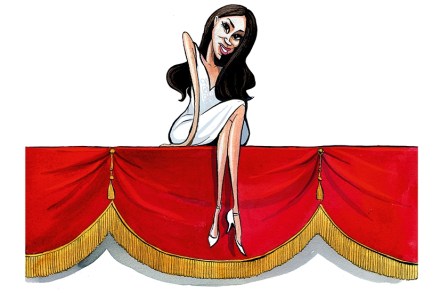
Oscar Wilde’s Algernon observed: ‘All women become like their mothers. That is their tragedy. No man does, and that is his.’ No man? Not quite. Prince Harry is in so many ways turning into a version of his mother. The first sentence of the joint new year statement from the Duke and Duchess of Sussex on their Archewell Foundation website declares: ‘I am my mother’s son.’ For those of us who were around when Diana was on the scene, there’s a pang of recognition here. Prince Harry is indeed his mother’s son. He’s what might have happened to Diana if this essentially English girl had been transported to California, had learned to think and speak woke, and had the redemptive down-to-earth aspects of her character removed.

The highlights of history: a Spectator Christmas survey

Emily Maitlis Six years ago I took my son, Milo, to Bucharest for his birthday. In the baking July sun, seeking shade, we crouched on the kerb in front of the presidential palace. And I played him the footage of the crowds on that bitter December morning of 1989 as Nicolae Ceausescu and his wife Elena emerged on to the balcony. The speech Ceausescu gave, or tried to give, on 21 December was his last. And it was extraordinary. Ceausescu used his balcony address to reassure, cajole, bribe the crowd. But it turned against him as he stood there. This footage — state TV rolling live at the time — became the physical, televisual embodiment of power seeping away from a president. The leaders and their bodyguards are above them, removed.

‘It’s not morally right to keep borrowing at these levels’: Rishi Sunak’s plan to fix the UK economy

After ten months as Chancellor of the Exchequer, Rishi Sunak has finally decided that it’s safe to settle into 11 Downing Street. When we meet, there’s a modern work of art depicting currency signs — €, $, £, Y — being hung in the sitting room, and a portrait of Disraeli being moved to another room. He never had much time to get comfortable, thrust into his job after the surprise resignation of Sajid Javid in February and expected to deliver a Budget the following month. ‘I thought my most difficult professional thing would be to put a Budget together in three and a half weeks,’ Sunak says now. ‘But it turned out actually that that was probably the easiest thing we’ve had to do.’ The Chancellor has certainly been busy.

City of gold: Peter Ackroyd on the undimmed spirit of London

The silenced city has been, for some, uncanny. Deserted evening streets, darkened pubs, shut shops and the absence of fellow footsteps might suggest that some essential spirit has fled. Yet this is exactly the wrong way to look at it, says the novelist, historian and biographer Peter Ackroyd. For him, both lockdown and winter provide opportunities to see London in a different light. ‘The silence and the empty streets are very appealing,’ he says. ‘This is the time when Londoners get to hear distant church bells,’ he adds. ‘The identity of the city changes enormously in the winter and loses some of its majesty — but it retains its life and light.