Drink

New reign in Spain

The Kingdom of Spain always sends outstanding ambassadors to the Court of St James, none more so than the appropriately named Santiago de Mora--Figueroa, Marqués de Tamarón, who was en poste when José María Aznar was the Spanish premier. Santiago is also a highly regarded poet, and he has a further advantage. He looks like a Grandee of Spain as painted by Velázquez or Goya. So during one of his recent visits, a good audience assembled to hear him. There was an obvious agenda: Catalonia, the closely fought left/right conflict in Spanish politics, and Spanish attitudes to Brexit. We took wit and charm for granted, while awaiting enlightenment and controversy. We waited in vain.

London’s perfect Paris brasserie

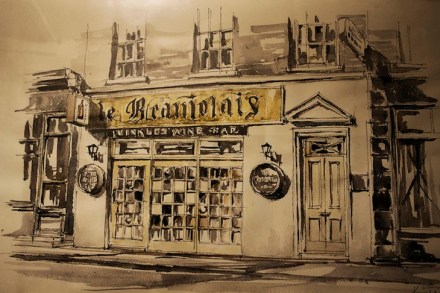
We order some French things better in London — often, admittedly, with French help. A grenouille friend recently took me to lunch at the Beaujolais Club just off Charing Cross Road. He said that it overwhelmed him with nostalgia. As a child, living in Paris, if the family were in town for the weekend, it was just the sort of brasserie in which they would have Sunday lunch (cook’s day off). Traditional dishes; proper bourgeois cooking; wine, no premiers crus, but solid, dependable bottles from solid, dependable growers — who were often friends or relatives of the owners. The children demonstrated their command of table manners and served an apprenticeship in gastronomy. In Paris these days, such places are harder to find.

That woman’s got me drinking

It is enough to make a man turn to drink. On a distinctly non-abstemious day, I was sitting in one of my favourite places on earth. It is not a great garden, merely a characteristically English one: roses, benign verdancy and the joyous sunshine of gentle summer. My dear friends have just finished restoring their late medieval house. It is not a great house, merely a classically English one. Chillingham Castle, the Wakefield family’s seat in Northumberland, which resplends in grandeur, was described by Walter Scott as bearing the rust of the Barons’ wars. This place, by contrast, is more a case of the gentle patina of manorial peace over long centuries. You feel that if you caught the house off guard, it would be smiling at its latest owners’ enjoyment.

Farewell to wine every day

Are there still travelling fairs? In many villages, they used to be part of the annual round. For weeks, the children’s anticipation would mount. Then the great day would come. Clowns, dodgems, candy floss: in those day no one knew about sugar-rushes so the brats grew delirious with excitement while the parents enjoyed themselves more than they let on. Does all that still happen – or do you have to go to Boris Johnson’s office for a similar spectacle? On a smaller scale, I entertain my friends about once a year with a fantasy which does not require so many props. It is called the Anderson diet fair. I announce my determination to lose weight and my audience responds with unalloyed scepticism.

Turning wine into words

Words, words, words. Over a couple of sessions, we drank a selection of serious wines, starting with a Cantemerle ’05. As everyone else thought it was delicious, it would have been curmudgeonly of me to say that although it had been open for a couple of hours, it would have benefited from another five years. So I abstained from curmudgeonliness. Even so, although 2005 is a great vintage, it needs longevity. We moved on to a wine I had never heard of, let alone tasted, but was ready: an ’06 Clos Louie, from Castillion in the Côtes de Bordeaux. Only in business since 2003, it has pre-phylloxera vines: 70 per cent merlot, 27 per cent cabernet franc and only a soupçon of cab sauv. Seriously good, seriously promising, it is not yet as expensive as it is bound to become.

Hungarian rhapsody | 26 April 2018

The wines of Tokaji run like a golden thread through Hungarian history. There are references to their nectar-like quality in the Hungarian national anthem. Imperial Tokaji, the world’s sweetest wine, has always been prized. As its name implies, much of it found its way to the Habsburgs’ cellars. Emperors often used it as birthday or Christmas presents for fellow monarchs. So I was delighted to taste some non-imperial bottles over dinner at the Hungarian embassy, courtesy of that impressive fellow Kristóf Szalay--Bobrovniczky, the ambassador, a good friend of President Orbán’s. Mr Orbán is much demonised. Along with President Trump and Brexit, he is seen to be a threat to the Fifth International: the pseudo-liberal bureaucratic one.

Too much too young

This April is the cruellest month, but not in the sense that Eliot intended. Memory and desire are mixed: memory for previous verdant seasons; aching desire for a new one. Instead, we appear to have permanent midwinter spring, with the emphasis on midwinter. So this might seem to be absolutely the wrong time to drink rosé. Readers may be aware of my considered prejudice, that rosé works well south of Lyon as a wine to drink mid--morning with the last crumbs of croissant. But there is the Domaines Ott, whose pretensions and prices soar well above the ground level of normal Provençal plonk. I had some the other day, in the most depressing environment possible. ‘The doors clap to: the pane is blind with showers.

No place like Rhône

As often, a good glass stimulated good talk. We were drinking some promising young Rhônes and the discussion ranged wide, moving onwards from the Rhône itself, to the differences between the UK and our sweet enemy France, then to the merits of democracy and the challenges facing it. Democracy has the overwhelming merit of providing governments with legitimacy, thus ensuring that conflicts are resolved in the legislature rather than on the streets or the battlefield. Though this does not always work — see Germany in the 1930s — it does so often enough to justify the Churchillian maxim: the worst form of government apart from all the alternatives. Yet there is a problem. If the electoral process is based on PR, governments are likely to be weak.

Big two-hearted river

The Rhône is a strong river. The Loire derives graciousness from its châteaux. The Rhine and the Thames have been sentimentalised: not the Rhône. There are no Rhône-maidens, no suggestion of ‘sweet Rhône run softly till I end my song’. A powerful onrush of water rips past the banks of a river that knows how to drown men. But it also brings fertility in abundance. This is probably the oldest wine-growing region in France. The romantic version is that Greeks brought the Shiraz grape from Persia; 2,500 years later, Syrah is still the region’s vinous bedrock. As one would expect from a combination of the River God and the Sun God, these are powerful wines, easily hitting 14 degrees.

Sweet drams

‘What seas what shore what grey rocks what water lapping the bow’. So evocative, which seems strange: one would have assumed that Eliot would have been seasick crossing the Channel. Yet he understood the gentle little tides — and also the beauty and the fear, the other-worldliness, the implacable grandeur, of the great waters’ vast dominions. In these islands, throughout the centuries, men have earned their bread from the sea. But it was rarely an easy harvest. The ‘-Mingulay Boat Song’ captures the perils of the quest. ‘When the wind is wild with shouting/And the waves mount ever higher/ Anxious eyes turn ever seaward/ Wives are waiting, since break of day/ To see us home, boys, to Mingulay.’ Not all those boys made it home.

Grateful for my grateful friend

The phone rang. ‘You are the last person in the world I should be talking to’, proclaimed an old friend from the States. ‘How have I offended you this time?’ was my surprised reply. ‘Not you personally. My beef is with your hero Donald Trump.’ ‘That is not true. In any jurisdiction, I always like to support the most right-wing legal party, so I keep on hoping that the President will calm down and stop twittering. Then one could relax and enjoy his capacity to infuriate whining leftist belly-achers. But he is devaluing his office and demeaning the great republic: no hero of mine.’ ‘Oh well, I forgive you and anyway I need your help, on Rousseau.’ ‘I’m not sure I’ve much to offer.

The true island spirit

Arran, in the Firth of Clyde, is an island whose charms vary with the seasons. In summer, the hills are verdant. By midwinter, there is a grandeur of rock and snow. These days, the attractions are enhanced by a better class of visitor. Time was, when it suffered from proximity to Glasgow, but the Gorbals-ites who want to start the morning with a cocktail of Buckfast and Irn-Bru now do so in Torremolinos. So: gentle sounds, sweet airs and a formidable amount of history. For centuries, Arran was on the front line in the constant warfare between Norsemen, Gaels, the lowland kings of Scotland and aristocratic factions. It is near Campbell territory: never a safe place to be. When it came to looting, burning and slaughtering, the Campbells could have given tuition to the Vikings.

A vintage in retreat

We were pondering the relationship between military history and wine vintages. It is extraordinary to think that the French managed to make wine throughout both world wars. In the late 1980s, Alan Clark had David Owen and me to lunch at Saltwood, his castle near Hythe. It is a proper castle; the stones are still marked by the rust of medieval warfare. According to legend, the knights who slew Thomas à Becket made their final preparations there. How appropriate for a future Clark residence. There was some dispute as to whether Alan went over to Rome on his deathbed, but during the years of swaggering health his sympathies would have been with the swordsmen, not the croziers. He would have had little use for turbulent priests. Anyway, he produced a swagger wine.

Evening service

It was a culinary triumph. My hosts do not spend much time in the UK, and are determined to entertain stylishly during their visits. This Christmas they succeeded, blending tradition and radicalism. The planning began in Pall Mall on the third lunching-day in advent. We addressed the major strategic question: satiation. After bird plus pud, there is barely the energy to fall asleep in front of an old film and the rest of the day can be unsatisfactory. In recent years, I have noticed a tendency to deal with this problem by de-fanging the pudding. There is a new girlie-man breed of Christmas puds which lack the embrandied pomp of previous generations. In my friends’ case, this was not an option.

The wines of a lifetime

In longevity, great wine can march with human life. Creating (better still, maintaining) a fine cellar really is a compact between the dead, the living and those not yet able to appreciate serious claret. There is a sort of comparison with trees and houses, yet in those cases, the time-scales transcend the shortness of our lifespan. I have a number of friends who plant trees in the serene and stoical knowledge that, one day, the offspring of their husbandry will spread a benison over the surrounding countryside, though they themselves will not be here to see it. Nunc dimittis. Houses are even more germane. One of the glories of England is the number of buildings which have survived in family hands for centuries, preserving a fair proportion of their contents.

Glad tidings from Burgundy

Advent: I am sure that all readers deplore the vulgarly commercial aspects of the pre-Christmas season as much as I do. But over the weekend, a quietly Christian friend made a gentle accusation of hypocrisy. I had been talking about a couple of festivities, evoking the ghost of bottles past, while looking forward to other imminent events and relishing the spirit of the bottles to come. Was this all that the glorious festival meant to me? my friend enquired. On the eve of the great event in Bethlehem, the great dramatisation of splendour and pathos, of hope and renewal, of joy — but also of foreknowledge that the road from the manger would lead to the Cross — was the Christian message nothing more than Nunc est bibendum?

Gender in fluid form

I have lost faith in British boyhood. In mixed schools, young males have failed to seize an opportunity that previous generations would have killed for. Imagine the scene, and to add piquancy, let us locate it in a headmistress’s study. Some hulking youth, a pillar of the rugger scrum, who already needs to shave almost every day, sidles in looking embarrassed. If the headmistress had any gumption — a big ‘if’ these days — she would already be on the alert. But these days that might avail her naught. The lad would have the spirit of the age on his side. ‘Please miss: I don’t know how to put this, but I have been so anxious. I’ve decided that I’m really a girl.

Unbridled delight

An artist ought to draw on broad human sympathies and an intense commitment to his craft. In both respects, Charles Church qualifies. As a youngster, he set off for art school, in search of instruction, and found it: a worthless curriculum. There was no copying of Old Master drawings (no drawing of any kind), no still lifes, no painting from the nude: no attempt to hold the youngsters’ noses to the grindstone of technique. He could have majored in acrylic, self-expression and pretentiousness. He could have qualified himself to be a court painter for Charles Saatchi and a future rival to Gilbert & George. Instead, he spurned meretriciousness and fled to Newmarket.

A Dutch treat from Bordeaux

In 1995, a young Dutchman completed an MBA. Banking beckoned. An internship was arranged. But Alexander van Beek thought that he would have a brief gap-summer before surrendering to a life of suited servitude in a counting house. Even though he spoke no French and had little technical knowledge of wine, he went to Bordeaux, rocked up at Château Giscours and asked for a job. Several points were in his favour. He worked hard and never minded getting his hands muddy. He cheerfully put up with any amount of teasing, which encouraged him to learn enough French to fire back. Finally, Giscours and its neighbour, du Tertre had been bought by a Dutch family, who were not thrown by the idea of a fellow Dutchman becoming a vigneron. So the summer passed. Alexander stayed.

The pride of Australia

When she graduated from university in Australia, Sarah Crowe decided to travel. So she sold her car, raised whatever other funds she could, and bought a one-way ticket to Istanbul. Anxious relatives’ doubts were brushed aside: rightly so. This was a brave and resourceful girl. As she made her way across the continent, Sarah’s embrace of European culture quickly extended to wine. Arriving in Burgundy, she used her personality, determination and zest for hard work to find employment and build up experience. Back in Australia, she had no difficulty in persuading a winery to hire her. Her qualities quickly shone through. No one at the vineyard put in longer hours. She did everything and learned about everything.