Chess

Lord of the flies

It is often said that the great chessboard artist, Polish Grandmaster Akiba Rubinstein, was afflicted during tournament play by an imaginary fly, which he sought in vain to swat away. As is the nature of imaginary beings, a case in point is the A Bao A Qu, the first entry in the bible of such entities, The Book of Imaginary Beings by Jorge Luis Borges, they remain undetectable to the uninitiated. The A Bao A Qu, of course, lived invisibly on the stairway of the Tower of Victory in Chittor, Rajasthan, imperceptible to all but those who had attained perfect Nirvana. It was not widely seen.   Similarly, the offending fly was visible only to poor, distracted Rubinstein.

Anon anon sir

Nowadays it is standard, when publishing a chess game, to give the names of both players. This was not always the case. In the 19th century it was quite common to reveal the winner’s name while leaving the loser identified solely as ‘anon’ for anonymous. Occasionally this was for the perfectly good reason that the loser’s identity had been mislaid in the age before modern communications, though there could also have been the fear in certain cases that the defeated player, insulted at seeing his name in print attached to some chessboard calamity, might challenge the publisher to a duel.

Gligoric

The great Svetozar Gligoric passed away last week at the age of 89. Gligoric represented Yugoslavia at a time when that nation was second only to the USSR in terms of chess strength. Three times a world title candidate, Gligoric was able to defeat such champions as Fischer, Botvinnik, Tal and Petrosian. Petrosian seemed to bring out the best in him. Petrosian-Gligoric: Rovinj/Zagreb 1970; King’s Indian Defence 1 d4 Nf6 2 c4 g6 3 Nc3 Bg7 4 e4 d6 5 Be2 0-0 6 Nf3 e5 7 0-0 Petrosian avoided his favourite 7 d5 Nbd7 8 Bg5, because his opponent was very confident in his handling of the variation 8 ... h6 9 Bh4 g5 10 Bg3 Nh5. 7 ... Nc6 8 d5 Ne7 9 b4 Nh5 At that time 9 ... Ne8 or 9 ...

Hedgehog fund

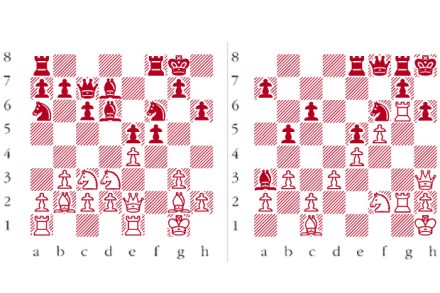
The Hedgehog is a respected chess formation, usually adopted as Black, where the defender crouches behind a wall of pawns on the third rank, spines abristle, fending off any hostile aggression until the time comes to unfurl and deploy the fretful porpentine’s armoury in earnest. Since the Hedgehog is essentially a defensive ploy, it is hardly seen as White, but in the elite Dortmund tournament last month former world champion Vladimir Kramnik demonstrated that it can also be adapted for a White offensive. In the following game White’s 22nd move constitutes one of the most astounding coups I have ever seen on the chessboard. It certainly had the effect of knocking the solid and experienced former world title challenger, grandmaster Peter Leko, entirely off his balance.

Dortmund

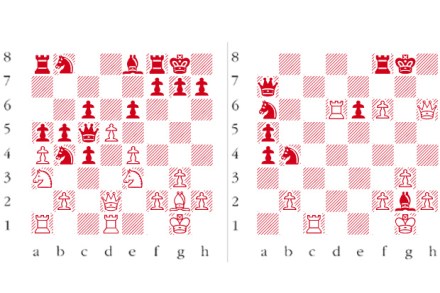
Britain’s top grandmaster Mickey Adams has won clear first prize in the tournament at Dortmund, ahead of former world champion Vladimir Kramnik. The full final scores (out of 9) were as follows: Adams 7; Kramnik 6½; Leko and Naiditsch 4½; Andreikin, Meier, Wang Hao and Caruana 4; Khenkin 3½; Fridman 3.   The last time a British grandmaster won outright at Dortmund was in 1980, when I took first prize, but the field then was far less impressive than the elite group over whom Adams triumphed. This week, some key extracts.   Adams-Andreikin: Dortmund 2013   Although this position features opposite-coloured bishops White’s active pieces and passed g-pawn create too many problems for Black.

Fawltless

David Howell turned in a sparkling performance in the 100th British Chess Championship in Torquay, which finished last week. In 2009 Howell also won at Torquay, so he must be hoping that the English Chess Federation selects the home town of Fawlty Towers as the permanent future venue for the British Championship. Scores at the top (out of 11) were as follows: Howell 9½; Hebden, Jones (the defending champion) and Gordon 8. Grandmaster Mark Hebden, aged 55, was undefeated and this week’s puzzle is a tribute to his continued resilience. Here is an example of Howell’s convincing play during the championship.

Miles gloriosus

England’s leading female player, Jovanka Houska, recently called for a memorial to the late Tony Miles. The timing is fitting. Miles won the British championship in 1982 and the centenary British Championship concludes this weekend in Torquay, the scene of Miles’s victory.   The year after he won the championship, Miles also triumphed in the BBC Mastergame series, defeating the then world champion Karpov in the final. Mastergame is usually regarded as the gold standard for presentation of chess on television. Sadly, however, due to a BBC technicians’ strike, the 1983 series featuring this superb win by Miles was screened in Germany, but not in the UK. Here, then, is Miles’s win against Karpov, which never saw the light of UK television screens.

Il miglior fabbro

Lothar Schmid, chess grandmaster, the world’s greatest collector of chess books and the only arbiter trusted by Bobby Fischer, died earlier this year, and the chess world lost one of its great characters.   Schmid (born 1928) officiated as arbiter at three of Fischer’s matches, including the 1972 Match of the Century, where Fischer wrested the crown from Boris Spassky. The difficulties and challenges in 1972 would have exhausted the patience of a stylitic anchorite, but he went on to arbit further stormy matches between Karpov, Korchnoi and Kasparov.   Schmid returned as arbiter for Fischer’s 1992 swansong against Spassky in the former Yugoslavia, but this time he faced no problems.

100 not out

On Monday next week the centenary British Championship commences at the Riviera International Centre in Torquay. The leading contenders are as follows: Gawain Jones, David Howell, John Emms, Mark Hebden and Keith Arkell. I first qualified for the British Championship by winning the Southern Counties title in 1967. However, since I had been selected to represent the English Student team later that year, I was not able to take up my place, which was held over for me until the summer of 1968. Looking back on that qualifying tournament I have found that one of my favourite games has eluded commentary. Here I take the opportunity to redress the balance.

Ivanchuk the Terrible

Although he has never won the World Championship, Vassily Ivanchuk is the scourge of the world’s elite. In his day he has defeated Karpov, Kasparov, Anand, Carlsen and Topalov, usually in spectacular victories. A new book, which I highly recommend, catalogues Ivanchuk’s most impressive wins, accompanied by outstandingly deep and instructive annotations.   White: Vassily Ivanchuk Black: Vladimir Kramnik Las Palmas 1996 King’s Indian Defence   1 d4 Nf6 2 c4 g6 3 Nc3 Bg7 4 e4 d6 5 Nge2 0-0 6 f3 c5 7 d5 e6 8 Ng3 exd5 9 cxd5 Nbd7 10 Be2 a6 11 a4 h5 12 Bg5 Qe8 Imaginative but dubious. Black’s idea is to fianchetto his queen! However, the more normal moves 12 ... Qa5 or 12 ... Qc7 are less complicated and better.

Gelfand’s hat trick

As previously reported, 45-year-old Boris Gelfand, the oldest player in the tournament, convincingly won the Tal Memorial in Moscow. This week’s game was Gelfand’s third and final win against the American grandmaster who had been his chief rival for top honours. Commendably, Gelfand sought early complications with a sharp line of the Sicilian Defence which had the instant effect of unbalancing the situation, thus increasing the probability of a decisive outcome.   Nakamura-Gelfand: Tal Memorial, Moscow 2013; Sicilian Defence   1 e4 c5 2 Nf3 Nc6 3 d4 cxd4 4 Nxd4 Nf6 5 Nc3 e5 The key move of the Sveshnikov Variation. Black weakens the d5-square but gains time by hunting White’s king’s knight around the board.

Anand’s crisis

A disturbing pattern has emerged in the games of world champion Viswanathan Anand. As White in the Ruy Lopez he has begun to disregard in serial fashion the precept that ownership of the bishop pair, against two opposing knights or knight and bishop, tends to confer a major advantage. Not only do the bishops act together as a scything weapon, they also permit the player in possession to decide if and when to trade for an opposing minor piece. The power of the bishops has been known since the days of Steinitz.

Age shall not wither

The Israeli grandmaster Boris Gelfand celebrated his 45th birthday last Monday (24 June) with outright victory in the Tal Memorial elite super-tournament in Moscow. Given that Gelfand has recently tied first in the Alekhine Memorial in Paris, this means that over a total of 18 games against the world’s best in these two competitions, Gelfand has won 5 and drawn 13 while losing none. With such youngsters as Carlsen and Karjakin, both in their early twenties, pushing rapidly to the fore, it is a remarkable feat by a man over twice their age to be performing at such a high level. The idea that brain power can increase with age, if it is trained appropriately, appears to be borne out by Gelfand.

Maharajah

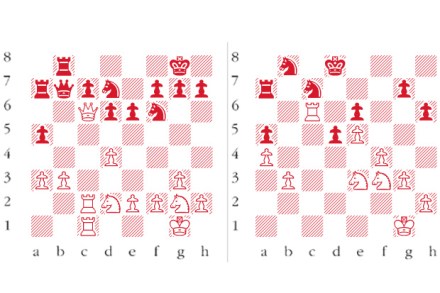
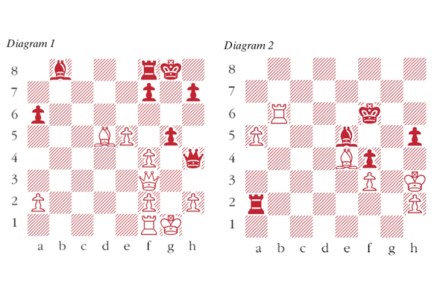
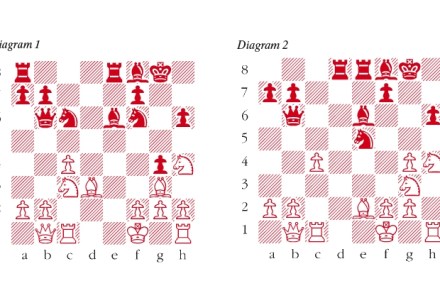
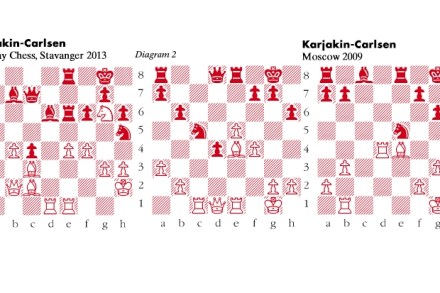
Viswanathan Anand, the world champion from Chennai (formerly known as Madras), defends his world title in a $5 million match in his home town in November against Magnus Carlsen. The venue will be the five-star Hyatt Hotel. This week, in my occasional series previewing the championship, I give a fine win by Anand against an ingenious but erratic opponent. A feature of Anand’s play has been an extraordinary facility to counterattack decisively with the black pieces.   Ivanchuk-Anand: Linares 1998; Sicilian Defence   1 e4 c5 2 Nf3 d6 3 d4 cxd4 4 Nxd4 Nf6 5 Nc3 Nc6 6 Bg5 e6 7 Qd2 Be7 8 0-0-0 0-0 9 f3 Nxd4 10 Qxd4 (see diagram 1) 10 ...

Thessaloniki

Thessaloniki is said to be named after a half-sister of Alexander the Great. Fidé staged a recent Grand Prix there, with the surprising outcome that it was won by the Cuban grandmaster Lenier Dominguez Perez with 8/11, ahead of such luminaries as Gata Kamsky and Fabiano Caruana on 7½ as well as Hikaru Nakamura, Veselin Topalov, Peter Svidler, Alexander Morozevich and Vasyl Ivanchuk.   Dominguez was given a boost when Ivanchuk failed to convert a winning position in an early round. The blow to Ivanchuk’s morale sent him into a tailspin into last place with just 3½/11.   Ivanchuk-Dominguez Perez; Thessaloniki Grand Prix 2013   With his next move Ivanchuk overlooks 26 Be5! winning at once. The threat is 27 Qxh6+ and 26 ...

Vishy business

World champion Vishy Anand will defend his title against Magnus Carlsen of Norway in November in a $5 million match in the Hyatt hotel in Chennai. Continuing my series on former World Championship matches, this week’s game is one where Vishy came horribly unstuck after forgetting his preparation in a critical line of the Grünfeld Defence. Although the Grünfeld remains popular with many players, including Peter Svidler, its record in championship contests is abysmal. Offhand, I can only think of three games won by Black in World Championship matches since the Grünfeld was invented in the 1920s. In contrast, I can recall a mass of losses, including the following game.

Title prospects

As a result of the London Candidates tournament, Magnus Carlsen will challenge Viswanathan Anand for the World Championship in Chennai in November, with a match budget exceeding $5 million. Between now and then I shall give occasional extracts from heroic deeds from past world title clashes. This week’s game comes from the marathon series of battles between Garry Kasparov and Anatoly Karpov. The puzzle is a coruscating victory by Alexander Alekhine, who held the world title from 1927 until 1946, when he died as champion, with a break of two years between 1935 and 1937.   Bogolyubov challenged Alekhine twice but was crushed both times.

Norwegian Blue

Magnus Carlsen, the Norwegian chess superstar who will be challenging Viswanathan Anand for the world title later this year, disappointed his home supporters by failing to win the first ever elite tournament to have been played on Norwegian soil. In spite of defeating 23-year-old Sergei Karjakin in their individual game, 22-year-old Magnus Carlsen stumbled at the final hurdle, much as he did in the London Candidates. This time, though, there was no time left to make up the lost ground. The final scores (out of 9) were as follows: Karjakin 6; Carlsen and Nakamura 51/2; Svidler, Aronian and Anand 5; Wang Hao 41/2; Topalov 4; Radjabov 3 and Hammer 11/2.

Fire and ice

Sergei Karjakin stormed into an early lead with 4/4 in the elite tournament at Stavanger in Norway, which finishes on Saturday 18 May. Karjakin also triumphed in a blitz tournament (four minutes per player per game) preceding the main event, the results of which were used to determine pairings for the competition proper. Leading scores in this speed event were: Karjakin 61/2/9; Anand, Carlsen and Nakamura 6. Here is the game which Karjakin won against Carlsen in the blitz event.   Karjakin-Carlsen: Norway Masters Blitz 2013; Philidor Defence   1 e4 d6 2 d4 Nf6 3 Nc3 e5 4 Nf3 Nbd7 5 Bc4 Be7 6 0-0 A tempting alternative is 6 Bxf7+ Kxf7 7 Ng5+ Kg8 8 Ne6 Qe8 9 Nxc7 Qg6 when White is well on top after 10 Nxa8. However, 7 ...

Alekhine Memorial

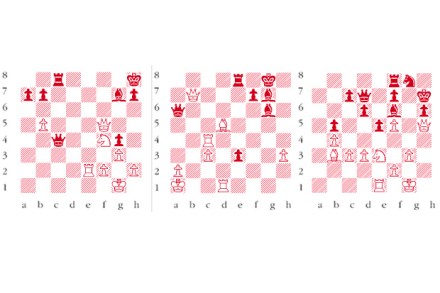
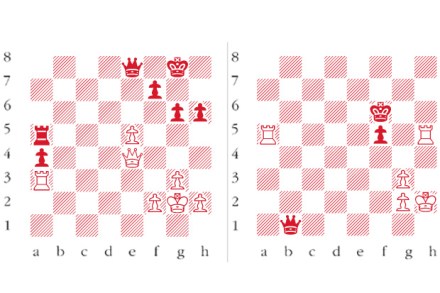
The Alekhine Memorial split between Paris and St Petersburg has been won jointly by Lev Aronian and Boris Gelfand. The final scores (out of 9) were as follows: Aronian and Gelfand 51/2; Anand 5; Vitiugov, Fressinet, Kramnik, Adams and Vachier-Lagrave 41/2; Ding Liren 31/2 and Svidler 3. Britain’s Michael Adams got off to a blazing start, winning against both Anand and Svidler. However, these were to be his only two victories and his final placing was creditable rather than glorious. The concluding phase of his game against the world champion was instructive. Anand-Adams: Alekhine Memorial, Paris/St Petersburg 2013 (see diagram 1) Endgames often come down to a race between a mass of passed pawns and a rook. Inexperienced players often allow the pawns to triumph.