Scotland

Watch: Nicola Sturgeon's hostile Covid briefing

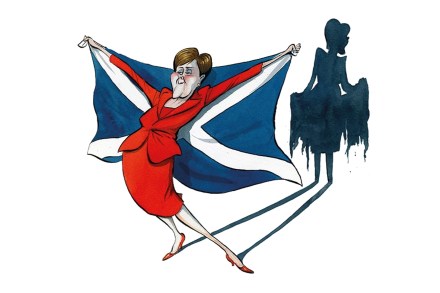
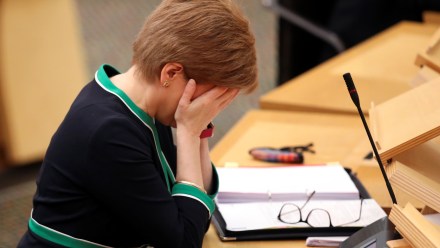
First Minister Nicola Sturgeon appeared to be in a poor mood today, after David Davis used parliamentary privilege in the Commons last night to make a series of allegations against the Scottish government over its handling of the Salmond investigation. After the ITV journalist Peter Smith asked Sturgeon about the new allegations at the Scottish government’s Covid briefing, the First Minister at first refused to answer the question at all, saying ‘I’m not having this briefing side-tracked into the latest instalment of the conspiracy theories we’ve all be hearing about for a long time’. Sturgeon then took a rather more hostile approach, saying she would only answer questions from the

David Davis's bombshell leak spells trouble for Nicola Sturgeon

The first thing to be said about David Davis’s dramatic intervention in the Salmond-Sturgeon affair is that it is a masterful piece of concern-trolling. The second thing to be said is that this does not matter. Davis, speaking armoured by parliamentary privilege, revealed information passed to him by a ‘whistleblower’ that has hitherto been kept secret. On the face of it, there are very good reasons explaining why the SNP and the Scottish government would wish to keep it that way. Ostensibly, Davis’s intervention is motivated by concern that the Scottish parliament and its members lack the ability to pursue the truth wherever it may lead. He came, he said,

The SNP’s nonsensical Covid book ban

Why is the SNP banning books? On 5 January the Scottish government introduced a strict new lockdown in response to the spread of a more infectious strain of Covid-19. As a student at the University of Edinburgh, one particular restriction has baffled me ever since. Unlike in England, Wales or Northern Ireland, the Scottish government decided to ban students from reading, borrowing or even touching books in their university libraries. Even as fears rose over the rapidly spreading ‘Kent’ variant, it seemed that this policy lacked any scientific foundation. The Scottish government’s explanation for its book ban is baffling, and seems to be just copied and pasted advice from public

Is Nicola Sturgeon's loyalty her big weakness?

Loyalty is an important virtue. Indeed, it was loyalty to my former boss which led me to offer to act as Alex Salmond’s spokesman during his Court of Session battle with the Scottish Government. It was, at the time, a thankless task, trying to persuade sceptical former media colleagues that the whole affair was a stitch-up. Those same journalists don’t require much persuasion today. Once the Scottish Government belatedly conceded the errors in their flawed complaints procedure, at a cost to the taxpayer of at least a million pounds, and the accusations against Salmond were thrown out by a criminal court, the repercussions began.  The Scottish Parliamentary Inquiry into how

Scottish Tories must be more than the party of no

Among the many challenges facing Scottish Tory leader Douglas Ross has been the question of definition. It is difficult to define yourself in the best of times, let alone in the middle of a pandemic. When, on top of this, your seat is in Westminster, and not the devolved parliament on which the Scottish media focuses their resources and priorities, it’s harder still to penetrate the public consciousness. No matter how often you try to get yourself in front of a TV camera, you can still feel like the Invisible Man. Ross used his speech to the Scottish Conservative conference to narrate who he is and what he believes. There

Will Boris Johnson take responsibility for the Union?

Even for a virtual party conference, Boris Johnson’s speech to the Scottish Tories was a muted affair. As might be expected, the Prime Minister talked up the strength of the Union as demonstrated by the Covid-19 pandemic. Almost 2 million Scots had received a jab thanks to the 400 million vaccine doses secured by the Treasury’s deep pockets — proof, he said, of ‘the United Kingdom’s collective strength’. He took time to praise UK Armed Forces personnel, 500-strong at present, who are spread across 80 Army-established vaccination centres throughout Scotland. This of course was a reminder that the British Army had been there to pick up the slack when the

The SNP’s radical assault on freedom of speech

When Humza Yousaf first proposed his Hate Crime Bill, I compared it to the late, unlamented Offensive Behaviour Act. Similarly rushed through Holyrood by the SNP, it sought to rid Scottish football of sectarian behaviour by, among other things, criminalising the singing of certain songs at matches. The Act didn’t specify which songs and so it was left to the discretion of a police officer overhearing a chant to decide whether or not it would be offensive to a reasonable person. Astonishingly enough, this didn’t work out and such was the fan and legal profession backlash that the Act was eventually repealed — in the teeth of SNP opposition. The

Why should independence voters like me have to support the SNP?

Scotland would be an independent country today if only the SNP had made one simple promise. Back in 2014, as the referendum approached, it was clear that the party could win only at the price of its demise. Alex Salmond should have promised to disband the SNP if ‘Yes’ won the day. For those of us who disliked the SNP and Alex Salmond, but who favoured an independent Scotland, it would have been enough to bring us on board. Now, his successor, Nicola Sturgeon, is making the same mistake as she attempts to win a second referendum vote. The SNP, of course, doesn’t see things this way. Its supporters fail

Ruth Davidson’s exit reveals Scottish Tories’ independence secret

Ruth Davidson has used her final speech to the Scottish Conservative conference to appeal to pro-Union voters. In a video streamed on the first day of the event, the former party leader said Scotland had passed ‘peak Nat’ and that, while the SNP was bound to emerge as the largest party after the May 6 devolved elections, the Tories could still deprive Nicola Sturgeon of an overall majority. This was imperative, she said, so that the Scottish Government could be ‘held in check’. She contended: If there’s no check on an SNP government after May, they will put their obsession with securing a second independence referendum above Scotland’s national interest.

How Unionists can battle against devocrats

This week, the government published its first Union Connectivity Review report. You’d be forgiven for mistaking this for another boring sounding Whitehall transport initiative that inevitably fails to get off the ground. But this seemingly inoffensive review has triggered the latest round of allegations from the devolved administrations that Westminster is engaging in a ‘power grab’. Doesn’t the Prime Minister know that transport is devolved, they cry? If the Treasury has extra money to spend, it should simply hand it over to the governments in Edinburgh, Cardiff, and Belfast to spend as they see fit. But there is an obvious problem with the ‘transport is devolved’ mantra. One can see

Boris Johnson's new approach to an independence referendum

Unionists are finding reasons for optimism when it comes to saving the union. As Nicola Sturgeon comes under fire north of the border over her handling of the Alex Salmond inquiry, ‘No’ has taken the lead in several recent independence polls. A poll this week for the Scotsman also suggested the SNP is no longer set for a majority in May’s Scottish parliament election; instead it predicted a hung parliament. Of course, the SNP could still secure a majority in the upcoming elections. If anything, that is still viewed as the more likely scenario by Tories in Westminster. This is in part why ministers are having to carefully plan their response as to what do in such

The SNP's foray into high finance has come at a big price

In a refreshing twist for Scotland’s party of government, the latest potential scandal facing the SNP administration does not involve allegations of sexual misconduct, but rather high finance. Earlier this week, finance company Greensill Capital filed for administration. Greensill specialised in supply-chain finance, which involves acting as an intermediary to raise money on the back of payment commitments between companies and their suppliers. Greensill’s innovative financing arrangements were instrumental in metals tycoon Sanjeev Gupta’s rapid expansion of his business empire, including his 2016 acquisition of an aluminium smelter at Lochaber in the Scottish Highlands, plus two nearby hydroelectric dams. Companies within Gupta’s GFG Alliance group bought the industrial assets from

Alex Salmond and the trouble with revenge

Ancient Greeks were not slow to express their enthusiasm for taking revenge. Observing the recent proceedings in the Scottish parliament, they would probably have concluded that Alex Salmond was of like mind. But will that revenge do him any good? Plato made Socrates define ‘justice’ as ‘rendering to each man what he is owed’, which another speaker amplified as ‘owing good to one’s friends and ill to one’s enemies’, a sentiment repeated across Greek literature. As a result, pure enmity was regarded as a perfectly good motive for revenge. The Greek orator Demosthenes once justified bringing a case against a man for tax evasion by pointing out that his opponent

Is Sturgeon losing support for Scottish independence?

Every politician likes to say that they don’t pay attention to opinion polls. In my experience, this is almost universally untrue. Those who sail in an ocean of public opinion want to know which way the wind is blowing. The most recent polls show the wind is in the Tories’ sails at the moment: the YouGov post-Budget survey indicated a 13-point Tory lead. But in Scotland for the past year, polls have consistently shown majority support for independence. That’s now changing. Nicola Sturgeon can’t claim she doesn’t pay attention to the polls; she has too often commented on ones showing independence ahead. After roughly 20 polls in a row put

The SNP cares more about power than principles

Defeats in politics sometimes appear to be victories at first, and victories to be defeats. The SNP has survived a vote of no confidence (VONC) at Holyrood, as it was always going to. The Nationalists were home and dry before the debate was even called thanks to the backing of the Greens. The Conservatives tabled the motion against John Swinney, Nicola Sturgeon’s deputy, after he ignored two votes in parliament requesting that he hand over the Scottish government’s legal advice to the Alex Salmond inquiry. Only when the possibility of a VONC was raised did he hastily release some of the documents. Obstruction has been a hallmark of the SNP

Will the SNP finally see sense on its flawed Hate Crime Bill?

The saga of the SNP’s Hate Crime Bill is drawing to a conclusion. This week, Holyrood will cast a decisive vote on the embattled bill. Introduced just ten months ago, it seeks to consolidate existing hate crime laws and create new offences on the ‘stirring up of hatred’ against certain groups. These proposals would make ‘threatening or abusive’ behaviour which ‘stirs up hatred’ on the grounds of age, disability, religion, sexual orientation, transgender identity and variations in sex characteristics a criminal offence, punishable by up to seven years in prison, an unlimited fine or, for the extremely unfortunate, both. The proposals have proved highly controversial and understandably so. In our society,

Why is the SNP afraid of issuing its own government bonds?

Rishi Sunak’s budget appeared to offer some good news to Scots, not that the SNP saw it that way. An additional £1.2 billion in Barnett funding was handed over to Scotland’s government. This is on top of £9.7 billion in extra spending delivered over the past year for pandemic support. But the SNP Scottish government took a different view. ‘While I welcome some of the announcements today, it is clear the Chancellor has not matched Scotland’s ambition for economic recovery and supporting households,’ said Scottish Finance Secretary Kate Forbes. Forbes and her colleagues often point out that ‘Scotland’s ambition’ includes more borrowing powers. Throughout the pandemic, the SNP has been at

The Sturgeon case exposes the fatal flaw in Scottish devolution

The campaign for a Scottish parliament was rooted in the notion of a ‘democratic deficit’. Scotland kept voting Labour but the UK kept getting Conservative governments. Devolution, so the logic ran, would give Scotland a more responsive government. Two decades on, a new democratic deficit is emerging: the chasm between the minimum accountability demanded by the parliament and the maximum Nicola Sturgeon’s government is prepared to give. A new establishment has taken root in Edinburgh, more powerful and less accountable than the old one. The Alex Salmond inquiry, which began as a recondite tale about a failed attempt by Sturgeon’s government to probe sexual misconduct claims against the former Scottish