Scotland

Has Salmond just shattered Sturgeon’s currency delusion?

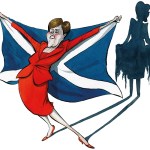
The war of the Salmondites versus the Sturgeonites is just getting started. Who knows how nasty it will get or what the longer term ramifications will be? Already apparent though is how Salmond's pantomime villain shimmy back into the political arena is forcing Nicola Sturgeon onto ground she would rather avoid during an election campaign. The usual SNP tactic around elections is to downplay separation talk and reach out to risk averse moderate voters, safe in the knowledge the party's most zealous supporters will stay in line. But with Salmond on the scene demanding to know how exactly Sturgeon will achieve independence, that is not an option. Sturgeon will have to make another referendum and her commitment to leaving the UK a central part of her campaign.
The economic case for the Union isn’t enough

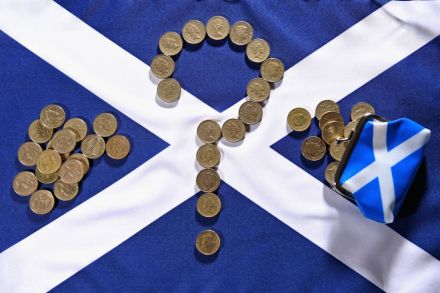
There is a certain kind of critic of independence who hears the news that public funding for Scotland is 30 per cent higher than for England and sits back thinking: ‘Job done’. The latest analysis from the Institute for Fiscal Studies does indeed confirm that the Union is a bargain for Scotland. It finds that, while real-terms resource funding for the Scottish Government is two per cent lower per capita than in 2010 (the beginning of the Tories’ austerity experiment), the spending drop is lower north of the border than in England. Scotland gets more than £1.30 per person for public services for every £1 spent in England.

Boris has a trump card in denying Sturgeon an ‘illegal’ referendum

Amidst all the dry economic arguments, one of the more emotive fronts on which the 2016 referendum was fought was whether Brexit could lead to the dissolution of the Union. Some Remainers made the argument that dragging Scotland, Wales, and Northern Ireland out ‘against their will’ would turbocharge support for independence. Unionists such as myself – who ended up on the Leave side – saw it differently: EU membership was actually making it easier for the SNP to sell separation as a low-risk proposition. Shared membership of the EU would, after all, allow Scotland as a newly-independent country to enjoy relatively normal social and economic relations with England.

Where did Alex Salmond’s ‘Alba’ party get its name from?

‘What, old monkey-face!’ said my husband with unnecessary lack of gallantry. He was referring to the 18th Duchess of Alba, who held 40 titles of nobility and died in 2014. She was a bit out of his league, but it is true that her bone structure came to give her face a simian air. As usual my husband had got it all wrong. Alex Salmond did not name his new party after the Spanish dukedom of Alba that gave the world the Dutch-clobbering 3rd Duke in the 16th century. That duke’s followers were called Albistas, which might come in handy as a label for the Salmond group. The new party’s name is that of Scotland in Irish and Gaelic. The BBC has had a Gaelic television channel called Alba since 2008.

How Nicola Sturgeon lost the leaders’ debate

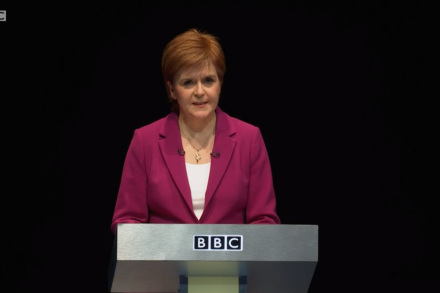
I’m not sure anyone won the first leaders debate of the Holyrood election but Nicola Sturgeon definitely lost it. The SNP leader spent more than an hour on the defensive, first from voters, who joined via Zoom to harangue her for prioritising a second independence referendum during a pandemic, and then by the opposition leaders, who tore into her record on health and education. She has been running Scotland, either solo or in tandem with Alex Salmond, for 14 years now and there is the slimmest chance the public is starting to notice she's not very good at it. Sturgeon handled neither the interrogations from the audience nor those from her opponents with anything like her customary self-assurance.

Can Alex Salmond’s plan to ‘game’ Holyrood’s voting system work?

Alex Salmond’s reemergence on the Scottish political scene as leader of the Alba party had a pantomimic quality – some cheers, some boos, and a lively mix of interest and anxiety about where the plot would now go with the principal boy back centre stage. But working out how the appearance of Salmond’s new party affects what happens is a considerable challenge, thanks to Scotland’s infernally complex voting system. To paraphrase Lord Palmerston’s reference to the Schleswig-Holstein question, it may be that only around three people truly understand the D’Hondt voting system employed in Scottish parliamentary elections, though there are probably more, who like the fabled German professor, have gone mad trying to figure it out.

Nicola Sturgeon reinvents herself as a social democrat. Again

It’s the surest sign there’s an election on in Scotland: Nicola Sturgeon has become a social democrat again. Addressing her party’s spring conference today, the SNP leader vowed to double the Scottish child payment to £10 per week for under-16s in low-income families if the Nationalists are returned to government after 6 May. She explained:  ‘I want to make ending child poverty a driving mission for the next parliament. It is time to end the scandal of child poverty, and this will help us do it. And it is a down payment of what will be possible when we have the full powers over tax and social security that only independence can deliver.’ Ending child poverty is a noble aim.

Who’s paying the price for Sturgeon’s pandemic politics?

Don't worry if you missed the press release announcing which Scottish taxes are going up to pay for Nicola Sturgeon's headline grabbing four per cent minimum pay rise offer for certain front-line healthcare workers, including nurses. You missed it because there wasn't one. In characteristically hubristic form, the Scottish Government made the announcement just a few hours before the pre-election 'purdah' period began, with Sturgeon immediately taking to Twitter to declare:  'Our NHS staff deserve more than applause and one per cent is not enough'.  It was a thinly-veiled dig at the offer Boris Johnson's administration has put forward in England. Normally when a government makes an announcement like this the immediate question is: where is the money coming from?

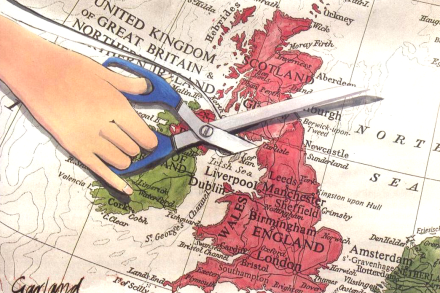
Is the United Kingdom still one nation?

Is Britain a nation? If you’re trying to maintain the United Kingdom — or destroy it for that matter — this is surely a very important question. It may seem obvious at first, of course the United Kingdom is a nation. Yet Unionists too often seem reluctant to address the question. Devolutionaries, often non-separatist nationalists, are keen to talk about Britain as if it were merely an arrangement between states — like some kind of federal ‘United Kingdoms’ plural, rather than a singular polity made up of constituent parts.

Scottish Covid adviser’s vaccine confusion

Oh dear. During the course of the pandemic, the University of Edinburgh professor of public health Devi Sridhar, has become a regular sight on television screens and comment pages – offering her insights on the best course of action over Covid. In her role on the Scottish government’s Covid-19 advisory group, Sridhar has previously caught Mr Steerpike's attention for lobbying repeatedly for more SNP powers which she claims are necessary to stop the spread of coronavirus. The snag? There was nothing stopping the Scottish government from quarantining travellers using their own powers, a move that was already planned at the point Sridhar demanded it.

Salmond’s comeback is a pitiful sight

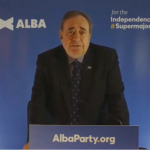
When Alex Salmond lost his seat at the 2017 general election, he finished his concession speech with a quotation from Sir Walter Scott’s poem, 'Bonnie Dundee':  'And tremble false Whigs, in the midst of your glee/You have not seen the last of my bonnet and me.'  Well, it is true that we have heard far too much from Alex Salmond in the years since but all roads, I suppose, led to the wholly unsurprising announcement this afternoon that Salmond is getting back into the game. Hell hath no fury like an ego ignored. The Alba party – Salmond’s new venture – will contest seats on the list portion of May’s Holyrood election.

Salmond’s return is a headache for Sturgeon

When he was acquitted on sexual assault charges at the High Court in Edinburgh last March, I predicted: ‘Alex Salmond is back from the dead and he will have his revenge’. The past 12 months has seen a relentless onslaught against Nicola Sturgeon and the SNP establishment and anyone who thought that would culminate in the equivocal findings of two inquiries (one clearing Sturgeon, the other damning her) will have been disabused this afternoon. Salmond has announced his return to politics in time for May’s Holyrood elections, under the banner of an outfit calling itself the Alba Party. The party will stand only on the regional list and is pitching itself as an effort to help secure an ‘independence supermajority’.

Sturgeon’s rush for a referendum could backfire

The Holyrood election campaign kicks off with Nicola Sturgeon buoyed by James Hamilton’s report concluding that she did not break the ministerial code. Unionists in both London and Edinburgh have been taken aback by how decisively Hamilton stated that Sturgeon had not broken the code. But, as I say in the magazine this week, it would be wrong to think Sturgeon hasn’t been damaged by this whole business.  Voters feel that Scotland’s recovery from the pandemic should come first The independence bill her government published this week was also a misjudgement. It states that the referendum will be held in the first half of the next Scottish parliament. In other words, before November 2023.

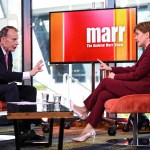
Andrew Marr: Scottish Unionists must rethink – and fast

Spring Cannot Be Cancelled arrives on the doorstep. It is a gloriously illustrated book by Martin Gayford about his conversations with David Hockney, now living in Normandy, and who I have recently interviewed. It’s a book about many things — Hockney’s love of France and French painting, his reflections on many other artists among them. But at its heart is this octogenarian’s adoration of nature, his belief that art is rooted in love, and a restless gusto for life. That’s a lesson I’ve been thinking about as I hirple (good Scots word) round Regent’s Park, observing spring surge all round me. Every day, the faint green haze on the trees grows richer, buds explode into white or pink, new flowers jump from the earth.

Sturgeon fights on ­– but at what cost?

A year ago this week Alex Salmond was acquitted on all 13 charges in his sexual assault trial. In normal times the conclusion of the most significant political trial since the Thorpe affair in 1979 would have dominated the news for weeks. Instead, the story was overshadowed by the start of the UK’s first lockdown. But the aftershocks of this trial continue to rock politics in Scotland and beyond. A Holyrood committee this week concluded that Nicola Sturgeon had misled it regarding her conversation with Salmond at her house about the Scottish government’s inquiry into him. The committee, which has a pro-independence majority but not an SNP one, decided this by majority vote.

How Unionists are playing into SNP hands

There is a chance pro-Union voters in Scotland are about to shoot themselves in the foot, but every time I try to pry the gun away I’m met with outrage and incredulity. The source of the consternation is All for Unity (previously known as Alliance for Unity), or rather my insistence on pointing out some facts they would rather I didn’t. AfU is standing on the regional list in May’s Holyrood elections, hoping to capture the hardcore anti-SNP vote and those frustrated with the mainstream pro-Union parties. AfU urges Unionists to vote tactically to send a group of anti-independence MSPs to Holyrood. I have pointed out the flaws in this proposition a couple of times now. My problem with AfU is simple: what it says isn’t true.

What we still don’t know about the Salmond affair

The inquiry into the Alex Salmond affair has concluded that Nicola Sturgeon misled parliament and potentially breached the ministerial code. If you could swear you heard the exact opposite yesterday, that’s because you did. On Monday, the Scottish Government’s independent adviser James Hamilton released the findings of his inquiry into whether Sturgeon breached the code. He considered four potential violations: Sturgeon’s unminuted, belatedly reported meetings and phone calls with Salmond; whether she intervened in the sexual harassment investigation against him; her omission of a meeting with a Salmond representative from a statement to parliament; and her government continuing to oppose Salmond in court in spite of the advice of counsel.

The Hamilton report has not vindicated Nicola Sturgeon

Let me first deal with the general confusion. Most Scots think that the Hamilton Report, published today, deals with the question of whether the First Minister misled the Scottish Parliament when she told MSPs that the first time she knew of the allegations of sexual misconduct against Alex Salmond (of which he was acquitted of in a criminal court) was on 2 April 2018.  On any view this is hardly a ringing endorsement of Nicola Sturgeon's reliability It does no such thing. Instead, the report deals with a possible breach of the Ministerial Code by Nicola Sturgeon on the question of whether she ‘failed to feed back’ the terms of her various meetings with Alex Salmond and others between March and July 2018.

Sturgeon’s survival now seems certain

James Hamilton’s inquiry has found that Nicola Sturgeon did not breach the ministerial code. The former Irish prosecutor, who serves as the independent adviser on the code, was tasked with reviewing the Holyrood First Minister’s actions in relation to the Alex Salmond affair. Hamilton considered four allegations: That Sturgeon’s failure to record meetings and phone conversations with Alex Salmond and others (held between March 29 and July 18, 2018) breached the code’s provisions that ‘meetings on official business should normally be arranged through Private Offices’ and ‘a private secretary or official should be present for all discussions relating to government business’.

The shine has finally come off the SNP

This week is still going to be a bad one for Nicola Sturgeon. But it seems probable that we won’t know just how bad until May, after the Hamilton inquiry today found that she did not break the ministerial code. By aggressively stonewalling two inquiries, the First Minister has managed to forestall calls for her resignation by casting herself on the mercy of the electorate, which still looks set to return the Scottish National Party in the May elections. Attention has mostly concentrated on how Sturgeon and her ministers have obstructed the Holyrood inquiry. But as pro-Union legal blogger Ian Smart has set out, there were huge and unnecessary delays to James Hamilton QC’s inquiry into a potential breach of the Ministerial Code too.