Scotland

Nicola Sturgeon is fighting for her political life

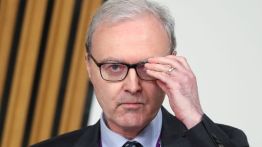
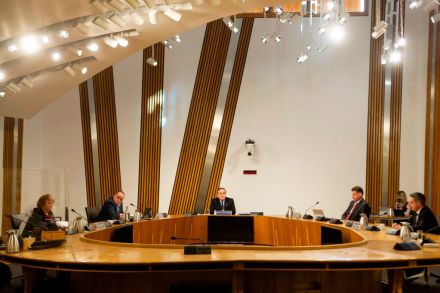
The Alex Salmond inquiry has seen its most remarkable day yet. Three pivotal documents have been released to the Holyrood committee probing a Scottish government internal investigation into sexual misconduct allegations against Scotland’s former First Minister. The Court of Session has already declared that investigation to have been ‘unlawful’, ‘procedurally unfair’ and ‘tainted by apparent bias’ and Salmond has been acquitted on 13 counts of sexual assault in a separate criminal trial. He claims that key figures around Nicola Sturgeon, his protege-turned-adversary, conspired to imprison him.

The Scottish government’s brutal legal advice

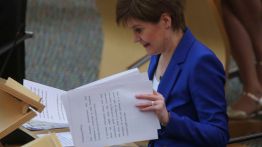
Today – after the deputy First Minister John Swinney was threatened with a no-confidence vote in the Scottish Parliament – the SNP finally agreed to release its legal advice from Alex Salmond’s challenge against the government. Mr S can see why Nicola Sturgeon wanted to keep the advice hidden... The documents concern Salmond’s successful legal challenge against the Scottish government, after it botched an investigation into allegations of sexual misconduct made against him (Salmond was later acquitted of these charges in a criminal court). In January 2019 he won his case and the Scottish government was forced to pay out half a million in costs.

The Lord Advocate shows the ‘punishable’ Scottish parliament where power really lies

The Alex Salmond inquiry is about far more than his allegations against Nicola Sturgeon and her government: it offers alarming insights into the extent and scope of political power in Scotland. In particular, the way in which the Crown Office, Scotland’s government prosecutors, pressured the devolved parliament into censoring Salmond’s evidence. It’s all the more worrying because the Lord Advocate, who runs the Crown Office, is a serving member of Sturgeon’s Cabinet. It was his turn to face that committee today. James Wolffe QC started by reminding them that they were dealing with someone above them. 'The actions of the Crown are not within the remit of the committee', he said in his first sentence.

Scotland could become the EU’s next great problem

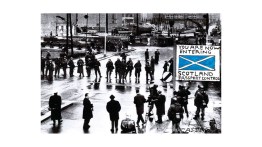
It is generally acknowledged, even by diehard Remainers, that the European Union’s handling of Cameron’s attempted renegotiation of the UK’s membership, as well as the EU’s subsequent interventions leading up to the 2016 referendum, was mishandled. It turned out they only added fuel to the Eurosceptic fire by appearing more as a foreign power attempting to interfere in British affairs rather than as a club of which the UK was an equal member. With Scottish independence seemingly the next constitutional tussle for the United Kingdom, with another referendum very possibly hovering into view, how should the EU be involved in this debate, if at all? A newly independent Scotland would have huge implications for the EU.

Another stitch-up in the Salmond inquiry

It's not the crime, it's the cover-up: just as Watergate exposed the workings of the Nixon White House the Salmond inquiry is giving the world a glimpse of how the SNP works in Edinburgh. And how the SNP-led committee investigating Nicola Sturgeon is shameless in its determination to rig the system. First, the committee tried not to publish Alex Salmond’s full evidence against Nicola Sturgeon citing legal reasons. That defence fell apart when The Spectator went to the High Court. Then, outrageously, the Crown Office (Scotland’s state prosecutors) told the committee to censor Salmond’s evidence. Leading to a question: what on earth was it playing at by interfering with parliament?

Can Anas Sarwar save Scottish Labour?

Sixty-eight days out from the next Scottish Parliament election might seem an ill-advised time to change the leader of Scottish Labour. This morning, Glasgow MSP Anas Sarwar was unveiled as the winner of a low-key internal election, defeating Labour’s Holyrood health spokeswoman Monica Lennon by 58 per cent to 42 per cent. The leadership was spilled after the abrupt ‘resignation’ in January of left-winger Richard Leonard following three forgettable years of drift and decline. Labour last won a Westminster election in Scotland in 2010 and a Holyrood one in 2007; in the 2019 European Parliament elections, it came fifth and just 1.1 per cent away from finishing behind the Greens. The polls do not suggest much cheer is on the way on 6 May.

Sturgeon’s establishment stitch-up

When The Spectator went to High Court in Edinburgh to seek clarification over the Alex Salmond case, we did not act out of chumminess or a conviction that he was telling the truth. We are not natural allies of his. We are not sure if his explosive claims are correct, but we are sure that they should be scrutinised by a free press and free parliament.  Sturgeon's allies were instead dealing with his allegations against her by seeking to stop Salmond's full story ever being told. The SNP-led investigating committee had said it would not publish his submitted evidence - which, as they knew, would mean he would not appear in front of them. The pretext?

Salmond’s case will have consequences – he just can’t admit it

As Alex Salmond finally testified before the Scottish parliament on Friday, it was clear that he was trying to walk quite a fine tightrope. On the one hand, the former first minister is alleging a conspiracy so vast that, if true, it would deeply discredit the central institutions of the devolved Scottish state. His claims put the reputations of the Scottish government, the Scottish parliament, and the Crown Office, not to mention the civil service and even the police, on the line. Yet he shrank from the implications of this. Right from the start, he sought to erect a firewall from the leadership of these institutions and the institutions themselves: ‘The Scottish civil service hasn’t failed; its leadership has failed.

The key moments from Salmond’s Holyrood evidence

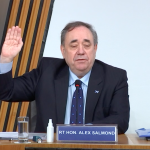
This afternoon, in the Robert Burns room of the Scottish Parliament, former First Minister Alex Salmond, for so many years the supreme political force north of the border, came out swinging against his successor Nicola Sturgeon and the wider Scottish establishment. In a remarkable evidence session, Salmond attacked the leadership of the Scottish government, suggested that the inquiry into its behaviour had its ‘hands tied behind its back with a blindfold on’, and argued that Nicola Sturgeon had broken the ministerial code. Salmond’s evidence to the Holyrood inquiry – set up to investigate the Scottish government’s handling of complaints made against him – had already been mired in controversy.

Full text: Salmond’s opening statement to the Holyrood inquiry

This inquiry is not about me. I've already established the illegality of the actions of the Scottish government in the Court of Session, and I've been acquitted of all criminal charges by a jury in the highest court in the land. These are both the highest courts in the land, the highest civil court and the highest criminal court.  The remit for this inquiry is about the actions of others. It's an investigation into the conduct of ministers, the permanent secretaries, civil servants and special advisers.

Will teacher assessed grades work?

17 min listen

Teachers will assess pupil's grades next year, the Education Secretary said today. Has the decision come too late, and will it disadvantage students? Cindy Yu speaks to James Forsyth and Katy Balls.

It’s a pity that both Alex Salmond and Nicola Sturgeon can’t lose

Henry Kissinger’s sardonic appraisal of the Iran-Iraq War is increasingly applicable to the war between Alex Salmond and Nicola Sturgeon: it is a shame they can’t both lose. Disinterested observers, however, are under no obligation to pick a team. It is wholly possible neither protagonist has offered a convincing version of events. Treating Salmond’s claims sceptically imposes no requirement to swallow Sturgeon’s and, indeed, vice versa. Salmond’s allegations are so extraordinary they risk seeming incredible. It is one thing to allege that senior officials within the SNP – including but not limited to Peter Murrell, the party’s chief executive and Nicola Sturgeon’s husband – wished to destroy Salmond’s reputation.

The Salmond case has left the House of Sturgeon teetering

From a distance, Nicola Sturgeon seems unbeatable. Polls show her party with just over 50 per cent of the vote, quite a feat in a five-party parliament. But this week, she has found herself fighting for her political future. Alex Salmond’s sensational claim to be the victim of a conspiracy designed to destroy him — even ‘imprison’ him — has the potential to bring down the House of Sturgeon. Salmond alleges that his successor has misled the Scottish parliament on multiple occasions about her knowledge of (and involvement in) her government’s investigation into complaints of sexual misconduct made against him.

Ian Blackford and the hounding of Charles Kennedy

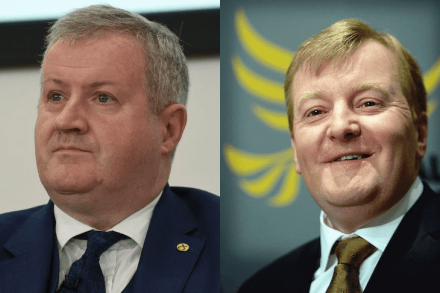
BBC Alba, Scotland’s Gaelic language channel, is not normally required viewing for the political classes. This week, however, Lib Dems across the country were seeking it out on Freeview. The channel last night aired a documentary on Charles Kennedy, the former Lib Dem leader who stood down in 2006 after acknowledging his struggle with alcoholism, which persisted until he died in 2015 at the age of 55. Three weeks before his death and after 32 years as MP for a Highland constituency – latterly called Ross, Cromarty and Skye – he was defeated in the 2015 General Election by Ian Blackford, now Westminster leader of the Scottish National Party and a man rich in hyperbole, bombast and bluster.

Unionists are preparing for the wrong fight

It makes bleak sense, when you think about it. The history of Unionism is littered with self-inflicted wounds and missed opportunities. So of course the Prime Minister would lose his grip on the Union Unit just as the Scottish government seems to be facing an acute crisis. Alex Salmond has once again withdrawn from giving evidence to MSPs after the Crown Office stepped in and got the Scottish parliament to redact his evidence (again). As it was already in the public domain, we can all see that the censored portions relate not to the naming of vulnerable women, but to criticism of Nicola Sturgeon. Yet it still feels hard to believe it’s going to impact the SNP’s poll ratings.

Sturgeon versus Salmond

20 min listen

Alex Salmond has pulled out from his appearance in front of the harassment complaints committee, where he was expected to give evidence about an alleged breach of the ministerial code by First Minister Nicola Sturgeon. Fraser Nelson speaks to James Forsyth and Katy Balls about the SNP implosion.

The Scottish establishment is playing into Salmond’s hands

The most remarkable — and chilling — day in the history of Scottish devolution ends the only way it could: Alex Salmond has pulled out of an appearance before the Holyrood inquiry. The road to his withdrawal began on Monday evening with the publication of a key document in the long-running inquiry. The submission, in which Salmond alleges that Nicola Sturgeon broke the ministerial code, was uploaded to the Scottish parliament website ahead of an evidence session by Salmond on Wednesday. However, the Crown Office contacted Holyrood authorities and demanded they remove or redact the submissions. The parliament complied, replacing it with a further-redacted version.

The SNP’s transphobia muddle

For a party so devoted to trans rights, it seems strange that the SNP is less than forthcoming over its new definition of transphobia that their National Executive Committee adopted in recent days. The mind boggles over what they may be hiding. Despite the twin pressures of Brexit and Covid-19, not to mention a key Scottish election three months away and the ongoing Alex Salmond affair, it seems that the party is prioritising the gender debate. As a trans person, even I am getting exasperated by this relentless focus.  Let’s be clear: transphobic hate crime exists but it is nowhere near as commonplace as the transgender lobby would like us to believe.

Scottish Tories are wrong to oppose voting for prisoners

The Scottish Tories don’t mean to be the way they are. Sometimes they just can’t help it. They are being that way again over plans to let some prisoners vote in the forthcoming Scottish parliament elections. I am not convinced those elections should be going ahead at all in the middle of a pandemic but, if they are to, there are good reasons for prisoners to be enfranchised. The Tories intend to force a vote at Holyrood on Wednesday against allowing those serving custodial sentences of less than 12 months to participate in the May 6 election. MSPs voted last February to extend the franchise in order to comply with a series of judgments from the European Court of Human Rights, beginning with 2005’s Hirst v United Kingdom (No 2).

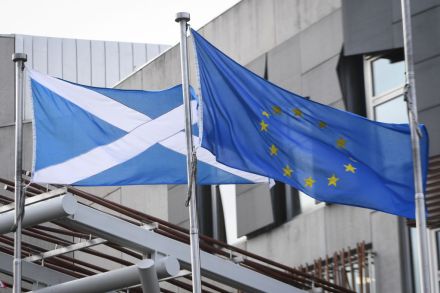
Does Nicola Sturgeon really want to fly the EU flag?

The news that Nicola Sturgeon has asked for the EU flag to be flown every day from the Scottish Parliament building won’t come as a surprise to those familiar with her much-documented Europhilia. Indeed, when Britain was edging ahead in the vaccine race, she threatened to publish confidential information about the UK’s vaccine supply in order to offer support to Brussels, potentially undermining our vaccine deals. The fact that she was prepared to do this in order to cosy up to the EU tells you everything you need to know about the SNP’s particular brand of nationalism. What’s most bizarre about Sturgeon’s focus on the EU is that she lives and breathes Scottish independence.