Life

The importance of the Band-Aid

Alexandria, Virginia Back in February, the first grader sustained a scrape that left a tiny red dot on her leg. She requested a soft cast and a medevac chopper. She settled for a dollar-store bandage. She shouldn’t have: it turns out she was quietly bleeding to death from the inside. She would have continued to deteriorate had we not been alarmed by a toilet clog the week after she fell. The Band-Aid was invented in 1920 by one Earle Dickson, a New Jersey cotton buyer with a clumsy wife. All her cooking mishaps inspired her exhausted husband to combine his stock with the methacrylates of surgical tape and some crinoline fabric found in petticoats. The J&J website can’t help but note that Mr.

band-aid
prodi italian europeans

Why are Europeans so untroubled by their ignorance of America?

Laramie, Wyoming Americans are infamous on the eastern side of the Atlantic for knowing little or nothing about European culture, history and politics – and for being proud of the fact, as Richard Hofstadter, the late Columbia historian, described in them in Anti-intellectualism in American Life, the winner of the Pulitzer Prize for non-fiction in 1964. Much less widely recognized is how little Europeans know about America, Americans and their own civilization – an ignorance that troubles them not at all, perhaps because they seem to be unaware of the fact.

The joy of French school lunches

Since moving to France, one of my greatest pleasures has been rushing to pick up my two grandchildren from the tiny schoolhouse in the village of Monthelie. I can’t wait to hear about what they had for le déjeuner. Le déjeuner scolaire, a three- to four-course lunch, subsidized by the government, is sacrosanct. The French even have a phrase for socializing and eating together: la commensalité. They know that “a family that eats together, stays together.” I remember when America, where I used to live, understood that, too. Rarely do you see the French eating lunch or dinner alone in restaurants, bistros or cafés. The exception is for une pause café or morning coffee, when the French do prefer to be alone with a croissant, newspaper and quite possibly a cigarette.

salmon

The beauty and complexity of salmon

Britain’s most popular fish comes with batter, not scales – but America can virtuously say its favorite fish is salmon. Salmon and tilapia, according to AI, but you must never take AI at face value. Nor tilapia, for that matter. Stop me if I’ve already recounted the sad tale in these august pages, but I once – disastrously – tried to serve my relations tilapia. I bathed it in lemon-butter sauce, sprinkled chopped garden-fresh chives on it and nestled it among roasted tomatoes, olives and little baby potatoes in their skins. I even called it whitefish. I really gave it a fair shot. But pointed questions quickly came sailing toward me. What is this fish? What do you mean, tilapia? Where does it live? What does it eat? What are its desirable attributes?

The Sazerac: an old favorite… from New Orleans

As the Super Bowl rolled into New Orleans, with Kendrick Lamar and his flared jeans in tow, I was thinking about the many contributions that this small Louisiana city has brought to the cocktail bar. There’s the creamy green Grasshopper, the French Quarter’s whiskey-based Vieux Carré, the tropical rum punch Hurricane and, of course, the comically difficult Ramos Gin Fizz – which blooms up in a tower of egg-white froth. But perhaps the oldest, most widespread and most conventional is the Sazerac: it is considered one of America’s oldest cocktails, having been served in New Orleans from the late 19th century.

alsatian wine

Is Alsatian wine primarily French or German?

Among the minor aporia bedeviling the universe is a question about Alsatian wine. “What is it?” someone asks. “Wine from Alsace,” comes the answer. “But where is Alsace?” This is where things get fraught. The answer is not latitude and longitude (for the curious, Grok offers 48.57º N and 7.75º E for Strasbourg, a plausible anchor for the area). The answer is not found in geography either. “West of the Rhine and east of the Vosges mountains” is all well and good. But it does not impinge upon the real question, which is a question of identity. Not to belabor the point, but should we think of Alsace as primarily French or primarily German? With that, as Jeeves might have said to Bertie Wooster, rem acu tetigimus.

Harry Sisson and trial by TikTok

This week, a story emerged about a dozen or so young women who each thought they were monogamously dating 22-year-old Democratic influencer Harry Sisson, albeit digitally. The 11 women, all around the same age as Sisson, claim that he had convinced each of them separately that they were the only woman on his “roster”; that they were the only women he was speaking to. He spoke to many of them for months at a time, with the conversations often being erotic in nature. Nudes were exchanged. But while each woman claims they believed to be the only person Sisson was doing this with, via social media, they have now come to learn that this wasn’t the case – he’d been flirting and sexting with several women at a time.

harry sisson

Trump’s security, dress codes and airport romance in Palm Beach

With President Trump spending so much time away from Washington at his home and club, Mar-a-Lago, in Palm Beach, there are good spin-offs and not-so-good spin-offs for Palm Beachers. One of the good ones is for the local hotels: his security guard is of such a size that they are being billeted all over town. Less good is the sheer cost of security. The city council has this month had to transfer $20 million to the sheriff’s department for the costs incurred so far, and anticipates a further $25 million expenditure in the course of the year. It expects to be reimbursed by the federal government, as it was during Trump’s first term as president, but it won’t be paid before the next financial year.

Palm

Asteroid 2024 YR4 and the geekoisie

"Giant Asteroid" has been a popular also-ran in the last three presidential elections, at least judging from bumper stickers, and those wiseacres who preferred planetary annihilation to Hillary, Biden, Kamala and Trump may finally get their wish in 2032, when the newly discovered asteroid 2024 YR4 has — according to current calculations, liable to change — about a 3 percent chance of hitting Earth. The geekoisie has been all a-twitter over this forecast, as visions of tsunamis and extinction-level events and the hot astrophysicists who adorn disaster movies dance in their heads.

asteroid

Why I won’t date younger women

I recently got some good news I’d like to share: I’m thirty-six years old. Yes, I know I’m chronologically seventy — but a blood and urine test I had reveals that I’m biologically thirty-six. (Your chronological age is the number of years you’ve lived; your biological age is how old your cells are.) Dr. Alka Patel, a brilliant British longevity expert tells me that she has never seen such a big gap between chronological and biological age as mine. So, what does this mean? It means I will probably live to a ripe old age, free of any related diseases. But to me it means that while, on the outside, I might look like an old white guy with a wobbly chin, sad eyes and the scar tissue of one too many failed romances — inside, I’m a vigorous and virile thirty-six-year-old man.

younger

Taking the fast train back to imperialism

I’m on a high-speed train. Forty years ago, such a statement would have been notable and specific: essentially, it meant you were in Japan or France. Nowadays, being on a high-speed train is barely a geographical indicator at all. Most of Europe has them, from Spain to Italy to Poland. Morocco has high-speed trains. Uzbekistan has high-speed trains. Even Egypt, Vietnam, Turkey, Thailand and the USA either have high-speed railways, or will have them in the next year or two. Just about the only country not powering ahead with high-speed rail is the birthplace of the railway — the United Kingdom — a fact that can either make you sob, or despair, or perform a kind of double sob etched with despair. What makes my experience unusual is that my high-speed journey is happening in Laos.

train
karoo

The Karoo has seen so much, but changed so little

It’s an incongruous name for a wilderness, “the Karoo.” The nursery-like sound belies the harshness of a vast, arid hinterland separating South Africa’s littoral from its grassland interior. For South Africans, the name is synonymous with bone-dry air, scented heathers, great rock formations, vast skies and even vaster sunsets. The scrubland here is so inhospitable that for centuries it insulated the southern tip of Africa from the rest of the continent. A single people — the Khoi bushmen — were adapted to its desicated conditions: Karoo is their word for “waterless land” that has come down to us as its modern name. In the nineteenth century, the pressures of the outside world began to weigh on this hardy time capsule.

baseball

Baseball may be trapped in a two-party system

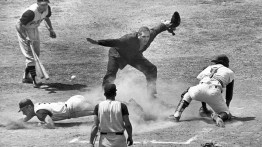
Hope springs eternal. With Opening Day 2025 under our belts, however, you cannot shake the feeling that America’s pastime, like its politics, is a two-party system. The Los Angeles Dodgers enter the season as the incumbent World Series champions, having triumphed over the New York Yankees last October. Who expects this year to be much different? Here is a quick rundown of the Dodgers offseason coup: two-time Cy Young winner Blake Snell and international phenomenon Roki Sasaki bolster an already stellar rotation featuring Tyler Glasnow, Yoshinobu Yamamoto and Tony Gonsolin. And just in case that’s not enough, their best offseason pitching acquisition is reigning MVP Shohei Ohtani, fresh from becoming the first player in history to slug fifty home runs and steal fifty bases.

German

Why German-origin Americans keep quiet about their culinary contributions

Irish Americans are arguably the most ostentatious in their national celebrations. It is hard to imagine any other group getting a day off work and spending it turning the Chicago River green. I wrote of my own Irish pride in these pages last year. March 17 was the highlight of our social calendar. My grandfather inaugurated our city’s St. Patrick’s Day parade, which still runs in Great Falls, Montana, today. Montana — especially Butte — is famous for its Irish population, which makes up 15 percent of residents. But there is a significantly larger ethnic group in Montana, whose traces of national pride are almost imperceptible. According to a US Census Bureau survey in 2020, 24 percent of Montanans claim German ancestry.

Ventoux

The excellent wine of Mount Ventoux

On April 26, 1336, the poet Petrarch, accompanied by his younger brother, climbed up the windy slopes of Mount Ventoux in the Rhône Valley. He said that he was the first person to climb that Alps-adjacent peak, which isn’t quite true. But it may well be true that he was the first person to go mountain climbing for fun. Petrarch wrote about his outing in 1350 in a famous letter called “The Ascent of Mount Ventoux.” The twentieth-century German philosopher Hans Blumenberg (speaking of mountains) wrote that Petrarch’s climb marked “one of the great moments that oscillate indecisively between the epochs,” namely between the medieval world and the Renaissance. Today, we like mountains. They mean picnics, sight-seeing, natural beauty.

Are we still doing phrasing?

Grandma McMorris seldom curses, so when she said, “never let a son of a bitch know he’s a son of a bitch,” I knew she was quoting her father, Pop Pop. My grandfather oozed apothegms, nuggets of wisdom that are now only found on refrigerator magnets, motivational posters and throw pillows: the Silent Generation’s forerunner to the meme. Mom was giving me work advice. It’s only been two months, but I no longer remember who the son of a bitch that I called a son of a bitch was, let alone why I called him that. The particulars vanished as soon as my mother spoke, the work crisis overtaken by a personal one. It was a barbecue, probably. Or perhaps a s’mores night at the firepit. A birthday party for one of her sisters? “Dad, when can I have a cigarette?

words

Road-tripping with Wittgenstein

North Carolina The ancients used the sun and moon to measure time, but modern man has a more exact instrument at his disposal: the odometer. It has ticked up a thousand-plus miles, a sure sign the 2024 holiday season has just ended. The children are all struggling in the backseat — against one another, their own bladders and the nylon straps the Car Seat Cartel has foisted upon them — and are thus unable to see the dash’s mileage ticker, as well as the incriminating orange “service reminder” messages your wife is pretending to ignore. When you read aloud the “Welcome to North Carolina” sign, your most intelligent child says, “Are we still in the United States?

Wittgenstein
backgammon

A week at the World Backgammon Championship

Most people will know that there are no rivers in Monaco. The one I found there is the metaphorical waterway used by poker player and professional pollster Nate Silver to describe an ecosystem of people and ideas focused on probabilistic thinking and calculated risk-taking. The term is derived from poker, where the last community card to be revealed in a game of “Texas Hold ’Em” is known as the River. Poker players paddle about in the river, but so do stock-market traders, venture capitalists and anyone else consistently taking calculated risks. A politician deciding how to respond to Covid or a foreign invasion is “in the river.” In the broadest sense, we all live in it as we make risky decisions in an uncertain world, tipping our hats to Heraclitus from time to time.