
Aidan McLaughlin

Le Sirenuse: the loveliest hotel in the world

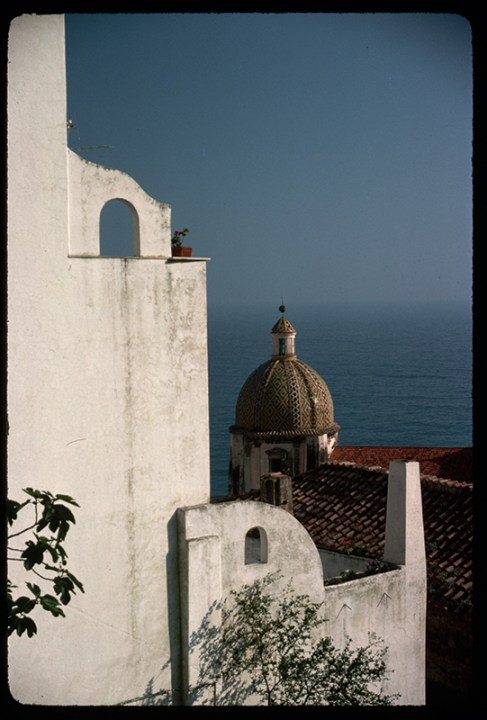
The view. [Aidan McLaughlin / The Spectator]

Look out from the balcony of your room at Le Sirenuse and you’ll see the trio of rocks jutting out of the Tyrrhenian Sea that gave the hotel, one of the last true greats in the world, its name. The three jagged islets form an archipelago, which is said by the Greeks to have been the home of sirens whose enchanting songs lured sailors to their deaths.

Le Sirenuse, a scarlet palazzo wedged into the cliff-face of Positano, boasts similar powers of attraction. It is a sprawling manse with a wonderful restaurant, several bars, including a vinyl listening room, and 58 rooms and suites, many with sweeping views of the kaleidoscopic tumble of Positano and the sea that stretches out to the horizon. 

It’s easy, particularly after a few drinks, to get lost in the hotel’s many floors and labyrinthine corridors, and yet every space somehow feels intimate. The rooms facing the sea invariably boast balconies built, by some feat of clever engineering, to maintain the privacy of their guests. Each room is unique, boasting stylish furniture, custom tiling and soft plaster archways. In a place known around the world for its beauty, Le Sirenuse stands out. It has developed a reputation as the loveliest hotel in the world; somehow, it exceeds that billing.

Originally built as the summer retreat for the Sersale family, an Italian clan with a rich history, the villa was opened to guests in 1951. At the time, it had a few rooms and a terrace. Franco Sersale, one of the four siblings who founded the hotel, refurbished the space through the years, while subsuming adjoining houses as part of an elegant sort of manifest destiny. It is perhaps that history that lends Le Sirenuse, in spite of its size, the quality of feeling like a family home. Staying there, you must remind yourself on a fairly regular basis that you are staying at a hotel, and not at the home of an old friend with spectacular taste. 

The place is now owned by Carla and Antonio Sersale, Franco’s son, and they can often be found on the terrace of the hotel’s bar and restaurant, Aldo’s, making conversation with delighted guests. Their sons, Francesco and Aldo, both handsome and charismatic, are also part of the family business. Both started their careers elsewhere — Francesco worked as an agent at WME in New York, while Aldo studied hospitality in Switzerland before stints at the Mandarin Oriental and Sant Ambroeus —yet couldn’t resist the pull of Positano. They are both now intimately involved in the management of a business that has expanded significantly in recent years. 

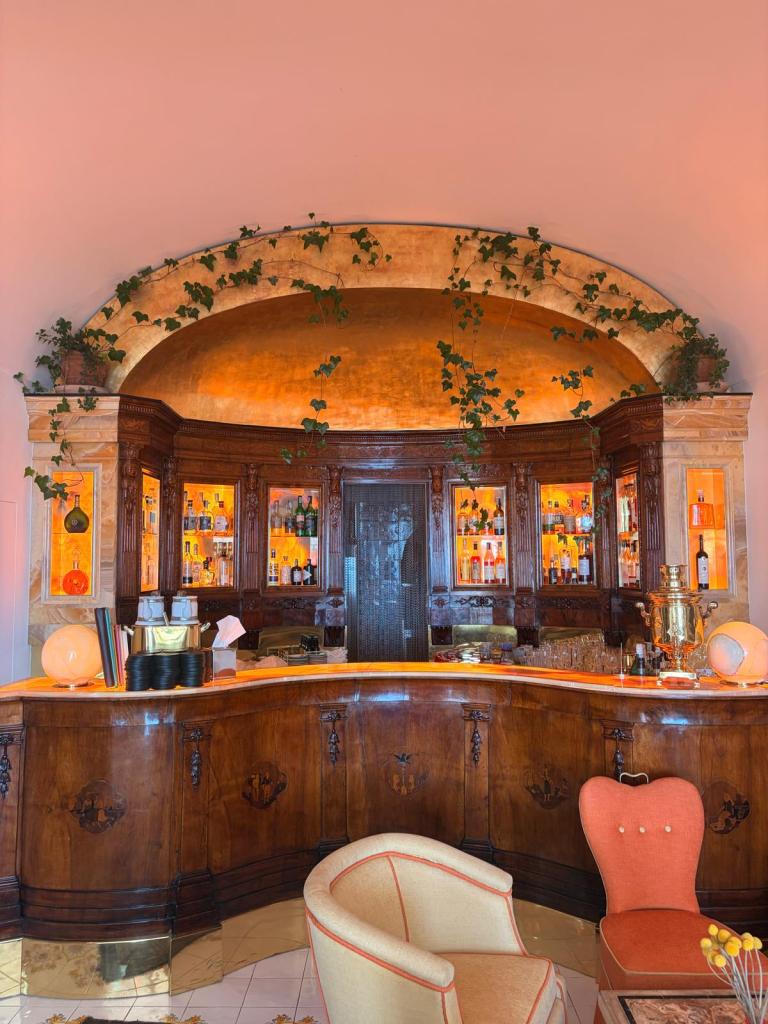
Indeed, the Sersale family has embraced, with no shortage of ingenuity, the modern hotel’s tendency to develop a brand as an extension of itself. Across the street there is Emporio Sirenuse, a shop selling branded beach attire, ceramics, and fragrances (all rooms have hand-painted ashtrays that guests are encouraged to pilfer, as well as delightful little books published by the hotel.) In recent years, Francesco launched Dolce Vitality, a luxury hiking and wellness retreat that will run next for a week in March. Aldo, meanwhile, worked with his father to develop the Don’t Worry Bar, a gorgeous speakeasy with a vinyl collection, hi-fi system, backgammon boards, and an opulent oak and marble service counter where drinks are poured. The space, inspired by ongaku kissa, the Japanese listening cafés like Tokyo’s Ginza Music Bar, is an indulgent place to grab a cocktail after dinner. There are other projects on the horizon: in April, the family is opening Le Sirenuse Mare, a beach club in nearby Nerano. It will have a restaurant with 180 seats, three bars, and a boutique. 

Carla and Antonio have also kept up Franco’s habit of packing the place with fine art — the place almost doubles as a contemporary art museum. There is a neon “Don’t Worry” sign from the British artist Martin Creed hanging from the vaulted ceilings of the speakeasy. At one point I turned a corner and found a striking painting from Stanley Whitney. Even the pool is a masterpiece: its floor features a mosaic by the sought-after Swiss artist Nicolas Party.

The hotel is grand enough that one could enjoy a week there without so much as venturing off property. Up above the hotel sits Franco’s, an al fresco terrace bar that pops with Yves Klein blues, terracotta pots, and a spectacular lemon-yellow fountain by Roman artist Giuseppe Ducrot. The bar opened in 2015 after Antonio had the bright idea to convert a little parking lot into one of the prettiest places to grab a drink on the entire Amalfi coast. The pool area is a particular delight, encased by lemon trees and bougainvillea that climbs the walls. I ordered a steady stream of Campari sodas to the beds, which are reserved for guests. When it feels like lunch, you saunter over to one of the round tables at the terrace edge, with sweeping views of the town and its harbor. There, I had a simple yet magnificent plate of paccheri with tomatoes grown on the slopes of Vesuvius, thick hunks of lobster and melting buffalo mozzarella. My meal was not—could not be— interrupted by the loud Texan family, their wealth apparently owed to oil, arguing about politics at a nearby table. I had entered a flow state.

Inside the hotel. [Aidan McLaughlin / The Spectator]

It is hard to imagine a family better suited to high end hospitality. I got a taste of the Sersales’ bottomless generosity a half decade ago when I first visited Positano for a long weekend. After being introduced to the family by a mutual friend, and after remarking to them that their restaurant La Sponda was hard to get a reservation at, the family offered up their own table — a standing Sunday reservation — and invited us to join them for drinks beforehand. From our table, lit by the 4,000 candles that illuminate the dining room, we watched through an indoor window as the staff worked tirelessly to clean every inch of the kitchen; it was a performance in perfection that I, having worked as a dishwasher in establishments of considerably less renown, found both mesmerizing and awe-inspiring.

This is one of the few times I noticed the hospitality of Le Sirenuse, which feels as though it is designed to have a light touch. You’re only reminded of how seamless the service is when you reflect on yet another lovely day spent. The Swiss-trained staff are efficient, but unlike the clinical service one sometimes gets in Italy’s northern neighbor, they are exceedingly warm. Seemingly insurmountable tasks are resolved with ease; a desperate request for cigarettes one night was resolved with quiet alacrity. A same-day reservation for johDa Adolfo, which I failed to obtain through various attempts at both seduction and coercion, was quickly obtained by Mauro Contino, the hotel’s indomitable head concierge, who called the manager and secured a table within seconds.

“Positano bites deep,” John Steinbeck wrote in 1964 upon discovering the seaside town. “It is a dream place that isn’t quite real when you are there and becomes beckoningly real after you have gone.” Steinbeck stayed at Le Sirenuse, which at the time was run by the Marquis Paolo Sersale, the father of Franco, a sophisticate and patron of the arts. He was also, improbably, a Communist in a town of royalists, a distinction that somehow helped get him elected mayor in 1944 at the age of 25. Paolo, in Steinbeck’s telling, was “a strong handsome man of about fifty who dresses mostly as a beachcomber and works very hard at his job as mayor.” It was a popular reign, lasting four terms across 16 years. Much has changed about Positano since the American author’s discovery; Le Sirenuse has expanded, but its unique charm and beauty — he described it as “a first class hotel, spotless and cool” — has remained intact.

There is one glaring failure of imagination in Steinbeck’s assessment of Positano. Explaining his impulse to share the place with readers rather than conceal its existence for himself, Steinbeck reasoned that the vertigo-inducing terrain meant Positano would never become a tourist destination. “There isn’t the slightest chance of this happening in Positano,” he wrote confidently. The tourist of the 21st century is perhaps more intrepid than his forebears. Positano has become one of the most popular getaways on the planet, owing no doubt to its comfort in front of an iPhone camera. Before visiting I felt as though I had seen its gorgeous face in Instagram posts so many times that I felt I already knew it rather intimately. Yet no degree of pixelated familiarity will prepare you for the real sight; the town seen from the boats that bob on the sea is always the town seen for the first time. Positano is one of the great visual pleasures of the world.

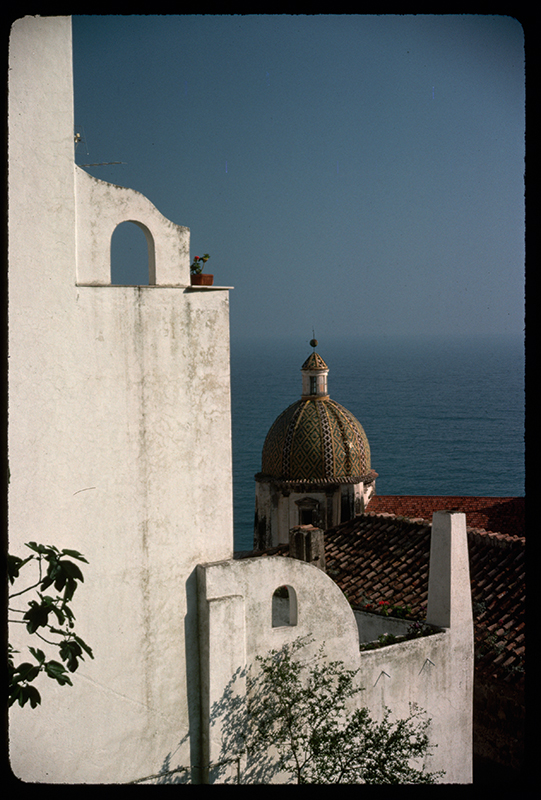
And worth wading through the throngs. Winding staircases and narrow alleyways usher you through this teetering hulk of pastels impossibly perched on a mass of rock jutting out from the sea like a psilocybin-induced miracle. Amidst the smattering of colors stands Le Sirenuse, looming just beyond the sparkling tile dome of the chiesa di Santa Maria Assunta, a 10th century church that, as history tells it, is the site of quite a few miracles of the ecclesiastical sort. From the boats that ferry tourists around the coast, the mention that one is staying at the hotel typically elicits a knowing — and faintly envious — nod. Celebrities can relax here; I spot a linen-clad Jason Mamoa and girlfriend Adria Arjona strolling near the port undisturbed.

Should you decide to venture outside the hotel, Da Adolfo is worth the trip. It’s a magical little restaurant, a bare-bones shack on the beach accessible only by boat (or, a gruelling 500-step climb down the precipitous cliff-face that might have actually killed Steinbeck). A small tender bearing the restaurant’s iconic logo, a bright red fish, ferries happy diners from Positano’s port to the restaurant. 

Back in Positano, I made my way to a booth manned by an old man and his tiny dog, where you can shoot air rifles at soda cans. “Più rompi più vinci,” his booth declared, which translates to “the more you push the more you win.” I pushed a few times and, perhaps owing to the lovely white wine served at Da Adolfo, missed. Nevermind. It was nearly dusk, and so time to go down to the shore, where bars and restaurants line the beach, and have a drink. Three Australian girls — drunk and in search of uppers to straighten out a day’s worth of drinking on a boat — guided me to Music on the Rocks. This charming nightclub, the only one in town, is carved into the limestone cliffs of the coast. The crowd is a mix of locals, Italians on leave from their jobs in Milan or Rome, and tourists from around the world; it is one of those places where champagne is sprayed rather than drunk. I made it back to the hotel in the early hours of the morning, and to my horror realized I once again craved a cigarette at an hour when all the tabaccis were closed. My apologies were dismissed with a warm smile; my request was resolved without fuss.
Comments