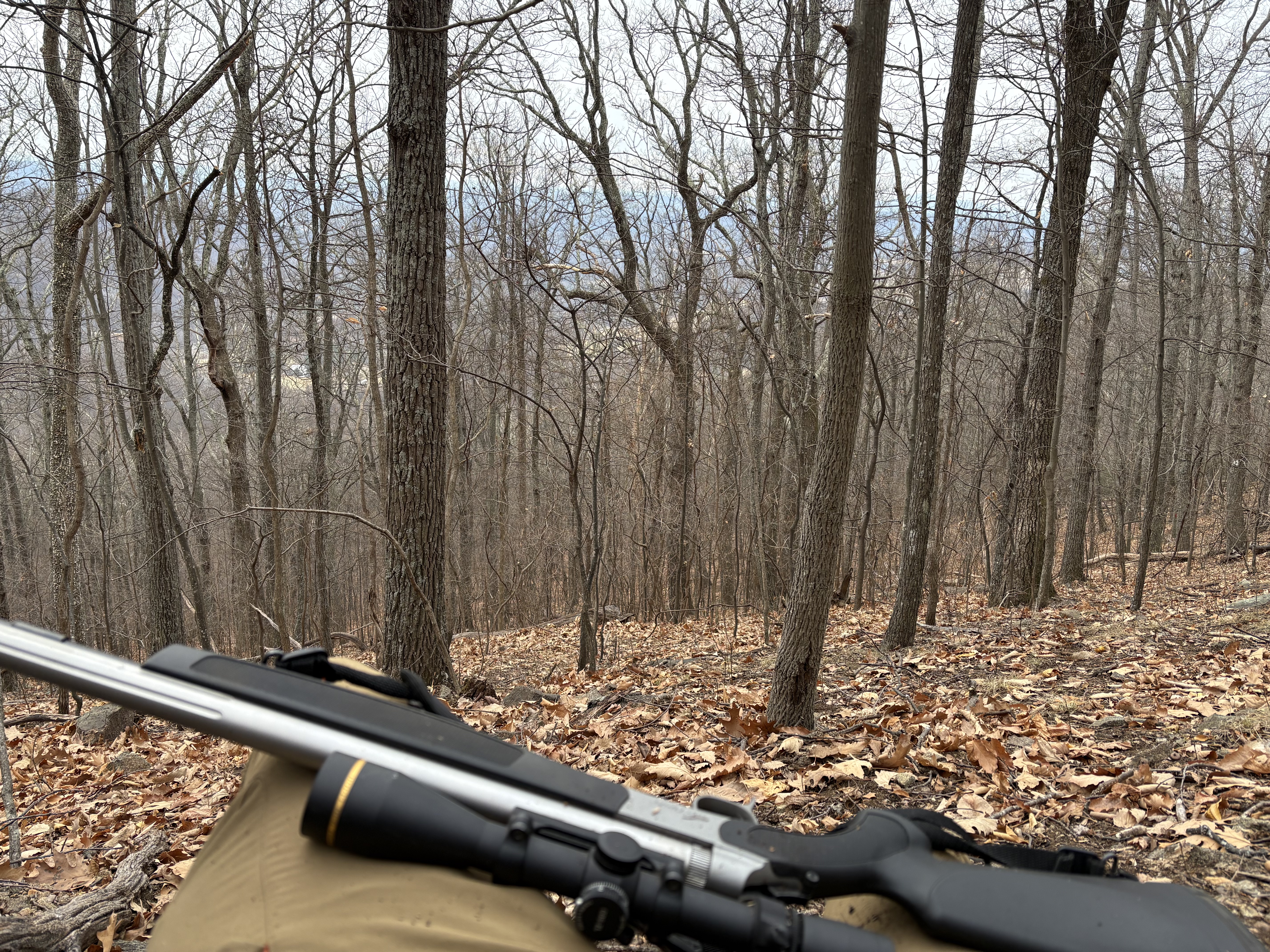
Climbing into the Blue Ridge Mountains in Virginia with a muzzleloader slung over my shoulder was a journey back in time. This was the gun that the colony’s first settlers used when they too trod the same ground 400 years ago to hunt deer and bear. It helped tame the state and then the entire country.
As I pushed my way through undergrowth at the base of the mountain range by the light of the moon at 5 a.m. on a bitingly cold and bitter January morning, unseen branches and briars clawed at my face in the dark.
This was the last day of the hunting season that had been extended – as hunting seasons across the US often are – for muzzleloaders. To keep this heritage weapon alive and to give the animals a sporting chance. For the deer population that had been shorn over the previous months at the hands of hunters with proper hunting rifles the finish line was in sight.
Hunters with muzzleloaders are not rated as much of a threat: the guns are prone to misfiring, inaccurate if not loaded correctly and liable not to go off at all. And if you do get a shot off, the process of reloading is time-consuming. Stand the gun on its butt, measure and pour gunpowder down the barrel and use a ramrod to push in a projectile. By which time the deer or bear could be in Kentucky.
But muzzleloaders are beloved by hunters with a sense of history. My hunting partner for the day Shane Townsend, who lent me one of his modern .50 caliber muzzleloaders, said that even though the gun is a “pain to load, a pain to clean, unpredictable and not particularly accurate,” he loves it.
“The muzzleloader gives me more time in the woods, it makes hunting a little harder than it has to be, and it feels old in the best way. My favorite deer hunting of the year is slipping around the mountains on a gray, drizzly day with a muzzleloader in my hand, willing a buck.”
Shane had a bear tag and I had a deer, and of course muzzleloader, license. We were joined by Kayla, who was also hunting deer, and trekked upwards for more than an hour towards the dark jagged peak, treading as lightly as possible on a carpet of dry leaves.
My gun had been much improved since the days of the musket but still bore many of the original design flaws. It did, however, have one thing the early hunters did not have: a scope. Would that be enough to make my one shot count? Would I even see a deer to get that one shot? As we split to go to our separate hunting grounds, I was about to find out.
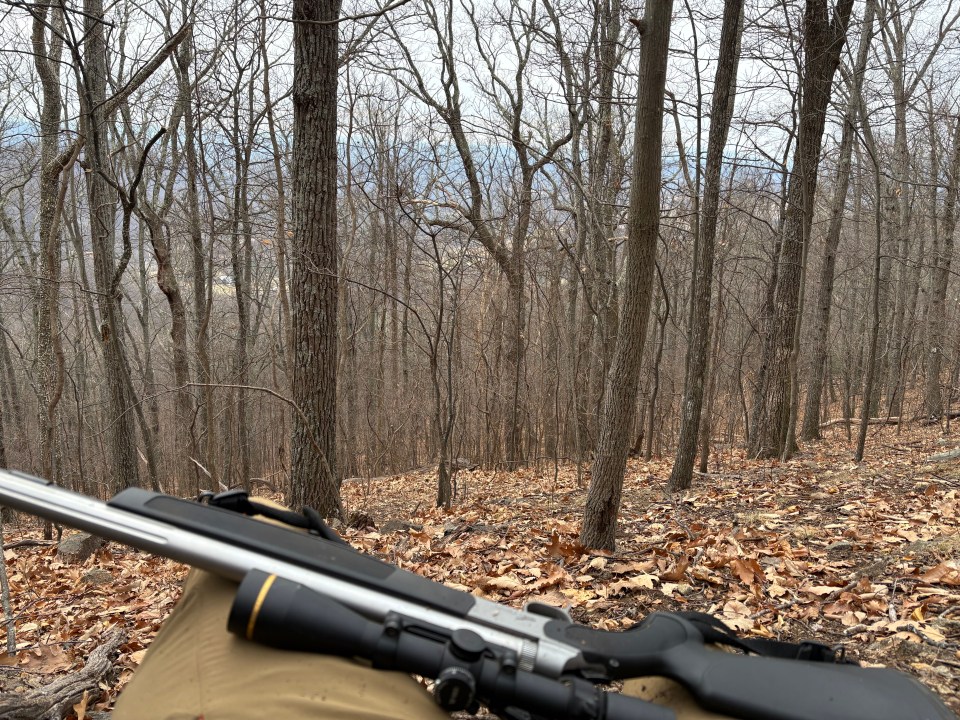
Dawn was breaking as I settled down into a nook next to a big tree and slung my backpack behind it. With the muzzleloader on my lap I looked down the mountainside into the thicket and willed a deer to emerge.
The forest slowly forgot about my presence and started to come alive around me. Birds sang and leaves crunched under small feet. Suddenly something rushed towards me, my heart jumped and gripping the muzzleloader I spun my head: two squirrels skipped across the ground and zigzagged up a tree. The small creatures playfully tortured me all day.
Now stationary, the cold became body-wracking, fingers and toes soon frozen numb. Four layers of clothing weren’t enough. My head was on a shivering swivel as I scanned the forest falling away on the slope in front of me.
Something big turned in the brush in the distance. A flash of white tail, hind quarters and it was gone. I cocked the gun, slid my finger closer to the trigger, aimed and looked down the scope. Nothing. Minutes ticked by. Was it a figment of my imagination? The shadow moved between trees, briefly a broadside shot of a distinct deer, but it disappeared before I could bring the gun round. The slow chase continued until another flash of white, kicking hooves and the shaking of undergrowth. My quarry was gone.
And with it my chance of taking a shot with a muzzleloader? Shane told me earlier in the truck that hunters can go for years without shooting deer on public land in Virginia. Perhaps if he’d told me that before I flew down from New York I wouldn’t be here.
I felt an urge to move towards where the deer had been in case others followed. I crept, carefully and quietly, from tree to tree, eventually so far from my bag I had trouble finding it later.
The clock ticked perilously close to midday – the agreed meeting time – and another shadow separated itself from the distant forest. For a split second it was recognizably a deer before it disappeared into the trees and scrub. The animal seemed to be moving slowly towards a small clearing 70 yards away that I had, as luck would have it, practiced training the muzzleloader on. Then there it was again – but before I could find it with the scope, it stepped behind a bush. The thicket filled my viewfinder. I couldn’t pull the trigger, though, until I could see the animal clearly, I couldn’t waste my one shot.
The doe’s head emerged first. She was grazing, nosing the ground. Slowly her forelegs and torso followed. I ran the crosshairs up her front right leg, pulled in towards her body slightly and pulled the trigger.
If nothing else I had at least fired the muzzleloader. I didn’t feel any recoil, only a puff of white smoke that transported me back hundreds of years and a memory, I was later far from sure about, of a doe’s white underside, legs upturned. Then she was gone again. Had I hit her?
Shane and Kayla heard the gunshot and joined me. First we made coffee and then the real work began. There was no trace of the doe at the spot I had shot her. Deer can run hundreds of yards after being shot so we fanned out to check trees, hollows, rocks and patches of dense scrub she could be concealed in – if my aim had indeed been true.
Two hours after pulling the trigger and still no luck, I felt a terrible guilt for wasting everyone’s hard-earned hunting time.
Then Kayla found blood. Where I thought I had shot the deer was 30 yards away from the spot I had actually shot her. Trees have an annoying habit of all looking the same after a while in a forest.
Curiously the blood trail ended after just a few yards. We circled the area looking for more splashes of red and found nothing. Kayla figured it out first. We had looked in every conceivable direction but one: down. She scraped away leaves from the ground with her hiking pole to slowly reveal gray fur. The doe had fallen into a deep channel of leaves that had shrouded her. That was why she disappeared after I took the shot, she had been instantly enveloped by the forest.
We pulled her out and field dressed her quickly. Shane and I passed the knife between us, separating skin from flesh, leg from body, and avoiding at all costs puncturing the sack that contained the internal organs. Legs and quarters were put into field bags and field bags into packs. Our own legs and shoulders burned as we carried them back down the mountain to the truck.
Later, back at Shane’s home, after some finer butchery, we cooked and sampled the first of the venison. The freshest and tastiest backstrap I’ve ever eaten.
Used correctly a muzzleloader won’t let you down. There’s a satisfying craft to loading it and a distinct echo of history when you fire it. The gun poses a test, but far from an impossible one to pass if I can pass it. As the early settlers understood, you have one shot, so make it count.
 Ben Clerkin
Muzzleloader season





Comments