World

China’s BYD could kill Tesla

Tesla and its hyperactive boss, Elon Musk, are having a rough month. On both sides of the Atlantic, there have been protests against the “Nazi-mobile” and the “Swasti-car.” The electric vehicle (EV) manufacturer’s sales are plummeting across Europe, and its stock is in freefall. On top of that, its biggest rival, China’s BYD, has just announced a super-fast charger that allows you to “fill up” your EV as quickly as you once could your gas-powered car. All companies go through rough patches, especially when they are leading a new industry. But Tesla is losing its technological edge to China— and that could prove fatal. If it performs as advertised, BYD’s rapid charging system could revolutionize the EV industry.

The problem with putting US nukes in Poland

Nuclear weapons are becoming a major issue for Poland. One way or another, both the Polish president and prime minister want their country to host tactical nuclear weapons as a deterrent against President Putin’s Russia. In the latest — but by no means the first — statement on this issue, President Andrzej Duda revealed that he recently discussed stationing American tactical nuclear weapons in Poland with Keith Kellogg, the US special envoy for Ukraine. In an interview with the Financial Times, Duda said: “I think it’s not only that the time has come, but that it would be safer if those weapons were already here.

Europe

Trump’s war on Europe should not surprise anyone

Has there been a more cataclysmic year for US-Europe relations than 2025? It began with J.D. Vance’s “sermon” to EU leaders at the Munich Security Conference last month, in which he berated Western Europe for its policies on immigration and free speech. This year has also seen the growing threat of NATO falling apart after 76 years of peace in Western Europe, with the White House seemingly tilting toward Russia and Trump demanding that alliance members such as Germany, France, and the U.K. dramatically increase their defense spending. This week, as the Trump administration imposes tariffs on Europe and Europe retaliates, there are even signs of a full-scale trade war.

Why Greenland’s election might not have been so bad for Trump

“We strongly support your right to determine your own future. And if you choose, we welcome you into the United States of America,” President Donald Trump told Greenlanders from a joint session of Congress earlier this month. And determine their future they did, as Greenland voted in a parliamentary election Tuesday. The results might not be as bad for Trump as NBC’s headlines imply. That's the takeaway of Tom Dans, a man Greenlandic media calls Trump’s sande mand — true man — in the island-nation.  Dans, who is in Washington, DC after spending weeks traveling across the icy Danish protectorate, previously served in Trump’s first administration’s Arctic Research Commission and the Treasury Department. He currently heads American Daybreak, a nonprofit organization.

greenland
europe museum america

How America enfeebled Europe

Fighting to “rebalance” NATO, American leaders now look on the old continent with dismay. Europe cannot seem to muster the physical resources — and, still more, the cultural ones — to provide for its own defense. Even American liberals now mark this down to a late social democratic decadence, or civilizational ennui. To a certain kind of Elon Musk outrider, “Europe is cooked,” or, “Europe is a museum.” The go-to explanation is that America has spoiled these countries rotten for too long. Sheltering under Article 5 of NATO, European nations were able to run down military budgets and use the dividend to pay for generous welfare states. US overspending had allowed Europe to live in a post-historical dreamworld, but reality would have to intervene sooner or later.

putin

Will Putin give peace a chance?

At a summit meeting in Moscow, Ronald Reagan was asked about his basic approach. He famously answered, “Here’s my strategy on the Cold War: we win, they lose.” Vladimir Putin has the same strategy for Ukraine. That is certainly his first response to President Trump’s offer to mediate an end to the war and bring a reluctant Ukraine to the negotiating table. If “we win, they lose” is Putin’s final response, then the war cannot end without Ukraine’s surrender or Russia’s collapse. Putin’s initial reply, filled with his maximalist demands, indicates he is still committed to the conquest of his neighbor, whose independence and sovereignty he has long rejected.

Is the Trump administration ready to stop Chinese espionage?

For Republican voters sick of “deep-state” shenanigans, Kash Patel, the new head of the FBI, seems an ideal appointment. He and his new deputy, the former police officer turned podcaster Dan Bongino, look and sound like exactly the right men to disrupt a bureau that has at times in the past eight years acted as an investigative arm of the Democratic party in its attempts to thwart Donald Trump through the legal system. Patel is considered so pleasingly anti-establishment that his ties to a Chinese e-commerce business have been largely overlooked. He has holdings worth up to $5 million in a fast-fashion company called Shein, founded in China but headquartered in Singapore, and he intends to keep his stock. There’s nothing wrong with that, per se.

espionage

Is Canada doing enough to tame Trump?

There’s such a thing as cutting off your nose to spite your face, and the tariff war between Canada and the US is starting to look like a prime example. On Monday, Ontario Premier Doug Ford announced a 25 percent surcharge on electricity exports to the US, affecting an estimated 1.5 million households and businesses in New York, Michigan, and Minnesota. Trump responded with all-caps outrage, raising the March 12 tariff on steel and aluminum imports from Canada from 25 to 50 percent — a move that would be devastating for Ontario’s auto sector. How, the President asked, could Canada stoop so low as to use electricity — a resource that impacts the daily lives of innocent people — as a bargaining chip and a threat?

Canada
Putin

Why Putin could reject a ceasefire

With all the good news coming out of the Jeddah talks about a 30-day ceasefire in Ukraine, there’s only one question that needs to be answered: Will President Putin be interested in any kind of deal right now? President Trump is convinced that Putin wants peace. But if the Russian leader truly wants to end his war, will he do so on America’s terms, or will he wait until he achieves one of his main objectives — the total subjugation of the four provinces in eastern Ukraine that he claimed to have annexed in the first seven months of the invasion? At a ceremony in St. George’s Hall at the Kremlin in September 2022, Putin declared that Russia now had four new regions: Donetsk, Luhansk, Kherson, and Zaporizhzhia.

Kyiv

Has Ukraine called Putin’s bluff?

Has Vladimir Putin’s bluff been called? It certainly looks that way. As long as the Ukrainians refused to consider a ceasefire, Moscow could portray them as the obstacle to the kind of quick deal Donald Trump appears eager to secure. Previously, Kyiv had floated the idea — after another unhelpful intervention from French President Emmanuel Macron — of a limited ceasefire covering only long-range drone attacks on each other’s cities, critical infrastructure, and operations in the Black Sea. But that was a non-starter, too transparently a trap for Putin, designed to make him look like the intransigent party if he rejected it. That certainly seemed to be Kyiv’s plan as of last night, when an unprecedented attack on Moscow involving some 140 drones killed three civilians.

Romania’s democracy has descended into farce

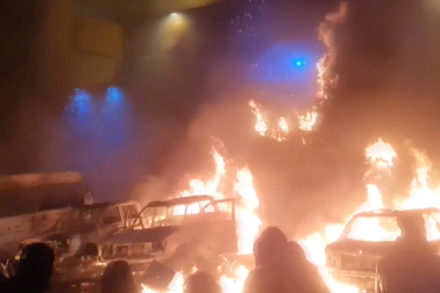
Violence broke out in Bucharest on Sunday evening after Romania’s Central Electoral Bureau disqualified Cǎlin Georgescu from running in May’s re-run presidential election. In a statement, the bureau justified its decision to exclude Georgescu on the grounds that his candidacy “doesn’t meet the conditions of legality” because he “violated the very obligation to defend democracy.” Supporters of Georgescu, whom the BBC has described as a “far-right, pro-Russia candidate,” gathered outside the Central Electoral Bureau to express their outrage and soon clashed with police. Until six months ago, Georgescu’s name was virtually unknown outside Romania.

Mark Carney is Canada’s new prime minister

It is difficult to overstate how much Donald Trump has changed the dynamics of Canadian politics. When Justin Trudeau resigned on January 6, his Liberal party was on just 16 percent in the polls — 25 points behind Pierre Poilievre’s Conservatives. Within six weeks, that had narrowed substantially, with Nanos suggesting there was just two points between the two parties. The top issue of national concern? Donald Trump and US relations. Visiting Ottawa in January, I was struck by the remark which one Member of Parliament made to me. “We don’t see America and tariffs as foreign affairs — we see them as actually an extension of our domestic economic policies.

mark carney

Freedom of speech in the UK is very, very under threat

With all the transatlantic back-and-forth over Ukraine, and J.D. Vance’s contentious remarks on Fox News about some “random country that hasn’t fought a war in thirty or forty years,” it’s easy to forget that just three weeks ago, the vice president gave a landmark address about free speech in Europe and Britain, in particular. Last week, when Keir Starmer visited Washington, DC, Vance raised his concerns more directly with the prime minister about “infringements on free speech … that affect American technology companies and by extension American citizens.

China’s response to Trump’s tariffs marks a dramatic escalation

Might peace in Ukraine be prelude to an even more serious conflict between the United States of America and China? Is that a hysterical question? The deal-or-no-deal drama starring Donald Trump, Volodymyr Zelensky and European leaders has dominated the news in recent days, so much so that the latest clash between Washington and Beijing has gone all but unnoticed. Yet China’s official response to the Trump administration’s move to raise its tariffs on Chinese imports to 20 percent does appear to mark a dramatic escalation. "Exerting extreme pressure on China is the wrong target and the wrong calculation,’’ said China’s foreign ministry spokesperson Lin Jian. "If the US has other intentions and insists on a tariff war, trade war or any other war, China will fight to the end.

Canada can do more to address the fentanyl crisis

It was a field day for the Canadian freight industry on Monday. Every truck in the country, stuffed to the gills with product, was racing the clock to the border. The few drivers still available commanded ridiculous prices — up to $12,000 higher than normal. At the stroke of midnight, the 25 percent blanket tariff kicked in. Trucks that had yet to make it across the border hit the brakes and turned around. The party was over; the coaches became pumpkins again, it was time for Cinderella to go home. The whole week before, business owners, brokers and shippers were asking each other: "Have you seen anything official on this? Anything from the Canadian government?" They hadn't.

fentanyl canada
ukraine military aid pause

Will Trump’s pause of Ukrainian military aid force Zelensky to the negotiating table?

The decision couldn’t have come as a surprise to Ukrainian president Volodymyr Zelensky. And if it did, then his capacity to read the room is even worse than imagined. Last night, the Trump administration paused all US military aid to Ukraine. The move came after an extremely tumultuous few weeks, which started on February 19 when Zelensky claimed that Trump was living in a Kremlin-orchestrated disinformation bubble. Trump wasted no time howling back by calling Zelensky a dictator because he canceled elections during a time of war. The spat accelerated on Friday, when the two men, egged on by Vice President J.D.

Zelensky goes to town

If the president of Ukraine, Volodymyr Zelensky, were on my Christmas list, I think I might give him a copy of Thucydides’ history of the Peloponnesian War. I’d mark that bit in book five we call “The Melian Dialogue.”  It tells the story of how Athens confronts the tiny island of Melos, a neutral ally of Sparta. Athens demands that the island surrender its neutrality. The leaders of Melos resist. Athens delivers an ultimatum: surrender or be destroyed.   The Melians offer a number of arguments about why they should not be forced to capitulate. Athens is not being fair, the Melians have right on their side, et cetera.

zelensky
ukraine zelensky white house

Zelensky’s White House visit goes off the rails

An astonishing flare-up in the White House between President Donald Trump, Vice President J.D. Vance and Ukrainian president Volodymyr Zelensky appears to have thrown any Russia-Ukraine peace deal — or US-Ukraine mineral deal — into jeopardy. Trump met Zelensky at the door of the White House where he gave reporters a thumbs up ahead of his arrival. However, the mood quickly turned sour when they sat down for initial remarks ahead of talks and a press conference where the pair were expected to sign the US-proposed minerals deal with Ukraine. Sat in the Oval Office, Trump was accompanied by key members of his team including J.D. Vance and Marco Rubio.

Trump on Mexican cartels: ‘You know what the only solution is’

Donald Trump’s second term has been revolutionary in many ways, particularly in his administration’s approach to foreign affairs. From the get-go, the nomination of Marco Rubio as his top diplomat and Chris Landau as Rubio’s deputy signaled a break from orthodoxy. In picking Rubio, previously the most vocal senator on hemispheric affairs, and Landau, Trump’s ambassador to Mexico in his first term, the message was clear: our neighborhood is a top priority.  In his first exclusive magazine interview of his second term, Trump met with The Spectator’s Ben Domenech in the Oval Office, where a large portion of the conversation delved into Latin-American affairs.

Europe learns the facts of MAGA life

Panic, even hysteria, has swept Europe. Its leaders realize that in their case Trump should be taken literally as well as seriously, and he seems prepared to trade the transatlantic alliance for détente with Russia. Eight decades of good times for the continent might be coming to a dramatic end. Trump demonstrated contempt for Europe during his first term; however, his top aides moderated his antagonism, carrying on policy as normal. While out of office he evidently decided never again. Today he is firmly driving American foreign policy. As ever, Trump’s tactics are often dubious, even counterproductive. However, only shock treatment is likely to cause Europe to take its own defense seriously.

europe