


Douglas Murray has narrated this article for you to listen to.
I think it was Zadie Smith who I first heard point out that race is in America what class is in Britain: the conversation underneath every conversation.
When I first heard that remark I slightly balked. Not least because one had rather hoped that class would be less of a thing in Britain in the 21st century. I suppose it is, although you do still meet people who treat the English language as though it is a minefield in which one incorrect vowel will suddenly take them out.
But if the class stuff still lingers in Britain, the good news is that we now have the American race obsession too.
For anyone who hasn’t lived in America, it is hard to describe just how permeated race is into every conversation in the culture. For example it is perfectly normal for US politicians to state that they need a black candidate to run, or a Hispanic. When Joe Biden said he wanted a vacant seat on the Supreme Court to be taken by a black woman it caused minimal disturbance. And it was also accepted that Kamala Harris did not choose Governor Josh Shapiro as her presidential running mate because he is Jewish.
If this sort of thing were said openly in the UK, there would still be some turmoil. And yet the same racial and other sectarian equations that dictate American life seem to be more quietly dictating things here too. Since at least the time of Tony Blair’s first administration there has been a generalized feeling that parliament must better reflect the general public. And there is plenty of sense in that – not least because thanks to Blair the general public has changed.
Still, Britain prides itself on not making a fuss about race. It was accepted as nothing much when Rishi Sunak became prime minister. I remember back then an American friend asking me what the British people were saying about our first Indian-origin PM and I told her that frankly I didn’t think that was an issue. “Oh you should see the press back home in India,” she said (she is from there herself). “They are treating it as a great victory for India.”
Likewise, it went without much comment – and certainly no congratulation – when the Conservative party elected its first black leader in Kemi Badenoch. There were even some on the right who seemed to suggest that the election of a black woman to lead the party might snooker the left, although if any of them seriously thought that then I have a bridge to sell them. The entire membership of the parliamentary Conservative party could consist of black female former nurses and the left would still claim that the Conservatives are a patriarchal, racist party whose sole desire is to destroy the National Health Service. But I digress. The point is that even as we think these things don’t matter, they are starting to matter more and more.
The same sectarian equations that dictate American life seem to be more quietly dictating things here too
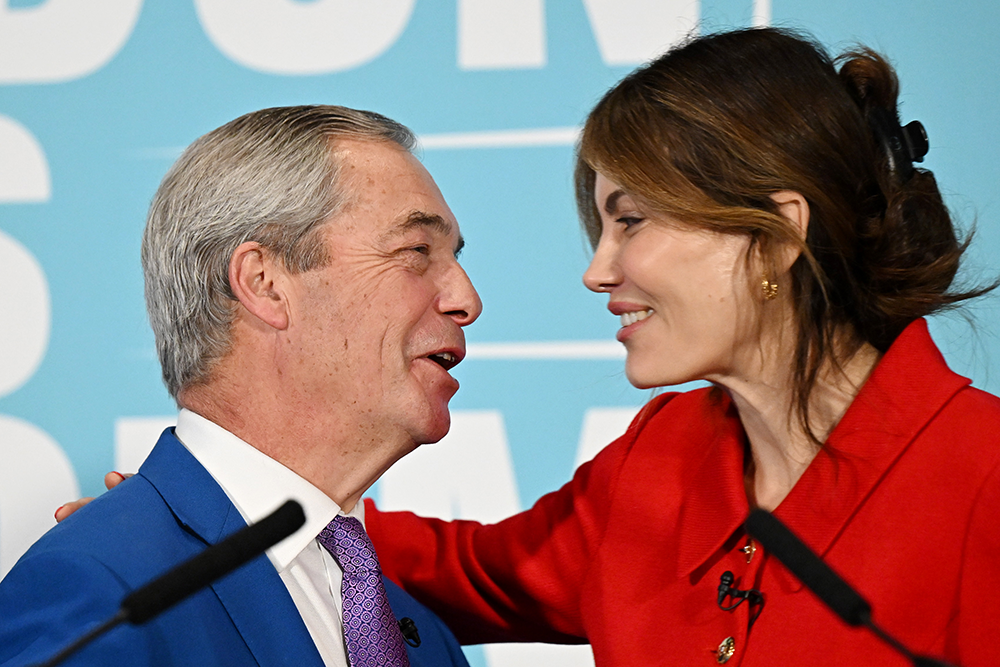
Everybody knows, for instance, that in order to stave off any claims of racism or bigotry, the best thing you can do is to have some prominent brown or black faces at the front of your party. Nigel Farage has always understood this. He has long been in the habit of promoting racial minority figures, presumably because it is an easy, shorthand way to dismiss an easy, shorthand insult. And it works – up to a point. For instance when Reform is represented on Question Time by the usually excellent Zia Yusuf, it is quite funny to see various white, male Labour MPs, my old friend Zack Polanski and others desperately trying to wield the racism and bigotry accusation against the only non-white person on the panel. Though Mr. Yusuf should be careful not to get high on his own supply, as he did last week when trying to accuse Rachel Reeves of racism.
In any case, I do wonder whether there isn’t a moment at which the whole right-wing counter to identity politics doesn’t end up being identity politics itself? For instance, there is a minor kerfuffle around the edges of Reform at the moment because of their choice of candidate for mayor of London. Laila Cunningham has a fair amount going for her. She is attractive, a good performer and has only been out of the Conservative party for a matter of months. She is also a Muslim. In her nomination, several things become apparent.

Perhaps it is inevitable that if Reform fielded a ruddy-faced white man as their candidate for mayor of our wonderfully diverse capital then it would just be too easy to dismiss him. It does make a certain “aha” type of logic to think: “You have a Muslim man? We will raise you a Muslim woman. Let’s see how you get around that one, lefties.” Except that – as mentioned above – the left can get around anything when they want to. And meanwhile another problem starts to come along.
It might be said to have been exacerbated this week by the defection of Nadhim Zahawi to Reform. Zahawi is not a stranger to political inconstancy. But I wonder what the average Reform volunteer who is going to be knocking on doors for the next few years will think about all of this?
After all, if it is true that you need a Muslim candidate to counter a Muslim candidate, does that mean that for the foreseeable future it will be impossible for the political right to put up white, male, heterosexual candidates? The majority of people in Britain are still white, and half of the population is still nominally male. When it comes to the proportion of heterosexuals it is increasingly hard to tell, but on balance they still seem to dominate.
Around the edges of Reform, and among some would-be members and voters, this is all becoming understandably vexing. The unwise will decide to dismiss their concerns. But you can’t dismiss them forever.
Or perhaps you can. Perhaps Britain in the 21st century is simply going to be a place where race and identity dominate everything.
Watch more of Douglas Murray on Spectator TV:






Comments