Operation Absolute Resolve, Donald Trump’s rendition of Nicolás Maduro in Venezuela, was a brilliantly executed coup. The audacious raid did not undermine international law, as many European and Democratic politicians have said. But it did expose the weakness and pomposity of the world’s multilateral bodies. Maduro traded oil for loans with China while helping Moscow avoid sanctions. He permitted the terrorist group Hezbollah and Iran to operate and build drones within his jurisdiction. He rigged elections and had opposition activists shot in the street. He allowed and enabled weapons, fentanyl and illegal migrants to flood towards America’s southern border.
Yet it wasn’t the International Criminal Court that arrested Maduro to bring him to justice in a New York court. A crack team of Delta Force soldiers did what the United Nations, with China and Russia on its security council, could never have done.
America First jingoists delight in what they see as the no-nonsense realism of Trump’s new agenda
The Trump administration made clear in its National Security Strategy document, published in November, that it will not accept a “rules-based international order” which allows its adversaries to flourish at the expense of American power. Team Trump believes, rather, in order-based rules – and the principle that “no adversary or danger should be able to hold America at risk.” This is the so-called “Donroe Doctrine” – or what the strategy calls “the Trump corollary to the Monroe Doctrine” – and it’s not just about Latin America. In a globalized world, Team Trump reserves the right to assert itself anywhere it sees America’s interests imperiled. “For a country whose interests are as numerous and diverse as ours, rigid adherence to non-interventionism is not possible,” says the strategy.
Perhaps that’s right, but the Trump administration also says it sets a “high bar for what constitutes a justified intervention.” And that’s where the Donroe Doctrine starts to become muddled. Has the Christmas Day bombing operation in Nigeria – undertaken with the noble ambition of helping persecuted Christians – helped solve Africa’s vicious sectarian conflicts? And what about Operation Midnight Hammer against Iran’s nuclear facilities back in June? Similar to the Venezuela attack, it was a dazzling expression of American might, and has no doubt hampered Iran’s quest to be a nuclear power.
But the pulverizing of the Fordow uranium enrichment plant hasn’t removed a theocratic regime in Tehran, hellbent on hurting the Great Satan. On January 2, President Trump promised to “come to the rescue” if Iran’s government regime violently suppressed the ongoing protests on its streets. Does that mean the Donroe Doctrine can enlarge its scope to include the Middle East whenever the Commander-in-Chief sees fit? “We are not the policeman of the world,” Trump told a group of West Point cadets in 2020. But the Trump of 2026 seems a capricious global sheriff whose vision of what constitutes “America First” switches dramatically on a whim.
According to the National Security Strategy, President Trump’s foreign policy is pragmatic without being “pragmatist,” realistic without being “realist,” principled without being “idealistic,” muscular without being “hawkish,” and restrained without being “dovish.” But it is also cautious without necessarily being “careful.”
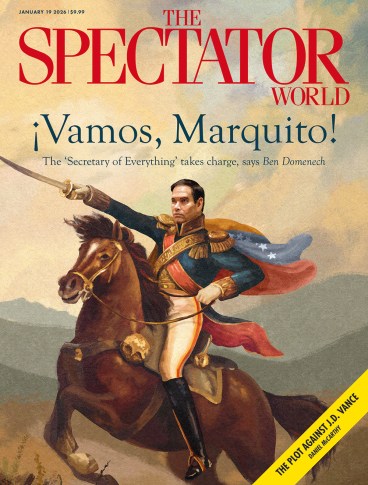
In the days following the Venezuela strike, Trump and his senior team found themselves speaking about the annexation of Greenland, again. This triggered an all-too-predictable barrage of international condemnation and panic from America’s NATO allies. But the back-and-forth over Greenland has the benefit of providing useful cover for the lack of a clear plan in Latin America. Trump has said the US will “rule” Venezuela until a “safe transition” is complete and American companies can start rebuilding the country’s oil industry, a process he says could take years. Meanwhile, he, Secretary of State Marco Rubio (our cover star) and other administration voices are also talking eagerly about toppling Cuba and, if need be, attacking Mexico and Colombia too. Yet there is no indication of a coherent policy to stabilize Latin America in the foreseeable future. And given recent history, it seems unlikely that a series of brief, dazzling and intimidatory military strikes will ever turn America’s continental backyard into an orderly or even obedient domain.
America First jingoists delight in what they see as the no-nonsense realism of Trump’s new agenda. Maduro “effed around [and] found out,” said Pete Hegseth, the Defense (and War) Secretary, standing next to his Commander-in-Chief. “This is a big friggin day,” South Carolina Senator Lindsey Graham told Trump. “And everybody in the world is thinking differently than they were because of what you did.” We are a long way from the liberal utopianism of the Bush and Obama years. But the fact that a veteran war pervert such as Graham – who happily cheered earlier disastrous interventions in Iraq, Afghanistan and Libya – is excited about the Venezuela strike should give decent and intelligent people pause.
It’s true the White House is not about to impose democracy at the barrel of a gun, as it may have done under previous presidents. Trump has no interest in promoting the Nobel Prize-winning Venezuelan opposition figure María Corina Machado. He seems happy to work with Maduro’s deputy, Delcy Rodríguez, if she plays to his agenda. But a Marxist-military-cartel alliance is still, for now, nominally in charge of Venezuela. In a few months, after the chauvinistic hoopla over Trump’s boldness and US military prowess has faded, Americans may rightly ask themselves: what was the point?
This article was originally published in The Spectator’s January 19, 2026 World edition.


Comments