Arts Reviews

The good, bad and ugly in arts and exhbitions

Taking stock

There’s a dog-leg road junction a mile up the lane off which I live that’s made dangerous by the pub that partially obscures traffic from the right. There’s a dog-leg road junction a mile up the lane off which I live that’s made dangerous by the pub that partially obscures traffic from the right. It’s safer in the dark when headlights show up from far off. I approached it in the second before daybreak the other morning, reckoning I wouldn’t have to stop (it’s a Give Way junction) because I’d see any lights in good time. There were lights and I saw them but I pulled out anyway and made
The glasses of time

Belatedly catching up with the BBC’s Margaret on iPlayer. It wasn’t the haircuts or the clothes that really characterised and dated the actors as politicos, it was their glasses. Huge great gig-lamps with clunkingly heavy frames and they were all wearing them, from John Sessions as a doleful Geoffrey Howe to Michael Maloney as a quietly manipulative John Major. It made it easier for the bespectacled to be convincing than, for example, Robert Hardy to make himself big and baggy and crumpled enough as Willie Whitelaw. Lindsey Duncan was compelling in the title role but just too beautiful and subtle for absolute verisimilitude.

The Ulster-Scots Style

Line of the day comes from David McNarry, an Ulster Unionist member of the Northern Ireland Assembly, looking forward (or not) to an entry to the Belfast Film Festival: “Porn is porn, is porn, is porn – and whether it is done Ulster-Scots-style, well, it really doesn’t come into it,” Aye, I guess that would be right, sure enough. 

Essential viewing

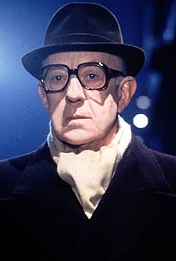
They don`t make them like this any more – they make them differently. Whatever, the 1982 BBC television version of John le Carré’s great spy novel Smiley’s People is a masterclass – in adaptation, script-writing, filming and acting – and in its re-origination for DVD it comes up fresh as paint, no detail or shading lost. The first thing you notice is the extraordinary stillness and quietness of it. It takes you aback, takes ten minutes to get used to, and then enfolds you in total concentration. Contemporary television drama is noisy, loud and ubiquitous and, above all, especially in the thriller department, it caters for those with the attention

‘The family didn’t approve of acting’

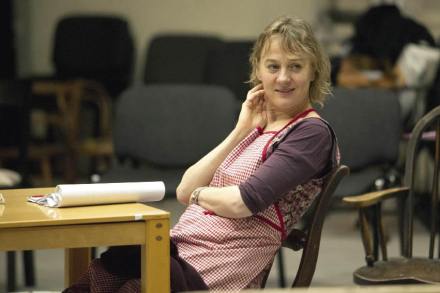
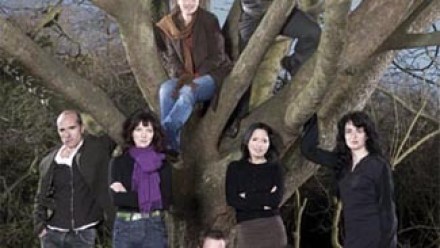
Mary Wakefield meets Niamh Cusack and finds an actress full of contradictions It’s oddly exciting, upstairs at the Old Vic: there are actresses rushing to rehearsal; the burble of PR ladies schmoozing the press; the sense of a curtain about to rise. A bright new play. I smile, look around hopefully for my interviewee-to-be, the actress Niamh Cusack, but instead a handsome bearded chap appears in front of me. ‘Oh, hi there, I’m Finbar Lynch [Niamh’s husband and co-star in Dancing at Lughnasa]. I’ll come back and take proper care of you in a second.’ What’s he talking about? Take care of me, how? I have no idea. I later

Out of proportion

Van Dyck and Britain Tate Britain, until 17 May In the course of my work last week, which included attending the press view of van Dyck at the Tate and visiting a couple of artists’ studios, one in north London and one in Oxfordshire, I found myself thinking about the current state of exhibition catalogues. This train of thought was encouraged by having to carry the van Dyck catalogue around for two days, on and off public transport, along with the more essential items of the itinerant writer’s kit. I say ‘more essential’ because catalogues have become less useful as they’ve grown more unwieldy and overblown. These days they are

Words, not pictures

Fidelio Cadogan Hall Vita Nuova Royal Festival Hall Birtwistle and Benjamin Linbury Studio Fidelio is an opera which, in my recent experience, almost always overwhelms me in a concert performance and almost always leaves me embarrassed or indignant when staged. Embarrassed, because the transvestite necessities of the heroine would almost never convince anyone, as Cherubino or Octavian can, or Handel’s galaxy of emperors sung by mezzos. Indignant, because the naïve assumption of the plot, that there is a Providence which ensures that things will turn out well for those with courage and conviction, is simply false, and that is much more manifest when acted out than when only sung. The

Building blocks

Three Days of Rain Apollo This Isn’t Romance Soho Richly sophisticated and over-contrived. This is the glory and the failing of Richard Greenberg’s Three Days of Rain. But, first, hats off to a writer who expects his audience to be smart, clued-in and intellectually curious. Dimwits, stay in the bar, we’ll join you later. The play opens in a disused office space in 1995 where three young adults who grew up together are tussling over their dead father’s will. Dad ran a hugely successful architectural practice and the plot turns on the ownership of an award-winning, postmodern house, built in the early Sixties, whose innovative design launched the careers of

Banking on greed

The International 15, Nationwide The Class 15, Key Cities The International is a big-budget action-espionage thriller starring Clive Owen as an Interpol agent determined to bring down a nasty bank called IBBC. Aside from doing the usual evil things banks do — like, I assume, having only one person behind the counter during the busiest times — it also runs brisk sidelines in arms trafficking, murder, supporting terrorism and promoting conflicts so as to profit from the debt it creates. (And you wonder why there is only ever one person behind the counter!) The bank’s ultimate aim is to make us all slaves to debt, which is a worry. I

Indelible impression

By happy coincidence, all four of 2009’s major composers’ anniversaries link in a continuous chain, illustrating, directly or obliquely, two centuries of English musical life. By happy coincidence, all four of 2009’s major composers’ anniversaries link in a continuous chain, illustrating, directly or obliquely, two centuries of English musical life. Purcell, born 350 years ago in 1659 and dying at 36 in 1695, overlapped Handel (b.1685) by a decade; at Handel’s death 250 years ago (1759), Joseph Haydn (b.1732) was already a seasoned musician of 27; 1809, the year of his death 200 years ago aged 77, was also the birthyear of Mendelssohn, who, like Purcell, died all-too-young, at 38,

Switch off

It might seem strange for someone who writes about radio to call on all listeners to switch off for half an hour a day. But after hearing the Archbishop of Canterbury and his guests talking about what silence means to them on Radio Three this week I feel compelled to recommend it. After all, the invention of the crystal set and microphone has added a potent new dimension to the endless babble of the world. A hundred years on, there’s scarcely a household in the land without access to a 24/7 stream of artificial sound. I confess I’ve been a hopeless addict all my life, although never so bad that

Shame about the moose

Jeremy Paxman has a dark secret: in real life he’s an absolute kitten. Jeremy Paxman has a dark secret: in real life he’s an absolute kitten. He does continental, gay-enough double-cheek kisses, he doesn’t shout exasperatedly, ‘Come on!’ or pull appalled faces to indicate just how ignorant he finds you, and he has about him a general air of gentleness and kindness you just wouldn’t expect from the horrid interrogational techniques he uses on MPs. Even so, for the first few seconds of his new documentary series The Victorians (BBC1, Sunday), I did worry that he might be pushing his Mister Nice act just a bit too far. He’d put

A Night at the Oscars

Oscar commentary is outsourced to the always-splendid Peter Suderman: The half-calculated, half-panicked seesawing between self-important Art and anxious populism means that the Oscars aren’t really an indicator of quality anymore, but rather an indicator of Oscarness. Oscarness does, admittedly, overlap with quality (see last year’s awards), but it is not the same thing. Undoubtedly, the biggest triumph for Oscarness this year was Sean Penn’s Best Actor win for his portrayal of Harvey Milk. It’s part political statement, part Hollywood politics, and part bias toward the self-important and showy. I thought Milk was a fine film, especially the first hour, and Penn was striking in the lead role, but he never

Revealing the physicist’s soul

Henrietta Bredin talks to the baritone Gerald Finley about how he portrays ‘the destroyer of worlds’ At precisely 5.30 a.m. on Monday 16 July 1945 the world entered the nuclear age. The first atomic bomb exploded in a searing flash of light and a vast mushroom cloud unfurled in the skies above New Mexico. ‘Now I am become Death, the destroyer of worlds,’ thought Robert J. Oppenheimer, the physicist who had masterminded its development. It was typical of the man and the deep contradictions within his nature that these lines from the Bhagavad Gita should have come to mind, and that he should have named the project the Trinity Test

Double the pleasure

Handel Wigmore Hall Die tote Stadt Royal Opera House The Wigmore Hall last Saturday afternoon and evening was a scene of sheer delight, with Handel’s Aci, Galatea e Polifemo being performed before tea, and Acis and Galatea in the evening. It was all masterminded by Paul McCreesh, with his Gabrieli Consort and Players, and a uniformly fine set of soloists, who also constituted the chorus. The Gabrieli Consort, which I unfortunately very rarely have cause to encounter in the pursuit of duty, is a wonderful early-instrument group, characterised by extraordinary sweetness of tone, and by an expressiveness which would be regarded as quaint if it didn’t emerge from the right

Keep on smiling

One of Van Morrison’s umpteen albums is called What’s Wrong with this Picture? It’s a question long-term fans are likely to echo as they contemplate the cover of his new release, Astral Weeks Live at the Hollywood Bowl. One of Van Morrison’s umpteen albums is called What’s Wrong with this Picture? It’s a question long-term fans are likely to echo as they contemplate the cover of his new release, Astral Weeks Live at the Hollywood Bowl. What’s wrong is that Van Morrison is smiling. This is, to say the least, unusual. Morrison is the most famous curmudgeon in popular music and he doesn’t do smiles. He prefers to appear on

Make my day, Clint

Gran Torino 15, Nationwide Gran Torino is a Clint Eastwood film — what, he’s still alive? — and it’s about a grouchy old fella who is hard-core racist but then gets involved with the Asian family next door and, would you believe it, discovers they are quite decent, really. This is probably not a very good film. It is clunky, corny, overblown and so obvious it even features one of those early-on coughs you know isn’t going to pan out as good news. One day, I would like to see a non-meaningful cough in a film; would like to hear a doctor say, ‘The tests are back and it’s nothing,

Tormented talent

When Sarah Kane’s play Blasted was premièred at the tiny upstairs studio in the Royal Court Theatre in London in January 1995, it created such a stir that her name was splashed across the tabloid newspapers. When Sarah Kane’s play Blasted was premièred at the tiny upstairs studio in the Royal Court Theatre in London in January 1995, it created such a stir that her name was splashed across the tabloid newspapers. How could a 23-year-old woman have come up with such an ugly, violent drama in which limbs are lopped off, eyes gouged out and so-called love is turned into a horrifying rape scene? One critic called it ‘a