Arts Reviews

The good, bad and ugly in arts and exhbitions

Creeping changes

Best line of the week on radio by a league was Stuart Maconie’s when he said, talking about the pop group Abba, ‘The girls stuck it out, on stage and in the studio, the words of their ex-husbands’ perfect three-minute psychodramas bursting on their tongues like acid bonbons.’ Maconie was turning over the history of the break-up song, not as you might expect on Radio 2, the old Light Programme, but on heavy-thinking Radio 4, home to news, current affairs and ‘radical economics’. Best line of the week on radio by a league was Stuart Maconie’s when he said, talking about the pop group Abba, ‘The girls stuck it out,

The human factor

Successful programmes often become bloated, and MasterChef (BBC1, Wednesday) is headed that way. They are now increasingly focused on the human interest rather than the food. What a long way it has come from the days of Loyd Grossman, and his catchphrase ‘deliberated, cogitated and digested’ as he contemplated some appalling dish of liver in a gooseberry jus, served with individual mackerel and yam pavlovas. In those days contestants were hoping to prepare a half-decent dinner party; now they want their lives changed. I am sure many lives are changed, though most winners seem to disappear, from our ken, at any rate. But the hype is needed to evince the

Stop the Press

Scramble the last RAF jets, re-commission Concorde, or do whatever else it takes you to get down at supersonic speed to the box office of West London’s Finborough Theatre.Today, the tiny theatre announced that two more matinees have been added to the blink-and-you’ll-miss it run of Emlyn William’s forgotten 1950s gem, Accolade. The production started its run last week and is already almost booked out thanks to the presence in the cast of that recent victim of violent death, Graham Seed, better known as nice-but-dim Nigel Pargitter from The Archers. But, with apologies to my fellow Archers fans, it’s taken something more than a genteel radio soap star to send

Double standards | 13 February 2011

Do Hindus drink cow piss? I know one or two and I’ve never seen them do it, but I suppose it could be the sort of thing they do in private so as to avoid attracting opprobrium. The Channel Four film Dispatches sent an undercover reporter into a Muslim school in Birmingham where it was revealed that the Hindu beverage preference was a part of the curriculum. As well as the usual filth flung in the direction of other kuffars. Kids were regularly beaten too. You can read the story here. Or you can prefer to read the school’s own description of its aspirations, which I took from the school

Never the same | 12 February 2011

There is a saying that art in restaurants is like to food in museums. You know the feeling: the attendant monstrosity on the wall peers over your shoulder, wrecking your appetite. But times are changing. Independent galleries have faded under recent financial strain, and the upward pressure on shop rents continues. Denied their premises, dealers are using new spaces and have reached new markets in the process. This is what brings Thomas Ostenberg’s Equilibrium to the Mint Leaf Lounge, 12 Angel Court, London EC2 (until 27 February). Ostenberg is a former vice-president of Citibank who had a Damascene moment in the Rodin Museum and vowed to become a sculptor. Plenty

Enlightened patronage

Alberto Della Ragione (1892–1973) was a naval engineer from Genoa with a passion for music, poetry and the visual arts; he also had the collecting bug. Alberto Della Ragione (1892–1973) was a naval engineer from Genoa with a passion for music, poetry and the visual arts; he also had the collecting bug. Towards the end of the 1920s, he sold his earlier accumulation of 19th-century paintings and began to acquire modern art, concentrating on works with a figurative bias, but by some of the most adventurous spirits then active in Italy. He became friendly with the second generation Futurists — Fillia, Enrico Prampolini and Fortunato Depero — and bought their

In from the cold | 12 February 2011

Philip Ziegler puts the case for Terence Rattigan, whose centenary is celebrated with numerous revivals of his work After decades in the doldrums, Terence Rattigan seems once more to be returning to popular and critical favour. Last year After the Dance was one of the National Theatre’s more emphatic successes, and the centenary of Rattigan’s birth is being celebrated by productions of his plays at the Old Vic, the Jermyn Street Theatre and in Northampton, West Yorkshire and Chichester. There is to be a Rattigan season at the British Film Institute, and a new screen adaptation of The Deep Blue Sea. Rattigan, it seems, is back. Of course, he never

Deriding Donizetti

Someone should write an opera about a once-great opera company, now in artistically suicidal decline. A few decades ago it had great productions and performances of the masterpieces of the repertoire, but it has been scared by successive governments warning about élitism, the need for attracting new, young, opera-hating audiences, and so on. So it has hired a succession of ‘directors’ (adopting the language of cinema), who have never seen an opera, to stage established works and mount new ones, making them look as much as possible like the eternally running musicals it eyes enviously. It makes sure to invite for first nights a large number of media people, who

Educating Rachel

The teeny-weeny Bush Theatre is grappling with the monster of the free schools debate. In Little Platoons by Steve Waters the issues are laid out rather simplistically, naively even, which is perhaps just as well with undereducated dimwits from London comps, like me, in the audience. The pivotal character is a disaffected music teacher, Rachel, who rabidly opposes the free school movement until she’s offered the headship of a zingy new academy whereupon, hey presto, her scepticism morphs into passionate support. Waters claims to be moderating the discussion as a disinterested umpire but his impartiality is, shall we say, only partial. He represents the pro-comp camp through the figure of

Still life | 12 February 2011

I didn’t go and see the Coen brothers’ remake of True Grit this week because I couldn’t get excited about it and don’t like westerns anyhow. I didn’t go and see the Coen brothers’ remake of True Grit this week because I couldn’t get excited about it and don’t like westerns anyhow. I don’t think women do, generally. They are too masculine; they are like those competitions to see who can urinate farthest up a wall, but with spurs, guns, a broken lawman who rallies honourably at the end, and tumbleweed rolling by. It’s just not our thing. Women could never, for example, have made High Noon. Instead, we would

Subtle approach

Those who believe that ballet today is often no more than a grotesque physical display ought to have seen American Ballet Theatre’s performance of Jardin aux Lilas last week. Those who believe that ballet today is often no more than a grotesque physical display ought to have seen American Ballet Theatre’s performance of Jardin aux Lilas last week. Antony Tudor’s economical, though demanding choreography does not allow any melodramatic explosion of technical bravura. It is a text made of subtly conceived shadings — in which stillness, basic steps and long-held poses speak louder than jumps, triple turns or supported acrobatics. Gestures, though frequently small and contained, play a significant role,

Grandfather’s footsteps

In the good old days, when Hackney still had a proper swimming pool, I used to do lengths every morning with an old boy called Bob. And, because I recognised him as a man of a particular generation, I used to prod him in the changing room afterwards to tell me his war stories. But Bob only ever told me one and it was rather depressing. He’d served in Palestine and one day his convoy had been ambushed by Irgun or Stern gang terrorists. Among those terrorists he and his fellow soldiers had shot while defending themselves was a young pregnant woman. ‘They called us the Baby Killers, after that.’

Getting the Arts into Shape

From 18th Century Shakespearian pretenders to the new establishment, if you find yourself looking for an artistic respite from sports overload at the Olympic Games, there will be few more exciting places to be in 2012 than Shakespeare’s Globe. In the spirit of Olympic internationalism, the Globe will be inviting 38 different companies from around the world to perform the complete plays of Shakespeare in their own languages (it seems they don’t count Double Falsehood either). For all that I’ve complained about the odd misstep, the Globe, with its inspirational research department, remains one of the greatest sources of theatrical energy in Europe. This latest project will only affirm that

Introducing DJ Naughtie and MC Filth. Represent.

Great news  – Radio Four is to employ a bunch of young black working class presenters, to replace all those old middle class white ones. Or at least I assume it is. The BBC Trust has decided that Radio Four is not adequately representing the population as a whole; it is too elderly, and too all that other stuff I mentioned. I think that the BBC Trust, like many middle class people, is guilty of synonymising “intelligence” and “middle class”. They hear someone using long words and immediately think they’re middle class. But John Humphrys isn’t from a middle class background, nor Roger McGough. But perhaps they are right, the

Why I love Westerns

We ran a version of this post by Samira Ahmed, the newsreader and reporter for Channel 4, on a previous incarnation of this blog. But with the Coen Brothers’ take on True Grit out next week, Samira has updated and extended it for us now. You can follow Samira on Twitter. here A long time ago, when all the grandfathers and grandmothers of today were little boys and little girls or very small babies, or perhaps not even born,” the Wild West was still – just about – in living memory. And a little British Asian girl growing up in 70s suburbia could read the opening lines to Laura Ingalls

‘I want to be a vagabond’

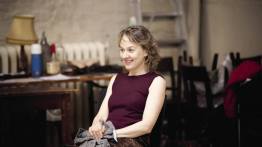
Lloyd Evans talks to Sophie Thompson, whose lack of vanity defines her approach to acting Straight off, as soon as I meet Sophie Thompson, I can see the look she’s striving for. Elegant ragamuffin. Torn jeans, scruffy trainers and a charity-shop blouse all offset by some peachy designer accessory worth five grand. Then I realise there’s no peachy accessory. She’s just pulled on her gardening gear and left it at that. And not a trace of make-up either which, for a woman over 45 — even though she looks ten years younger — is either reckless or bold. Or perhaps just genuinely modest. Thompson is starring in the social satire

There is no alternative

Stand-up comedians: is there anything they can’t do? Not only do they make up a huge proportion of chat-show guests — and of chat-show hosts — they also present Horizon, give us guides to the night sky, utterly dominate panel shows and regularly pop up on Question Time. Recently, they even set up their own news discussion programme in the as yet formless shape of Ten O’Clock Live. And that’s just television. In the lead-up to Christmas, Dawn French saw off Stephen King, John Grisham and Maeve Binchy to have the country’s bestselling hardback novel, while the fastest selling DVD in British history is Michael McIntyre’s ‘Hello Wembley!’, whose title

Wedding belles

The pedants who say fly-on-the-wall documentaries are cheap, meaningless television could not be more wrong. They are the postmodernist answer to David Attenborough, the Life on Earth de nos jours. Anyone who doubts this should watch My Big Fat Gypsy Wedding on Channel 4 (Tuesdays, 9 p.m. and, if missed, on 4oD). Not since meerkats exploded on to our screens have television cameras transported us into such a rare and fascinating habitat. Those uptight commentators whingeing about the antics of the gypsies entirely miss the point. Does one watch Attenborough and afterwards complain that ‘this daft meerkat fell asleep on its feet and toppled over’? No. Personally, I felt utterly

Look and learn

Bridget Riley turns 80 this year, a fact easy to forget when looking at the surging energy and contemporaneity of her pictures. She is a remarkable artist who, although imposing severe formal restraints on her work, manages continually to surprise us with the richness of her invention. Perhaps it is because of the self-limitations she endures that her imagination is compelled to delve so deeply in the narrow field she has made her own. And its very modernity is an aspect of the way her vision is directly and inspirationally linked to the art of the past. The free display in the Sunley Room at the NG, sponsored by Bloomberg,