Arts Reviews

The good, bad and ugly in arts and exhbitions

Had Hollywood not lured him away, Dennis Hopper could have made his name as a photographer

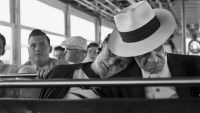
In an age when photographs have swollen out of all proportion to their significance, and are mounted on wall-sized light boxes the better to show off their high-resolution colour, it’s a relief to see an exhibition of small photographic prints in good old black and white. Dennis Hopper (1936–2010) is best known as an actor and hell-raiser, but he was also an artist who worked in various media. ‘I am an Abstract Expressionist and an Action Painter by nature,’ he insisted, but in the Sixties he took thousands of photographs, a group of 400 of which are now on display in the Academy’s Burlington Gardens galleries. Because they are relatively


Gilbert and George have lost their bottom over the burka

Let’s brood, shall we, on the following report in the Evening Standard about an exciting new departure by the winsome duo, Gilbert and George, on the back of their new exhibition, called ‘Scapegoating Pictures’ for London which opens tomorrow at the Bermondsey White Cube Gallery: ‘The artists Gilbert and George feature women in burkas in their new exhibition reflecting the changing face of the East End, their home for decades.  The veiled figures feature in giant photomontages demonstrating the artists’ long-standing hostility to all religions which they believe “terrorise” people.  They appear alongside images of the artists themselves and a string of typically foul-mouthed slogans urging “molest a mullah” and

A celebration of Scottish artistic success over the past 25 years

Since spring this year, art venues across Scotland have been dedicating themselves to a gigantic project called Generation. Involving more than 100 artists and 60 venues, the programme is a celebration of Scottish artistic success over the past 25 years, a multifaceted retrospective that recreates lauded exhibitions of yore and puts together new ones by old faces. The scale and ambition are impressive. There are fine artists involved and a clutch of Turner champions, too. But this is an event that demonstrates there’s more to Scottish art than the ‘Glasgow Miracle’ and lays out its case all across the country. Generation coincides with the Commonwealth Games in a kind of

The two men who walked barefoot to the capitals of the four nuclear powers on a peace pilgrimage

You might (if you’re over a certain age) still think it pretty amazing that TV not only allows you to watch Mario Götze put in that amazing goal, live, as it happened, in Rio de Janeiro’s Estádio Maracanã, but also that you can witness so immediately and tangibly the passion, the drama of that moment — you on your sofa in twilit Surrey, Somerset or deepest Sutherland watching those emotions fleeting across the individual faces of traumatised Argentinians as they come to terms with bitter defeat. The impact of that extraordinary connection across the continents is nothing, though, when compared to the intimacy and immediacy of radio; the way a

How did a New York nanny become one of the great photographers of the 20th century?

Finding Vivian Maier is a documentary about the American nanny who led a wholly secretive life as a photographer and who, posthumously, has been described as ‘one of the greatest photographers of the 20th century’. It’s a good story, which is well told here, and told breezily (83 minutes), which we like. But I’m not convinced the quote from Michael Moore on the poster — ‘Amazing…this should be seen with other people, in the dark, on a big screen’ — is necessarily true. Ms Maier has already been the subject of Alan Yentob’s Imagine strand on the BBC, and this film could just as happily be viewed on TV as

Richard Bean doesn’t believe in humans – just weasels, snakes, rats and vultures

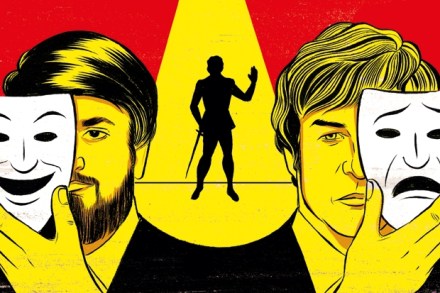
Mr Bean, one of our greatest comic exports, has an alter ego. The second Mr Bean, forename Richard, is the author of One Man, Two Guvnors, which thrilled audiences on both sides of the Atlantic. His latest play, Great Britain, dissects the corruption of power in parliament and beyond. The inevitable comparisons with The Duck House, which mocked the expenses scandal, are a little unfair, since the temperament and the intention of the two shows are vastly different. The Duck House was a delicious slice of theatrical levity about a Home Counties couple drawn into criminality by the culture of parliament. And being a family comedy, it had reserves of

‘Artmaking is a drug’ – interview with poet Paul Muldoon

A fellow festival-goer at the recent Calabash literary festival in Treasure Beach, Jamaica, enjoyed chatting to a gentle Irish poet called Paul. He told her he ‘dabbled’ in poetry, and she was seconds from asking if he was planning on reading any of his work at the open-mike session. When Paul Muldoon, the poet in question, came to give his reading, it was soon quite clear that he is, in fact, a famous poet. He opened with ‘Comeback’, a poem about a washed-up rock band for ever on the brink of their next great hit: ‘We’d pay in cash/For a kilo of Khartoum/And come back to trash/Another hotel room/And make

Buxton Festival sticks its neck out with two rarities by Dvorak and Gluck

Dvorak’s The Jacobin and Gluck’s Orfeo ed Euridice, the two operas that opened this year’s Buxton Festival, are both relative rarities today, but their creators’ fortunes tell an interesting story. Dvorak’s operas — or at least Rusalka — joined the repertoire around the same time, during the 1980s, that Gluck’s arguably starting slipping from the stage, to the extent that now means the UK’s main companies are all but ignoring the composer’s 300th anniversary this year. Both works, in their different ways, also explore the power of music. Orpheus is the archetypal musician in art, whose power as singer enabled him to bring back Eurydice from death — temporarily in

Indiscretions from two veteran producers

Stars, playwrights and even set designers are constantly being lionised in the papers. But why not producers? They, after all, are the ones who choose the plays, the stars, and then make it all happen. Duncan Weldon and Paul Elliott are two veteran cigar chompers who’ve been in the business for 45 years. They’ve made and lost a packet, over and over again. They never seem to learn. Like all producers, they love their wives almost as much as they love a hit. Over lunch in the West End, I discussed the knack of being and staying a producer. Great exponents such as Cameron Mackintosh and Bill Kenwright have always

Painted, sculpted and stuffed: a history of the bird in art

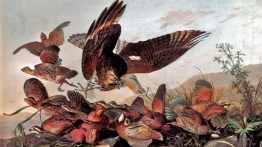
These days, as the sparrows and starlings so common in my youth are growing scarce, there’s less need for a rarity like the osprey or butcher bird (the red-backed shrike) to raise awareness of the plight of birds, and with Radio 4’s Tweet of the Day you might say that birds are in (or on) the air — but then they would be. The flightless varieties, such as the dodo, have always been in greater danger, unless they could run very fast. Birds are synonymous with flight, and as such are a potent symbol and embodiment of many of humanity’s hopes and dreams. They connote both the human and the

A miracle: a three-hour film that flies by

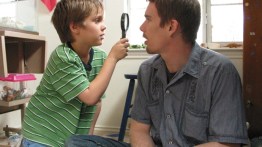
Richard Linklater’s observational chronicle, Boyhood, was 12 years in the making and is 166 minutes long — that’s nearly three hours, in real money — and I wasn’t bored for a single moment. Isn’t that miraculous? Have you ever heard the like? Me, who is generally bored at the drop of a hat? Me, who is generally bored before the hat even hits the ground? But those 166 minutes (still nearly three hours, in real money) just flew by, as can happen, when you are utterly engrossed. Who knew? This is the story of a family, as told through the eyes of a boy, Mason (Ellar Coltrane), who ages from

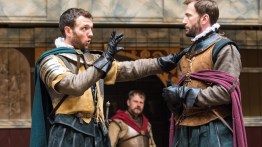
The sweating, dust-glazed saints at the Hampstead Theatre tells us nothing new about the miners’ strike

Hampstead’s new play about the 1984 miners’ strike was nearly defeated by technical glitches. Centre stage in Ed Hall’s production there’s a clanking great iron chute that stubbornly refused to go up and down when ordered. A bit like the miners. The writer, Beth Steel, is a collier’s daughter and she romanticises the pit workers to the point where they seem like an exotic species of humming bird. Brave, high-minded and selfless, these noble sons of toil go marching off to the pithead every day to hack and burrow their way through the depths of hell. Into the elevator they trudge, their shovels resting on their shoulders, their voices uplifted

The next new presenter of Woman’s Hour should be a man

It seems incredible now but when the BBC’s youth station, Radio 1, was launched in 1967 there were no female presenters. That’s right. Not a single woman’s voice to leaven the mix of Fluff, Blackburn and co. One-half of the young people the Corporation was hoping would stay tuned beyond Listen with Mother and Children’s Hour were burning their bras and demanding the pill. Yet the world presented to them by Auntie was strictly male-only. It took three years before Annie Nightingale was allowed behind the mike, and several more before she had company. Lessons had been learnt by the time Radio 5 Live was launched 27 years later, and

Ryedale Festival: a beacon of survival without subsidy

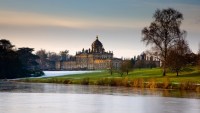
There are festivals of everything, everywhere. So why get excited about the Ryedale Festival (11–27 July) apart from the fact that it happens on my Yorkshire home ground — and I used to be its chairman? Every summer music festival proclaims the richness and variety of its menu. Ryedale, under the artistic directorship of Christopher Glynn, competes with the best, from its opening Monteverdi Vespers in Ampleforth Abbey to its Royal Northern Sinfonia finale at Hovingham Hall. But what’s really special about this one is the opportunity to pass an extended fortnight tootling across what I truly believe is England’s loveliest landscape, picnicking en route. The itinerary takes in Lastingham

Royal Opera’s Maria Stuarda: pathos and nobility from Joyce DiDonato, lazy nonsense from the directors

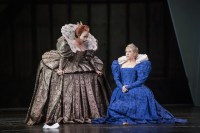
London is lucky to have heard Joyce DiDonato at the height of her powers in two consecutive seasons. The American mezzo has arguably done less well out of the arrangement, however, finding herself at the centre of two disappointing new productions. Last year it was Rossini’s La Donna del Lago, an intractable non-drama which John Fulljames’s staging (sponsored by Harris Tweed) turned into an unconvincing treatise on constructions of Scottish nationalism. This season it’s Donizetti’s Maria Stuarda — similarly, if even more obliquely, concerned with Anglo–Scottish relations. Based more on Schiller than on actual history, it might have plenty of bel canto padding, but it presents a director with much

Perfect dancing but boringly beautiful

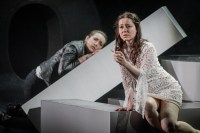
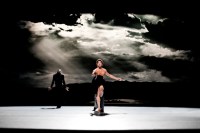
Aesthetically speaking, last week’s performance by the Nederlands Dans Theater 1 was one by the slickest of the season. Fashionably engineered juxtapositions of black and white, sets that stun on account of their elegant simplicity and mechanical complexity, chic costumes that de-gender dancers, scores decadently à la mode and clockwork dancing came together seamlessly to make a powerful visual impact. Beauty can be boring, though. Created by Paul Lightfoot and Sol León, who are the driving force behind Nederlands Dans Theater 1, Sehnsucht (‘longing’) and Schmetterling (‘butterfly’) came across as perfectly structured concoctions of derivative formulae, though they lacked any spark. In the former, a would-like-to-be languorous duet took place

Isn’t it time we asked the National Theatre to support itself?

[audioplayer src=”http://traffic.libsyn.com/spectator/TheViewFrom22_10_July_2014_v4.mp3″ title=”Lloyd Evans and Kate Maltby discuss the National Theatre’s funding” startat=1261] Listen [/audioplayer]Two glorious playhouses grace the south bank of the Thames. Shakespeare’s Globe and the National Theatre stage the finest shows available anywhere in the world. Both are kept in business by the play-going public who last year helped the Globe to turn over £21 million, with a surplus of £3.7 million. Audiences also flocked in record numbers to the NT and it notched up nearly 1.5 million paid attendances, with its three houses playing to over 90 per cent capacity. But there’s a massive difference between the two. The Globe is funded by customers who spend

My Grandmother Said

It was the First World War. Her husband was away. So she knew fear, but also found new freedom in the day. On Thursdays, with the farmer’s wife, old basket in her lap, by butter slabs, she rode to Brigg, shawled, in the pony trap. Oh how I envied her! I whined to Brigg by bus, for school, no pony’s dancing knees, first sun in elder bush. She would have crossed the Ancholme, seen the canal glint wide. She could buy apples and white thread, jog home, to new moon’s rise. ‘But I was frozen, to my bones, all winter.’ Was that all? My grandfather took up the reins. She