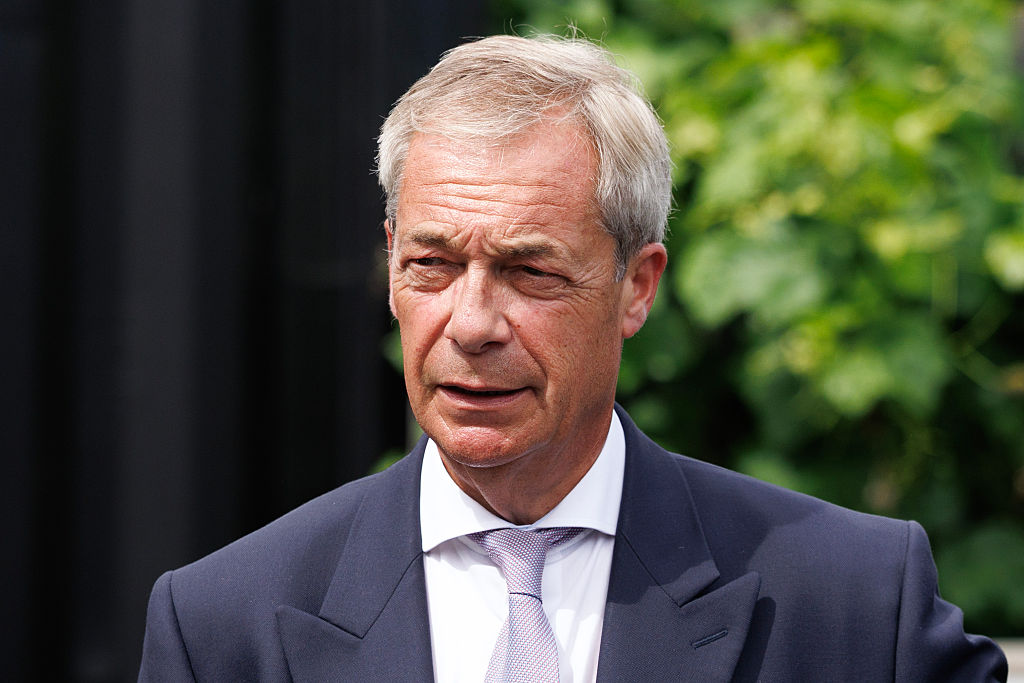
There will always be a certain class of people who sigh that Nigel Farage only reaps what he sows. Ever since milkshakes starting being tossed at a man they regard as an incendiary rabble-rouser, they have argued that it’s his fault for having raised the volume and coarsened the tone of political discourse in this country in the first place. In other circumstances this would be called ‘victim-blaming’: he shouldn’t have behaved so provocatively. He was asking for it.
We have for so long derided the puritanical left for their hyper-sensitivity to language, that we forget how this thin-skinned, intolerant mentality has long been embedded in the mainstream
In a week in which it was revealed that the Reform leader has received 1,577 threats since February, including 597 death threats, the victim-blamers have been out in force again. Two letters in the Times on Wednesday repeated the thrust of the argument. ‘There can be little doubt that Nigel Farage has thrived by being provocative and confrontational,’ one began. ‘Would it not be better if he toned down his approach to the level of normal political discourse?’ Another, agreeing, added: ‘it is incumbent on all of us to moderate our language’.
In a more nuanced, specifically in regard to Reform’s party chairman Zia Yusuf, Hugo Rifkind, in his column for the same newspaper, reiterated that it’s ‘pretty damn obvious that the more violent and condemnatory our discourse, the more likely it becomes that various maniacs will find focus for their mania.’
We have for so long derided the puritanical left for their hyper-sensitivity to language, their conviction that nasty words cause violence, that we forget how this thin-skinned, intolerant mentality has long been embedded in the mainstream.
Few will have failed to notice how censorious our political climate has become in recent decades, especially under this Labour government. How people with dissenting or unpleasant views have been cancelled, censored or jailed. While Keir Starmer would have us believe that his tenure has been a success, for great swathes of the country his brief time in office will be remembered for the two-tier justice, police door-stopping members of the public for non-crime hate incidents, attempts to criminalise those who criticise Islam, moves to gag the press and muzzle social media, and the jailing of Lucy Connolly.
The reason why Nigel Farage and Reform UK have emerged to command such support in recent years – in many cases in spite of Farage, not because of him – is because the public have had enough of the politics of cancelling, censorship, evasion and lies.
People are fed up with being told what they can and can’t say, and of seeing what happens to those who do say the wrong thing. Lucy Connolly is no martyr, but the excessive punishment meted out to her in the wake of the summer riots of 2024 was significant. This woman was given an inordinately long sentence for her online comments, while those who commit or threaten violence seem to get lesser punishments. That was seen as regime justice.
Secondly, people are fed up with the politically-motivated deceitfulness of those in authority, a trend exemplified by the conduct of Devon and Cornwall police this week, who broke customary procedure in the wake of Ann Widdecombe’s murder in their desperation to say that the crime was not political. That kind of shiftiness was even more apparent in the wake of the Southport murders, when the authorities did everything they could to ensure the ethnic background of the perpetrator remained hidden from public knowledge.
That deceit also reflected a third source resentment when it comes to free speech. People are fed up with an unwillingness to speak the truth openly and honestly about the problems in our country, especially on taboo matters concerning Islam and immigration. The cowardice and slipperiness after Southport mirrored the same problem that the unveiling of the grooming-gangs scandal made clear: there are those in authority who won’t address or speak about an issue if they think they might be tarnished as racist.
As for the ‘maniacs’ in our society today? A pervasive and insidious mood of ultra-left-wing self-righteousness has spawned a generation of cult-like fanatics and belligerent ideologues who have no problem with violence, and no compunction at killing people they genuinely believe to be evil. They, like Charlie Kirk’s killer, are those who were reared in a culture of safe spaces, shielded from criticism, and forever had their opinions validated. Molly-coddled, spoilt children always lash out when they don’t get their own way.
The irony now is that if people who governed this country had been more open and honest about delicate matters, if they hadn’t been so eager to cancel or incarcerate, if they hadn’t been unwilling to address the fact that people don’t like untrammelled immigration and think multiculturalism has failed, Nigel Farage would never have emerged to prominence to begin with.



Comments