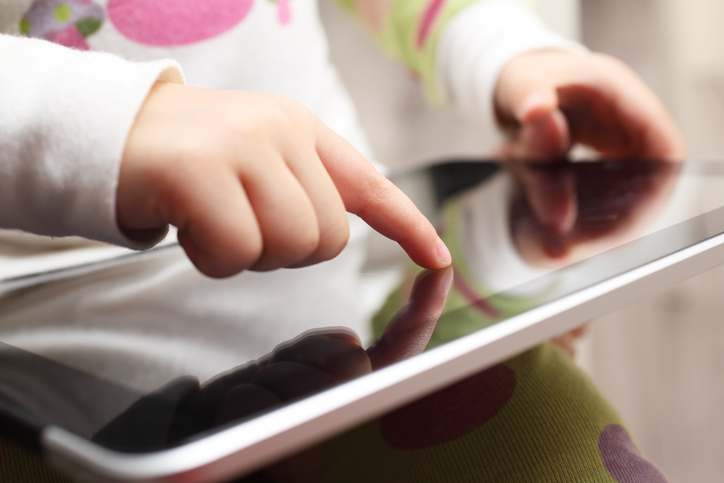
As a parent of an 18-month-old, the glorious weather last weekend could mean only one thing: a tour of the various playgrounds on offer in Oxford. Amidst the joyful scenes of children digging in sandpits, rocketing down slides and queueing to buy ice creams, there was one particularly depressing image that summed up this strange, screen-obsessed world we live in. On the swings was a child, around 3 or 4-years-old, silently swaying back and forth, eyes glued to an iPad mere inches from his face. He was completely oblivious to the fun, laughter and play going on around him, and his mum? She was on her phone too, of course.
This eerie, almost dystopian image of a toddler fixated on a screen, outside on the sunniest day of the year, may seem like an extraordinary exception. Yet the truth is that from the moment they are born, children go from being umbilically tethered to their mothers to invisibly tied to the technology around them. For some children the screen-time shackles are more obvious than others.
Ideally, we need sustained investment in public service children’s programming
How do we tackle this problem? We need widespread social change so that handing your two-year-old an iPad becomes as taboo as smoking in pregnancy – yet this is unlikely to happen when parents are addicted themselves. The government now advises no screen time for under 2s and then to limit this to one hour a day for under 5s. It is well-intentioned guidance, but not particularly helpful when it is so out of touch with reality. New research suggests that more than two-thirds of babies under two use screens, with some exposed for up to eight hours a day.

A key issue with the government guidance is that for the vast majority of parents, these suggestions are unachievable, and so many parents will assume that they shouldn’t try at all. And after all, why should parents bother when screens are then handed out on a silver platter in schools and childcare settings? For example, the Reception Baseline Assessment – a screen-based test which all children must take within their first weeks of primary school – contradicts every piece of advice the government is now giving to parents.
Unless parents feel particularly pious about screen time, or are exceptionally self-disciplined, or have an incredible amount of support, they will inevitably end up using screens – whether that’s in more ‘acceptable’ contexts, such as 20 minutes whilst they put dinner on, or less necessary ones, like walking their child in the pram. Both ‘fail’ according to the new government guidance.
The reality of looking after a child, particularly when both parents are working and don’t have an immediate village nearby, can be really difficult, particularly in winter. Before I had a child, my husband and I smugly assumed that we would resist the temptations of television. (We also naively assumed that we would not rely on a dummy, or a white noise machine, or any other sleep crutch, only for my husband to humbly cycle to John Lewis at 7 a.m. on day three for opening time, desperate to buy whatever may help send our son to sleep).
We have similarly had to adjust our expectations around screen time, and the most sensible way to do this is to realise that not all screen time is created equal. An hour of watching old-fashioned, low-stimulation shows like Postman Pat or Pingu on a TV is not the same as an hour of playing brightly-coloured games on an iPad. An hour of watching adaptations of a Julia Donaldson book as a family – and then reading that book together – is not the same as an hour of Cocomelon (the children’s TV equivalent of crack cocaine) alone, watching with headphones in.
This is where the government’s guidance fails. It fails to give any sense of nuance: that watching an old Disney film, with a clear narrative and story structure, and requiring 90 minutes of concentration that most phone-checking adults couldn’t sustain, is better than the frenetic, fast-paced, neon-coloured slop that makes up most modern shows. It fails to emphasise that TV is superior to a tablet in every way: it can be a communal activity; it can be switched off; it can be limited to a physical place – crucially, it can’t be watched on a swing outside in the sunshine.
If the government is serious about limiting the harms associated with screen use in young children, it must take a more holistic approach. This means regulating screen time in educational settings as well as the home, but also giving parents an option for how to best use screen time – and by this I really mean TV-time – in moderation. Ideally, we need sustained investment in public service children’s programming: creating high-quality, developmentally appropriate content that is not just designed to capture attention but sustain learning. We need to direct parents away from commercial platforms with their manipulative, addictive designs and offer them slower, better alternatives.





Comments