
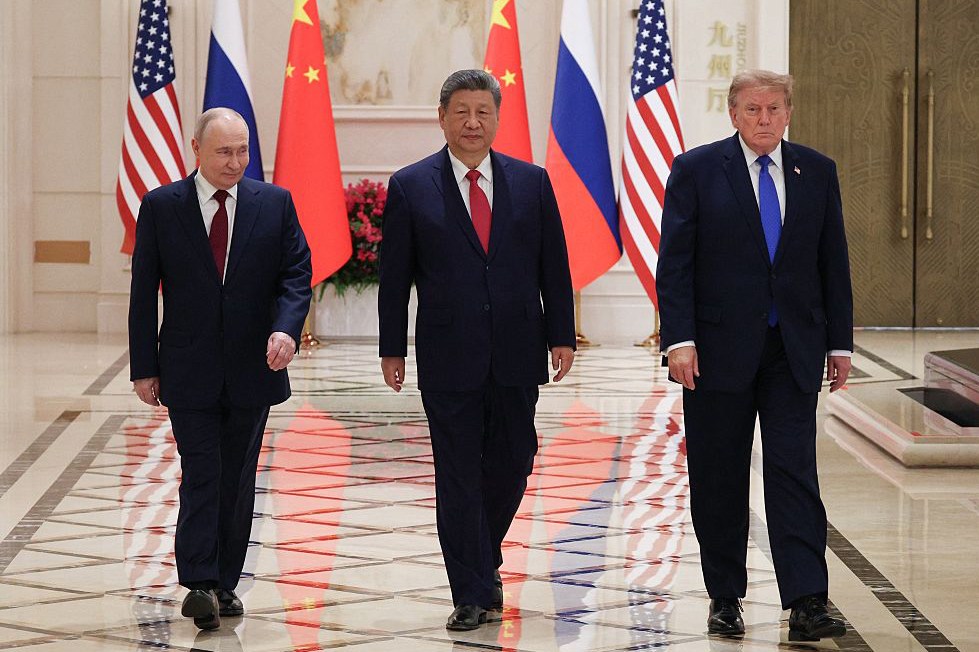
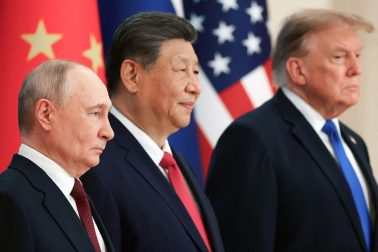
Vladimir Putin did not get to carve up the world at today’s historic summit in Shenzhen with Donald Trump and Xi Jinping. But he got the next best thing, which was a photo opportunity. Plus, warm words of friendship from Donald Trump. And from the Chinese side, the validation that Xi still values the two inheritances of Cold War superpower status that Russia has hung on to – a large nuclear arsenal and a permanent seat at the UN’s Security Council.
Best of all for Putin – and most shocking to Trump’s critics – was the moment when Trump called Putin “my friend” and promised that they would do “a lot of wonderful things” together. For many Democrats, European leaders and Ukrainians, the sight of Trump being overtly friendly to an autocrat who is engaged in a war of annihilation against his neighbor was distasteful in the extreme.
The 90-minute summit meeting itself was little more than an exchange of diplomatic platitudes
“What is unprecedented is that a United States president – a position that used to be associated with the leader of the free world – is calling two autocrats, Putin and Xi, his best friends,” wrote Michael McFaul, Barack Obama’s senior Russia advisor and former US Ambassador to Moscow.
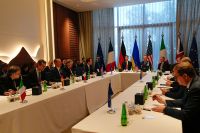
The 90-minute summit meeting itself was little more than an exchange of diplomatic platitudes. The three men sat around a vast, Covid-sized round table that would easily have fitted 40 and read prepared remarks into microphones. Shenzhen was summit as political kabuki theater – the opposite, in fact, of the 1945 Yalta summit to which it has been compared, where Stalin, Roosevelt and Churchill engaged in days of intense, private horse-trading late into the night. The final joint communique was full of high sentiment but short on action. In parts, it played to Putin’s strengths. During the talks Putin had argued that the permanent five members of the UN Security Council were responsible for “preserving and strengthening the system of international law” – and sure enough, strengthening the UN was the summit’s stop resolution. But on nukes the communique contained a sharp, if veiled, warning to Russia. Xi Jinping called for a complete ban on nuclear weapons and stressed that a nuclear war cannot be won and must never be fought – a rebuke to Putin’s frequent threatening references to his own nuclear arsenal.
No matter. The important thing for Putin was to be in the room and in the photos. Symbolism is an crucial part of projecting power, and Putin’s meeting will allow him to continue to pretend to his own people that he is a world-historical leader who is the equal of the world’s two most powerful men. No matter that Russia’s economy is in fact smaller than Britain’s. Or that Putin’s pointless war on Ukraine has killed, according to the Russian government’s own statistics published after a recent hack, 450,000 Russians, or close to 1 percent of the country’s military-aged men. Or that on the very eve of the summit Ukrainian missiles destroyed the road-bearing of the Kerch bridge linking Russia to occupied Crimea – and during the summit another attack also knocked out the rail-bearing side too.
The Chinese had been wary of a three-way meeting and confirmed it only on Monday. In part that could have been because the status-conscious Chinese wanted to avoid giving the impression of parity between Xi and Putin. In part it could also have been a justified nervousness about Trump’s tendency to say outrageous things and make outlandish claims. In this regard, Trump did not disappoint. Asked if he was going to ask the Chinese to curtail spying on the US, Trump cheerfully riposted that the US did plenty of spying on China too. “I cant tell you what they tell me,” Trump said, grinning. “But I know everything.”
Xi, the host and choreographer of the diplomatic dance, was at pains to demonstrate Putin’s junior status in small but telling ways. Xi personally met Trump at the airport; Putin was greeted by a mere chief of staff (while Japan’s Prime Minister Sanae Takaichi was, insultingly, met by nobody at all). At the official welcoming dinner Trump was seated at Xi’s right hand, while Putin was relegated to a more humble seat on the other side of the table. Xi took every opportunity to turn to and talk to Trump, never to Putin.
One thing the Big Two plus one did not discuss was Ukraine. Whether one Donbas town or another was Moscow’s or Kyiv’s was judged beneath Xi and Trump’s pay-grade – and besides, Xi has earlier made it clear to Germany’s visiting President that Ukraine was a European security problem that must be resolved by Europeans.
Unsurprisingly the tripartite summit had been Putin’s idea, floated to Trump a month ago, because Putin has the most the prove and the most to gain. Instead of proving Russia’s status as a major world power, Putin’s catastrophically bloody and economically ruinous war against Ukraine has ended up proving the opposite. All Moscow’s missiles and men cannot defeat or control even a small regional neighbor. Russia’s nuclear arsenal and its UN seat – both inherited from the USSR – are Putin’s sole remaining claims to sit at the big table. At Shenzhen, Putin had his proud moment in the sun, and his relationship with Trump has doubtless been boosted. But none of that helps Putin to crush Ukraine, or shore up his economy, or recruit men to replace the thousands he is losing every week.


Comments