Why do we raise monuments? Why do we tear them down? These questions hover over MONUMENTS, now on view at Los Angeles’s Museum of Contemporary Art and the Brick. The premise is straightforward enough: gather the remains of America’s shattered sculptural conscience – decommissioned Confederate statues and their graffiti-marred plinths – and display them alongside contemporary works on racial topics. This comparison is supposed to reveal something about America’s nature and history, and it certainly does: it shows us just how attached we are to grievance. Both the raising and the destruction of monuments nourishes convictions on either side, ensuring that the argument can never end.
Readers will remember the push in the late 2010s to remove the South’s monuments to Confederate soldiers. It accelerated in 2020 amid the George Floyd protests, and, according to the LA MOCA, some 200 monuments were decommissioned. The justifications ranged from civic repentance to the hope of depriving the right of its more ornamental rallying points. Plenty of ink was spilled arguing against their removal. The irony is that both positions come from the same place.
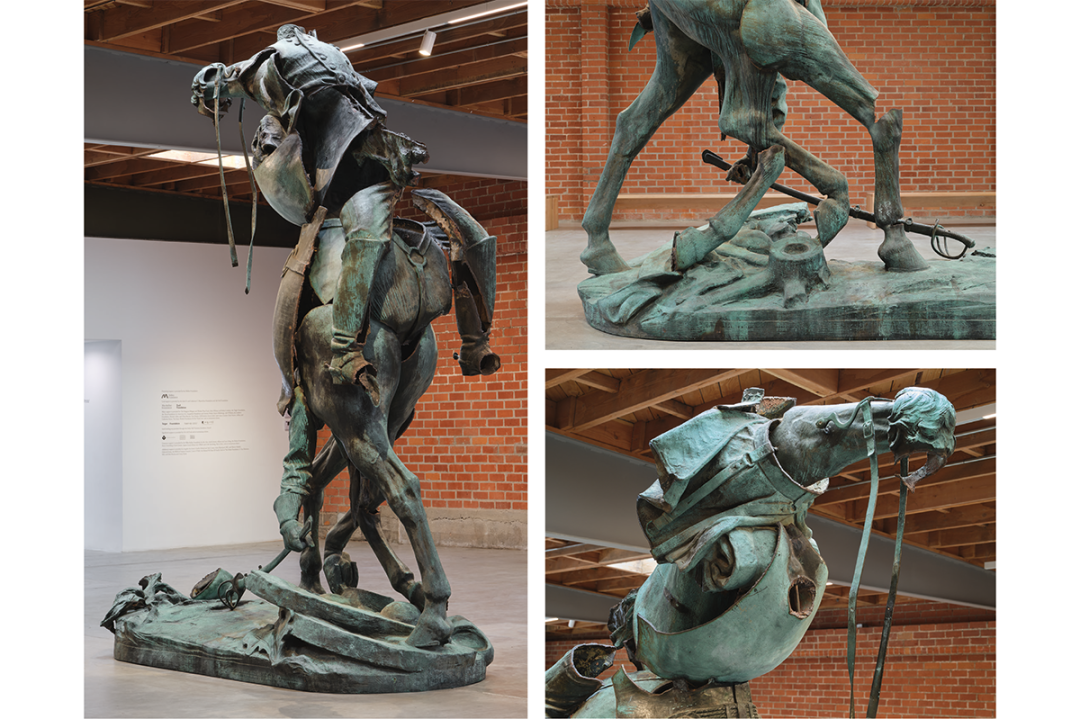
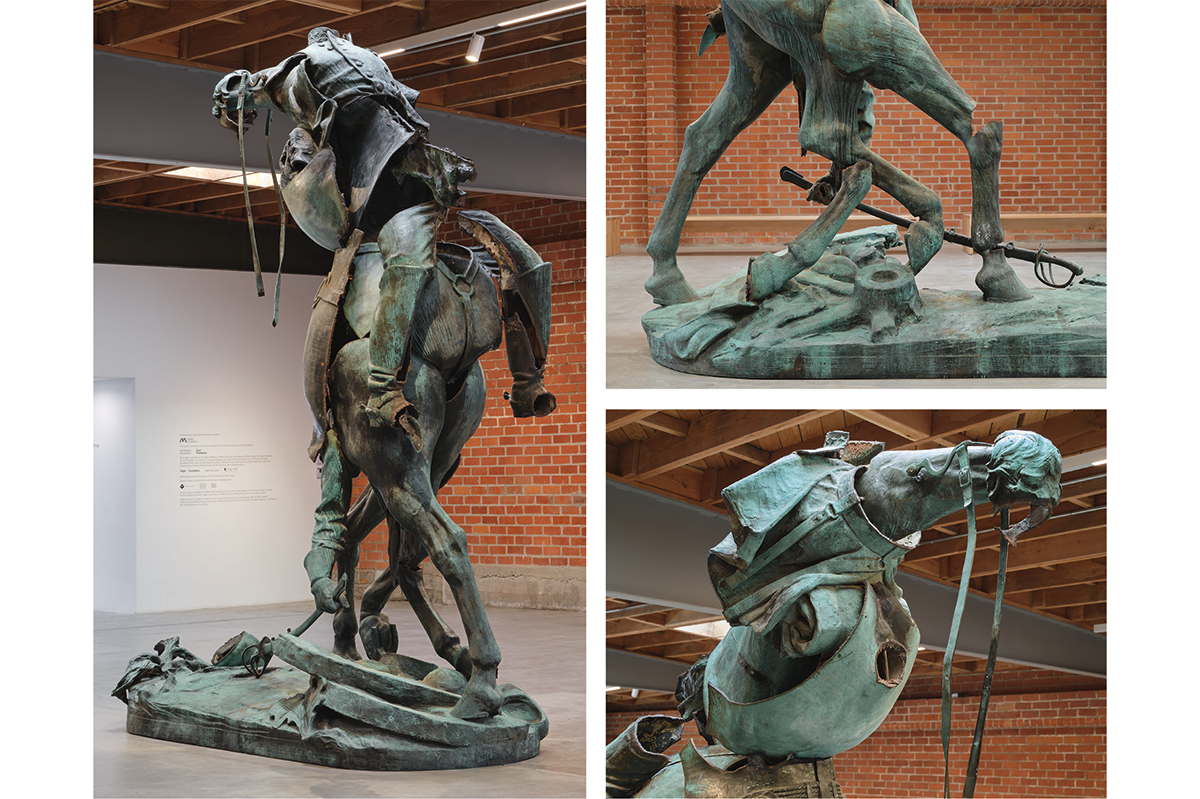
Consider Charlottesville’s Jackson Park, once anchored by Charles Keck’s statue of Thomas Jonathan “Stonewall” Jackson (1921) atop his horse. During the first Trump administration, the monument was vandalized with graffiti – protesters spray-painted “1619” on it, a reference to the year the first African slave ship arrived in the Americas – and it was eventually removed in the wake of the George Floyd protests. The bronze was then transferred to the Brick.
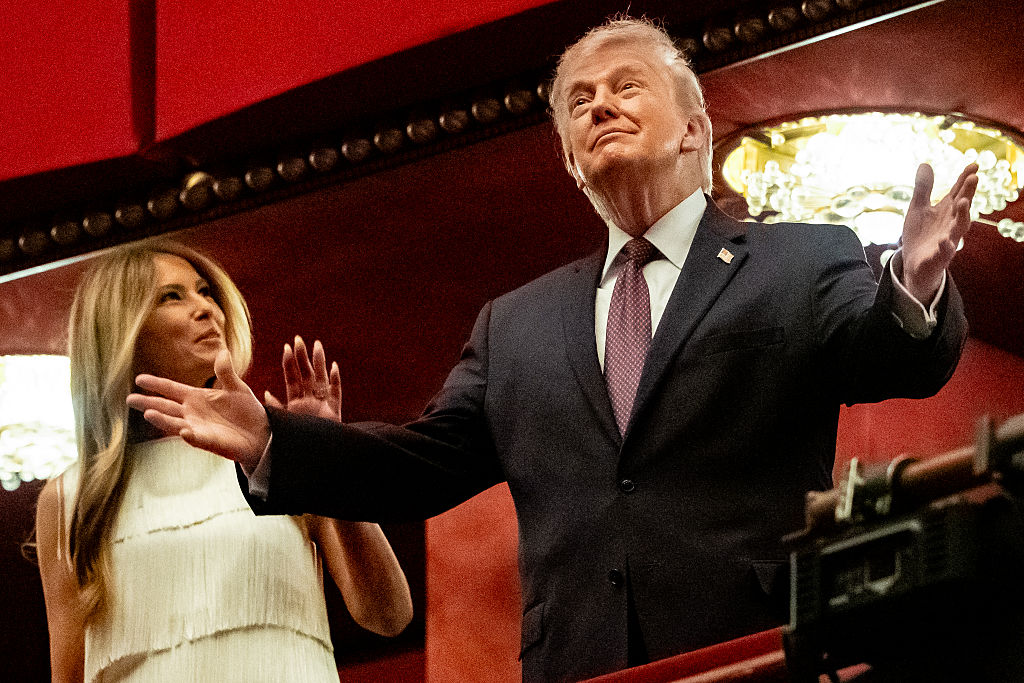
The artist Kara Walker then sliced up and reformed the bronze. Its new shape is a grotesque hodgepodge of horse and human parts, a terrifying menace of history. She renamed the piece “Unmanned Drone” (2023). Walker calls Keck’s original “sympathetic magic” to which she responds with “an act of butchery.” According to her, the point is not to correct Keck’s monument but to expose the violent spirits that were always latent in it. She links the piece to Donald Trump and the 2017 Unite the Right rally, metaphorically positioning her sculpture in the path of “this march of fascism.” But in doing so, she keeps the idol alive – for those who stand against Jackson’s history and those who stood for it.
It seems Walker’s “butchery” is born out of the same impulse that created the piece: grievance. Why did the South ever raise such statues? After the Civil War, the South’s “Lost Cause” narrative became a cognitive balm for military defeat, heavy casualties and economic devastation. Driven by a need to justify the sunk cost of the war, the region raised nearly a thousand Confederate monuments as an act of moral salvage. Having invested so much blood, money and memory in the cause, communities then maintained those statues for more than a century. They could not concede that it was all a waste; the investment was as much emotional as it was financial. Creating such statues was therefore a stand against American history, reimagining military defeat as moral victory.
The raising of monuments like the statue of Jackson was an act of civic sacrament, with oratory and brass bands achieving a sort of public unity. The collective came together to express its righteousness and pride. In the 21st century, the sheer effort of dismantling, reconstructing and unveiling the new version of the statue mirrors this same process; crowds gather, declare their allegiances and enemies and decide the group morality. The labor confers righteousness on the destroyers. Cities have spent tens of thousands to remove, store and destroy the objects, creating new sunk costs of conscience to replace the old sunk costs of heritage. The cranes, tarps and televised teardowns became rituals of purification.
In other words, grievance toward American history inspired the South to raise Stonewall Jackson, and grievance toward American history inspired progressives to tear him down. In both cases, there is a demand for solidarity and conformity. If anything, destroying and rebuilding these monuments accelerates the movement toward idolatry – “Unmanned Drone” is itself a new idol. For those who believe in the South’s “Lost Cause,” the destruction of the statues lends them higher status; meanwhile, remade statues such as “Unmanned Drone” gain a higher status in the eyes of those who once hated the monuments. Either way, idolatry is reinforced and grievance is rewarded.
Such grievance is palpable throughout MONUMENTS. Nona Faustine’s “White Shoes” (2024) photographs – in which she poses nude except for white shoes at places with slave-holding legacies – reduce history to formula: black body plus trauma site equals moral lesson. They’re sincere, but they are also painfully formulaic. Then there is Leonardo Drew’s “Number 363,” a block of cotton and wood that resembles haybales and monumentalizes the South’s chief export tied to slavery. Both “White Shoes” and “Number 363” are familiar in their earnest obsession with identity and resentment, and both are light on proposition.
Unsurprisingly, several works reach for Christian iconography in search of rhetorical gravity. J. Maxwell Miller’s 1917 “Confederate Women’s Monument” – removed from its Baltimore pedestal in 2017 – shows a dead soldier draped across his mother’s lap, a Dixie pietà that drafts maternal grief into the service of a defeated cause. A century on, Jon Henry’s photographic series “Stranger Fruit” (2019-21) revisits the pose, depicting young black men reclining across their mothers’ laps in various American cities. The wall text invites viewers to “meditate on loss and sacrifice,” but repetition across 14 images dilutes the effect. Miller’s bronze and Henry’s photographs turn private grief into public allegory. In both cases, moral authority trumps aesthetic concerns.
More subtle is Andres Serrano’s 1990 suite of photographs “The Klan,” which shows Georgia Klansmen lit like Old Master saints. These sparse photographs are unforgettable. Serrano neither vilifies nor absolves his sitters. He demystifies them by presenting close-ups of their regalia; cheap plastic buttons and polyester sheen horrify through their banality.
Like Walker’s “Unmanned Drone,” with its horse bits and human limbs, these Klansmen are incongruous and terrifying. Also, like Walker’s monster, Serrano’s photographs are much more successful because they do not merely tell viewers what to think or stoke anger or hostility. They make viewers think for themselves.
What emerges from MONUMENTS is not a single coherent curatorial thesis, but a revelation of a national habit: our inability to let history end, Francis Fukuyama notwithstanding. The same psychology that once lifted Confederate generals to the sky now powers their descent into museum storage. Either way, the objects hold on to their fetishized status and we keep fighting the same old narrative of war driven by grief. How do we break the cycle?
If MONUMENTS proposes any way out, it lies not in correction or vandalism or symbolic erasure, but in what Paul Ricoeur called “the work of mourning”: absorbing history rather than avenging it. Mourning, in this sense, integrates the past instead of seeking to dissolve it. To mourn responsibly is to accept that history cannot be perfected and should not be forgotten, but understood.
That shift in posture – away from victory or vengeance, toward sober understanding – suggests a civic ethic for monuments old and new. Rather than melting them down, we could let monuments become reminders. Otherwise, the cycle of destruction and reclamation will continue indefinitely.
Take the proposed National Garden of American Heroes, a monument dreamed up to celebrate the 250th anniversary of American independence. With all the good sentiment behind it, this is a short-sighted idea because it rehearses the errors of the past: such a pantheon is bound to mint fresh icons for future dismantling.
The most successful pieces in MONUMENTS work because they do not simply reassure viewers that their grievance is righteous. This type of reassurance is a national problem: we like symbols that affirm us – or that bait us into rage. The real challenge is to tolerate those that confound us. The future will not be found on a pedestal and it won’t be found in a bulldozer. It will depend on our willingness to let history be difficult without turning it into a weapon or a shrine. Only then can we step off the carousel of grievance and see the past for what it is, rather than what we need it to be.
MONUMENTS is at the Los Angeles Museum of Contemporary Art and the Brick until May 3, 2026. This article was originally published in The Spectator’s December 22, 2025 World edition.



Comments