Contemporary art

Head to Deptford for one of the exhibitions of the year

From our UK edition

Grim news from gallery-land, where even Manhattan’s mega-blue chips are shedding jobs by the truckload. ‘The market’s fucked,’ one soundbite-handy dealer told me last week, admitting that the reckoning was probably long overdue. For artists, this is bleak: the oligarchs are stuck in Moscow, public funds have run dry and, short of shilling for the Saudis or tech barons, there remains only one street on which to beg: fashion. The prestige rag trade has always had a synergy with the art biz: both hawk luxury goods, at least nominally underpinned by visionary genius, for ludicrous prices. Artistic careers have been made by shows at tax-efficient fashion foundations and both domains are notoriously exclusive.

The Venice Biennale was just that bit worse than usual

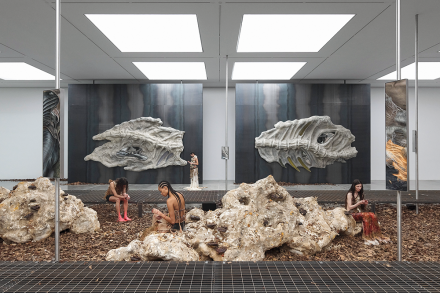
The 61st Venice Biennale arrived freighted with portent. To cut a long story short: Russia and Israel were invited to exhibit, and the prize jurors resigned in protest. Then, on preview day, the city was hit by a storm of biblical force. I sat in the Stansted Wetherspoons for hours, oblivious to the fact that the Ryanair ahead of mine was taking a pummeling that ultimately landed it on the wrong side of the Adriatic. “It was terrifying,” a journalist colleague recounted. “And apparently, Bjork was on board, too.” The bad juju had set in last May when Koyo Kouoh, the program’s curator, dropped dead aged 57. The event was left rudderless, and with all due respect – it shows.

biennale

The Venice Biennale was just that bit worse than usual

The 61st Venice Biennale arrived freighted with portent. To cut a long story short: Russia and Israel were invited to exhibit, and the prize jurors resigned in protest. Then, on preview day, the city was hit by a storm of biblical force. I sat in the Stansted Wetherspoons for hours, oblivious to the fact that the Ryanair ahead of mine was taking a pummelling that ultimately landed it on the wrong side of the Adriatic. ‘It was terrifying,’ a journalist colleague recounted. ‘And apparently, Bjork was on board, too.’ You’ll leave feeling that you’ve spent five hours trapped in the basement of Italy’s most patronising headshop The bad juju had set in last May when Koyo Kouoh, the programme’s curator, dropped dead aged 57.

Brooklyn’s answer to Nathan Barley has struck gold

From our UK edition

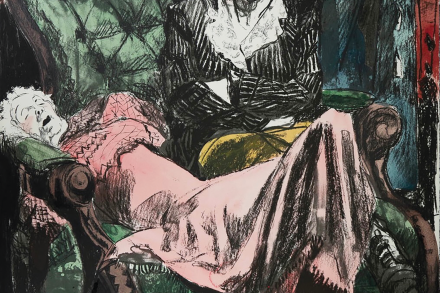
I was on the way to Cecily Brown’s exhibition at the Serpentine last week when I heard that Kensington Gardens had been locked down. Word was that terrorist drones armed with ‘radioactive material’ were on course to blitz the Israeli embassy, presumably taking out a large part of west London with it. Scary though this was, it was also –  as far as I’m aware – a wholesale fiction: an elaborate psy-op some would-be jihadist had staged to convince us that, yes, it could happen here. That it didn’t, and probably couldn’t, was irrelevant; what struck me was the fact that the security services didn’t consider it wholly improbable.

I miss post-internet art

From our UK edition

I got my first paid writing gig back in the early 2010s, for an online magazine fixated on the then-current phenomenon we were already calling ‘post-internet art’. The journal was all but unreadable, its house style both po-mo and po-faced to the extent that contributors were obliged to adopt pseudonymous bylines. I went with ‘Screamin’ Jay Jopling’, which counted for a rare laugh. Yet the tone was very much in tune with the art we covered. Whether it was video, sculpture, photography or pretty much any other medium, it was chiefly concerned with the intrusion of digital technology into – the style guide’s punctuation, not mine – ‘real’ life.

The art of ageing

More than 30 contemporary artists have contributed to the Wellcome Collection’s latest exhibition, which asks what it’s like to age at a time of unparalleled longevity. But as so often happens at the Wellcome’s exhibitions, it’s the ephemera that draws the eye first.  ‘These 2 men are the same age,’ says a leaflet advertising Kellogg’s All-Bran breakfast cereal. ‘One has driving power – energy – the will to succeed. The other is listless – tired all the time – it is an effort for him to plod through each day’s work.’  The point being that ageing is, to a not inconsiderable degree, something we do to ourselves, and something we do to each other. It is a process, not an event.

Does Tate’s director care about art?

From our UK edition

I met the Tate’s outgoing director Maria Balshaw only once, back when she was in Manchester running both the Whitworth gallery and the city’s municipal art museum. She was given to management-speak and annoying soundbites – she more than once described herself as ‘feisty ’ – but she’d done a superlative job. She was charismatic and supremely competent – in theory, the perfect candidate for the soon-to-be-vacant Tate leadership. She got the job two years later, but the confrontational demeanour that had worked so well up north didn’t wash in London, where the phrase ‘can do’ routinely elicits the same retort: no, you can’t.

Am I a useful idiot visiting Uzbekistan’s first art biennial?

From our UK edition

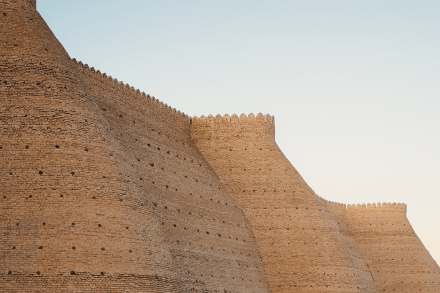
In the ruins of a 16th-century mosque, in the heart of the ancient silk-road city of Bukhara, dozens of abstract figures stand mute and motionless. As the desert sun dips below the horizon, and the shadows thicken, the effect is eerie. Wandering among the statues alone, you feel as though you’ve stumbled upon the aftermath of a forgotten, inscrutable rite. But these aren’t Ozymandian relics. They’re an artwork, ‘Close’, installed last summer by the British sculptor Antony Gormley. His work was one of more than 70 scattered across the Unesco World Heritage city as part of the inaugural Bukhara Biennial, which ran from 5 September to 23 November last year.

What monuments stand to teach Americans about themselves

Why do we raise monuments? Why do we tear them down? These questions hover over MONUMENTS, now on view at Los Angeles’s Museum of Contemporary Art and the Brick. The premise is straightforward enough: gather the remains of America’s shattered sculptural conscience – decommissioned Confederate statues and their graffiti-marred plinths – and display them alongside contemporary works on racial topics. This comparison is supposed to reveal something about America’s nature and history, and it certainly does: it shows us just how attached we are to grievance. Both the raising and the destruction of monuments nourishes convictions on either side, ensuring that the argument can never end.

monuments

Why is divorce so seldom addressed in art?

From our UK edition

Two years ago I was flown to Reykjavik to interview the Icelandic performance artist Ragnar Kjartansson. It was a weird old trip, booked in at 48 hours’ notice, but Ragnar was consistently charming and generous. Indeed, the only slightly touchy moment came when I asked him about his 2012 video installation The Visitors, a berserk undertaking split across nine screens, in which the artist and an entourage of musician friends spend 52 minutes chanting the baleful refrain from a song written by his then recent ex-wife. The artist tensed up as he considered the question. ‘Shit, I gotta go,’ he said. He probably did, but his reticence might also have had something to do with the fact that the work was possibly conceived as a cathartic means of putting his first marriage behind him.

London’s stupidest gallery

From our UK edition

Everyone loves a private view, and I am no exception. I don’t know how many hours I must have spent trudging around central London’s art galleries in search of warm white wine – my social life doesn’t extend much beyond the confines of that circuit to be honest. Lately, however, I’ve been to some dreadful things; shows that seem to exist purely in order to enable their ritzy opening galas. I suppose I have only myself to blame for turning up to an evening at London’s stupidest gallery last week, but it was truly horrible: a party thrown for a scenester artist who turned DJ for the night, spinning butchered mash-ups of 1980s club hits to a scrum of pouting influencers. As for the art: suffice to say I’m not giving anyone the dignity of a namecheck.

The best artist alive? Probably

From our UK edition

Taking place every October in Regent’s Park, the Frieze fair is probably the biggest event in London’s art calendar. It is also, as a spectacle, by far the least enjoyable. With works crammed into cubicle-sized booths, and punters battling a crossfire of air kisses and the palpable stress ricocheting around the flimsy partitions, I struggle to think of a worse context in which to look at art of any stripe. Still, it always used to be an occasion to take the pulse of the contemporary art world, to pick out the visual signatures of the reigning avant-garde tendency and clock what Jeremy Deller was doing with his facial hair at any given moment. This year’s iteration proposed no such insights.

The best Turner Prize in years

From our UK edition

So, the Turner Prize: where do we start? It’s Britain’s most prestigious art award, one that used to mean something and now attracts little more than indifference. Taking place every year, it grants £25,000 to a winner chosen from four shortlisted artists, all of whom are obliged to display work together either at Tate Britain, or at a regional gallery. The latest iteration, at Bradford’s Cartwright Hall, is the best in a while – but before we get to that, some context. The Turner was established in 1984, but only really grabbed anyone’s attention when Channel 4 began televising the prize-giving ceremony in the 1990s.

Wittily wild visions: Abstract Erotic, at the Courtauld, reviewed

From our UK edition

If you came to this show accidentally, or as a layperson, it could confirm any prejudices you might have about avant-garde sculpture. Pretentious, ugly and resorting to kink. Those pendulous string bags, that enormous turd – gimme a break. Except that would be a mistake. Because the work here is the real thing: the 1960s originals that spawned a million imitations and parodies. The exhibition is perhaps a little cool about selling itself, so allow me. This is a snapshot of the work of three artists around the time they all took part in a 1966 New York show called Eccentric Abstraction. Two of the artists, Louise Bourgeois and Eva Hesse, were nascent superstars.

Beguiling grot, TfL surrealism and Insta-art: contemporary art roundup

From our UK edition

Last month, I got the train down to Margate to interview the Egyptian-Armenian artist Anna Boghiguian (b. 1946), whose exhibition The Sunken Boat: A glimpse into past histories was about to open at the Turner Contemporary. Long story short, the conversation did not go well: Anna reacted to my questions with some irritation, swatting them away like low-flying bluebottles. I got flustered, she got bored, and eventually so did I. We wrapped things up around the 20-minute mark and I ran away to stare into the abyss. It was a shame, because the show was, for the most part, really good.

London’s best contemporary art show is in Penge

From our UK edition

If you’ve been reading the more excitable pages of the arts press lately, you might be aware that the London gallery scene is having one of its periodic ‘moments’. A fair few spaces, mostly concentrated around Fitzrovia, have sprouted up since the pandemic, notable for their bacchanalian openings and tantalisingly gnomic Instagram posts. Their online presence is at best spectral: the most hyped of the bunch, a Smithfield gallery called Ginny on Frederick, has a holding page in place of a website. Still, I like a scene, and London Gallery Weekend, an annual June event, presented a good opportunity to investigate. Niso gallery, on New Cavendish Street, has put on a seductive showing of the Argentinian conceptualist Martina Quesada (open until 28 June).

Absorbingly repellent: Ed Atkins, at Tate Britain, reviewed

From our UK edition

In the old days, you’d have to go to a lot of trouble to inhabit another person’s skin. Today you can simply buy a customisable 3D avatar from Turbosquid.com, animate it with your own movements by wearing a sensor-filled motion-capture bodysuit, and presto! Lifelike but eerily soulless, Ed Atkins’s video portraits occupy a strange visual hinterland between computer-game graphics and deepfake realism. The close-ups elicit a tingling revulsion: this seems to be a human being, but something is off A man tosses and turns in bed before his home is violently swallowed up by a sinkhole; a besuited talkshow host puffs away on Silk Cuts while conversing with the disembodied voice of a woman (Atkins’s mother) about her struggles with depression. In both videos, the artist is incognito.

If ‘wokeness’ is over, can someone tell the Fitzwilliam Museum?

From our UK edition

Optimists believe that the tide of ‘wokeness’ is now ebbing. If so, the message has not yet reached Cambridge, whose wonderful university museum has its classical façade covered in sententious phrases in neon, and which has recently opened a new exhibition in agit-prop style: Rise Up: Resistance, Revolution, Abolition. Such activism is fully in step with the Museums Association, the curators’ club that instructs its members to turn their institutions into activist cells. If all this makes its founding benefactor Viscount Fitzwilliam turn in his grave, all the better: he is stigmatised as a profiteer from the slave trade, even before one reaches the cloakroom.

In defence of deaccessioning

From our UK edition

There’s more than a grain of truth in the popular caricature of a curator as a mother hen clucking frantically if anyone gets too near her nest – not that her eggs are about to hatch, let alone run. The recent threat of the British Council to ‘deaccession’ – to put it more bluntly, sell – its 9,000-strong collection of British art has caused a predictable flurry in the curatorial world. Doesn’t the British Council know that public art collections are sacrosanct and must be preserved for all time? When I was director of Glasgow’s museums and art galleries, I remember talking to my committee about my long-term plans for the city’s great permanent collection when the leader of the council, Pat Lally, commented drily that there was no such thing as ‘permanent’.

Presenting our planet and perilous situation as art

Philippe Pastor is an artist on a mission to educate, alarm and call to action. His subject: our planet and the perilous situation we find ourselves in at this moment of time.  Pastor’s latest works, installed to coincide with Climate Week in New York, are a clear indication of where he sees the state of play. The first enormous canvas, ominously titled La Fin Du Monde, seems to depict an apocalyptic clash of water, fire and ice. Heavy brush strokes are densely laid on with glue and pigment, giving a sense of the swirling waters enveloping us all. “I start the paintings with a story in my mind,” he said, speaking from his studio — a former seventeenth-century farm near Cadaqués.