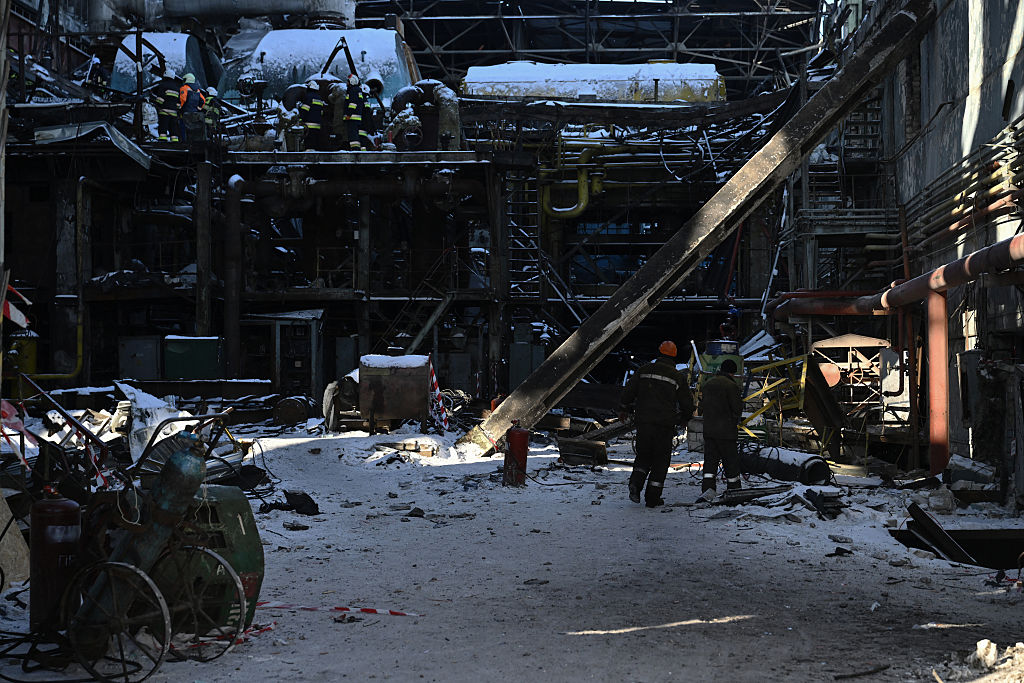
Kharkiv, Ukraine
In a bunker on the outskirts of Kharkiv, a group of rookie Ukrainian soldiers are learning the basics of combat medicine. The temperature outside is -4°F, and clouds of breath hang in the air – as does the gravity of what they are letting themselves in for. The dummies used for training have fake bullet holes and missing limbs, and during a quiz at the end of the lesson, gruesome scenarios are playing out.
“If you tie a tourniquet, but there’s still bleeding, what do you do?”
“What is the significance of cerebral fluid in the mouth or ears?”
Most of these medics will not even be right on the frontline’s “red zone.” Instead they work in field clinics a few miles further back, where troops drop off injured soldiers for immediate triage. This is the so-called “yellow zone” – not that it is much safer these days. Thanks to the armed drones that now stalk the frontlines, hovering and swooping like birds of prey, even the rearward echelons are perilous.
“Today you can be in danger from drones anywhere up to about 25 miles back,” says Daniel Ridley, a former British soldier who runs the training course, a private scheme called the Trident Defense Initiative. “That makes the task of evacuating casualties far more hazardous.”
Ridley now refers to the yellow zone as the “gray zone,” a nod to how drone warfare has transformed the battlefield. When the Russians first invaded, the fighting was like the first world war – the sides shelled each other relentlessly and fought close-quarters battles when capturing trenches.
Today, by contrast, drones makes it perilous to even pop out of a fox hole for a smoke. Soldiers’ bodies lie rotting in no-man’s land because it is too risky to retrieve them. Some troops talk almost nostalgically of the war’s early days, when all they had to worry about was 155mm Howitzers and machine gun fire.
With the fourth anniversary of the war looming this month, Ukraine is entering something of a gray zone itself. Neither victory nor defeat seems in sight, and like the wintry skies, the mood shifts between various shades of light and dark. While the Trump-backed peace talks may still may dominate western media coverage, here many people no longer bothering follow it. Many haven’t even heard of Steve Witkoff, Trump’s property dealer pal-turned-presidential envoy. Which may be just as well, given that in interviews last year, Witkoff struggled to name the parts of eastern Ukraine he is tasked with negotiating over.
“Trump is a businessman, he doesn’t really care about people,” says one of Ridley’s apprentice combat medics. “Biden was better for Ukraine.”
Worldwide interest in the war has also waned. Despite still being the biggest and bloodiest conflict on European soil since the second world war, Ukraine now jostles for coverage with Venezuela, Gaza and Iran. Gone are the days when every Donbas hotel was packed with hacks. Those who do come find it tough going. The drones make frontline access for media far harder, and neither side is capable any more of making eye-catching lighting advances.
This is, however, is the first year in which “General Winter” – who handed Russia victory in the second world war by freezing Hitler’s armies to death – has really been a player. The recent temperatures of -13°F are the lowest Ukraine has had in more than a decade. Hence the Russians trying to destroy the capital’s heating and electricity – although as a Kyiv friend of mine pointed out, the real worry is the plumbing.
“It’s bad enough if you’re living on the 19th floor and you’ve got no heating, electricity or lifts, but if the plumbing fails too, you can’t really lug pails of water up all those stairs,” he said. “People can manage with being cold, but not being able to use the loo is a real morale destroyer.”
Things are even tougher on the frontlines, as Ridley, 30, knows all too well. After leaving the British Army in 2015, he served as a medic with Kurdish anti-Islamic State forces in Syria, and in 2018 joined Ukraine’s 36th Marine Brigade, fighting pro-Kremlin separatists in the Donbas. He has grim memories of his own time serving in the depths of winter.
“At -20°C [-4°F], all people want to do is hunker down in their trenches,” he said. “Most electronic kit stops working – drone batteries will die in a minute and thermal vision won’t work. The trenches also end up like ice rinks – sometimes you have to crawl through them, because it’s too slippery to stand up.”
When the Russians besieged Kyiv four years ago, Ridley was living in the suburb of Bucha, which bore the brunt of the Russian assault. He set up a makeshift hospital in the basement of his apartment block, treating injured civilians. After smuggling himself out through a Russian checkpoint three weeks later, he went to set up Trident, teaching NATO-standard infantry and paramedic skills to Ukraine’s rapidly-expanding armed forces. Trident has since trained more than 19,000 troops, many of them rookies who had never fought before.
The courses focus mainly on combat medicine these days, as the presence of drones has rendered basic infantry skills less of a priority. Trident has access to cadavers from a nearby morgue for practicing emergency field surgeries that are otherwise hard to replicate. These include cricothyrotomies, where a patient’s throat is slit to allow the insertion of a breathing tube, and intraosseous injections, where a needle is forced directly into bone marrow.
“It is much more realistic for the trainees to practice on a corpse than a dummy, and it helps prepare them psychologically for what is to come,” Ridley adds. “If they can’t handle dealing with a cadaver, we don’t let them pass the course.”
Among the instructors on Ridley’s courses are fellow ex-soldiers from Britain and the US, who often plan to move on eventually to fighting as volunteers on the frontline. Ridley does his best to dissuade them, pointing out that it will not be the soldiering experience that they expect.
“I get young lads coming here itching to fight, but they aren’t going to get what they are looking for, shooting at Russians,” he says. “They are just going to get drones dropping bombs on them.”
Among the Ukrainian students, the days of young guns champing at the bit are long over. Many of Ukraine’s “Greatest Generation” – the idealistic twenty-somethings who signed up in droves at the start of the war – are now dead. The class being taught on the day I visited were mainly in their 30s or 40s, with the exception of one very committed 17-old girl, keen to join the army since the conflict began.
They are surprisingly sanguine about the growing numbers of their compatriots who are dodging the draft – some two million in all, according to figures from Ukraine’s defense ministry last month.
“We are not judging them, but we don’t want people like that in the trenches with us anyway,” shrugged one soldier. “You can’t depend on them.”
The quiz over, the students trudge off in the snow, ready for another day of blocked airwaves and sucking chest wounds. As they leave, I ask the instructor how the morale of the students is holding up.
They are tired, the instructor says. And tired too, of the rest of the world going on about how strong and resilient they are. Nobody, it seems, wants to be heroes forever.




Comments