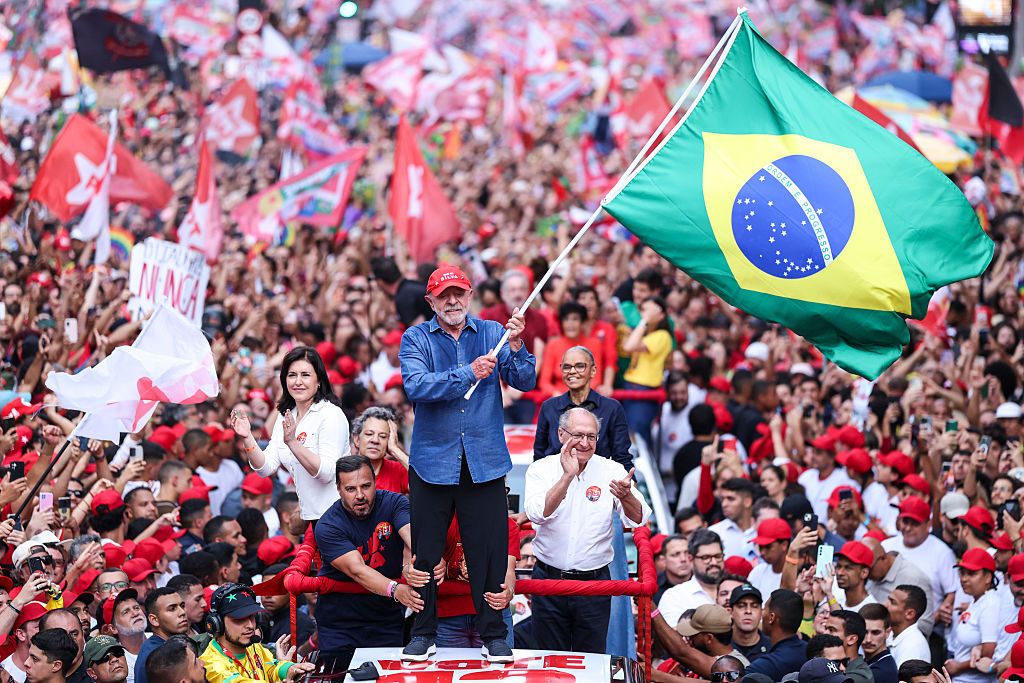
In a dramatic reversal, Brazil’s 80-year-old president, Luiz Inácio ‘Lula’ da Silva, has secured a fourth term in office, defeating Flávio Bolsonaro, the son of former president Jair Bolsonaro. Flávio had finished first in the opening round of the election three weeks ago, and his political camp had performed strongly in congressional and gubernatorial elections. Lula’s victory, with almost 52 per cent of the vote and a substantial margin of nearly 4.4 million votes, was decisive. But the election was marred by the badly managed extension of voting hours.
Lula’s fourth term will begin in an extremely hostile environment, amid accusations of foul play on election night
It was a night of confusão and emoção. But who, in Brazil, would have expected otherwise? For the left, the stakes extended far beyond the presidency. With Flávio in pole position, it was now all or nothing for Lula and his compatriots in the ultra-left Workers’ party (PT). Losing the presidency would have meant losing access to the political patronage, appointments and public resources that come with control of the executive.
As voting drew to a close on Sunday afternoon, both camps sought to extend the voting hours, citing difficulties affecting their supporters. Flávio Bolsonaro’s campaign pointed to severe weather in parts of the south, while the PT complained of disruptions to public transport in ten other states. Things escalated quickly. Unproven accusations by the Workers’ party that right-wing mayors were deliberately stopping buses from ferrying their supporters to polling stations even led Lula to call for arrests.
The electoral authority had not ruled on either party’s request for extended voting hours before polling stations began closing at 5 p.m. Then came an unprecedented and extraordinary intervention. Shortly after the polls were scheduled to close, Supreme Court Justice Cristiano Zanin – a lawyer who had previously represented Lula in criminal proceedings and was appointed to the Supreme Court by him in 2023 – ordered voting to be extended nationwide until 7 p.m. As the electoral authorities had just begun counting votes and publishing the first results, Zanin ordered the count to be halted.
The order arrived too late for many polling stations, creating confusion for election officials and voters alike. Zanin’s subsequent clarification was equally confusing: the extension would apply only to polling stations that had not yet closed. Those already shut would remain so. But why, you might ask, were some polling stations still open after 5 p.m.?
For Bolsonaro’s supporters, the episode revived memories of the bitterly contested 2022 election and has reinforced their suspicions of institutional bias. Flávio Bolsonaro has announced that he will not recognise the result and will seek to have the election annulled.
The controversy is clear, but the crucial question is whether the extension materially affected the result and whether the electoral authorities can demonstrate that the process remained fair. An extraordinary intervention by a politically appointed Supreme Court justice – minutes after polling was supposed to have ended – also requires sound legal justification, not to mention an explanation about why the order was not communicated and implemented in good time.
Lula may have won another term, but his victory will remain highly controversial, particularly if this controversy is not properly clarified. Nor has he won a blank cheque to rule. Flávio Bolsonaro is backed by a staunchly conservative Congress and received more than 48 per cent of the valid vote. Conservative voters will continue to worry about lax public security, excessive government spending and the virtually unlimited power exercised by Brazil’s Supreme Court – all disturbing features of Lula’s political legacy.
Lula’s campaign clearly benefited from last-minute promises of enormous extra social spending and assistance that – if all implemented – could cost Brazil a whopping £40 billion. Such measures may provide legitimate relief to poorer households, but their timing and disastrous fiscal consequences are plainly populist. Public money is not cost-free: Brazil’s next president will face slow growth, high interest rates, mounting public debt and competing demands for social expenditure and public investment.
Lula’s fourth term will begin in an extremely hostile environment, amid accusations of foul play on election night. Unlike in 2022, he will now have to contend with a conservative-leaning Congress. The Centrão, the loose and pragmatic bloc of centrist and centre-right parties, will remain pivotal. Lula may draw some of its members into his orbit, but Bolsonaro’s movement will try to block his every move and initiative.
Meanwhile, Bolsonaro and his allies can challenge the handling of the vote in the courts and Congress, while conservative governors will remain important centres of opposition. Relations between the executive, the legislature and the judiciary could become increasingly confrontational. Impeachment proceedings, particularly against justices Zanin and Alexandre de Moraes, will undoubtedly be on the table, while institutional disputes and further political polarisation seem inevitable. Lula’s victory may have preserved the PT’s political machine, but it also leaves the country deeply divided and its institutions under even greater scrutiny.
With Congress likely to make his next term extremely difficult, Lula may try to shift some of his responsibilities to his more moderate, centrist vice-president, Geraldo Alckmin, who could play an important role in bridging the divide between the presidency and Congress. Even so, anything coming from Lula’s presidency will be treated with deep suspicion by Bolsonaro’s camp.
Lula’s continuation in office offers little reason to expect a fundamental shift in Brazil’s foreign policy. But a hostile Congress may seek to undermine him wherever possible. Brazil’s international standing ultimately depends on economic performance, political stability, the government’s ability to address corruption, tackle organised crime and public insecurity, and upholding the credibility of its institutions.
The way the final hours of voting were handled has created a controversy that will outlast election night. Bolsonaro’s camp must still demonstrate that the Supreme Court decision materially favoured Lula or altered the outcome of the election. The margin of victory is substantial, and allegations of irregularity are not proof of electoral fraud. But neither should anyone dismiss legitimate questions about the legal basis, timing and implementation of this unprecedented intervention.
If Brazil’s democracy is to emerge from this election with its credibility intact, the handling of the extension must be examined transparently, and any challenge must be judged on evidence rather than on partisan lines. And extending voting hours after closing time, should not become an accepted way of conducting elections. In a democracy, the rules must be clear before the votes are cast, not improvised as the result begins to emerge.




Comments