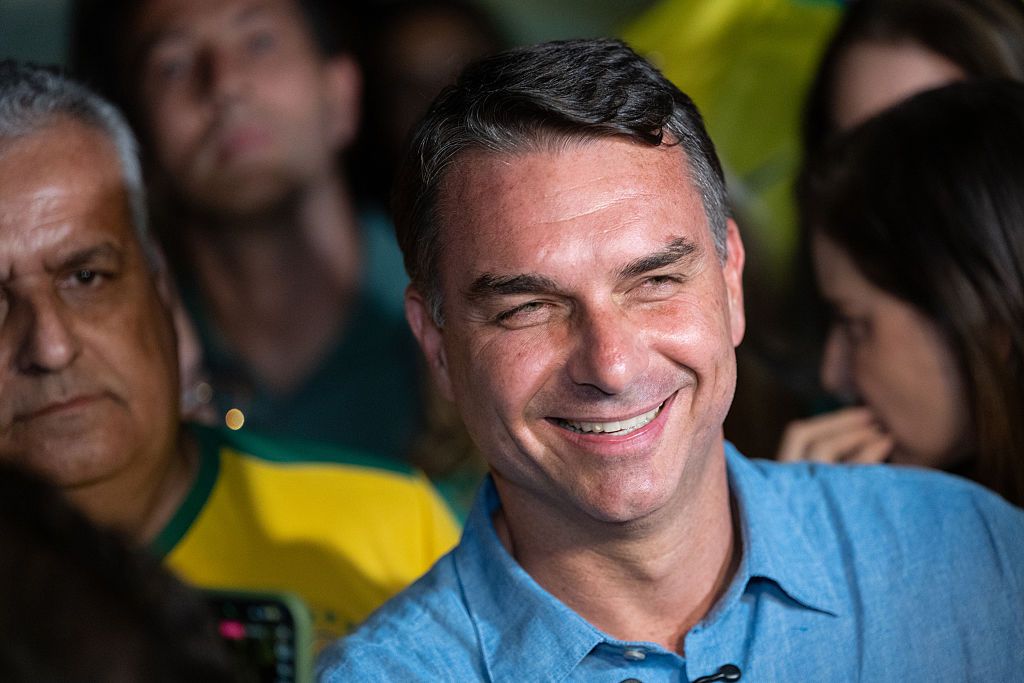
Against all the odds, Flávio Bolsonaro – the son of former president Jair Bolsonaro – has come first in Brazil’s presidential election. Although there will be a second round of the presidential race in three weeks’ time, as none of the candidates secured an outright majority, the first round of these fiercely contested elections has resulted in a painful defeat for the country’s left.
After securing 47 percent of the vote, Bolsonaro is in pole position for the second round, especially as three smaller right-wing candidates are out of the race. Their voters are now up for grabs.
All night long, as results poured in from across the vast country, Bolsonaro junior maintained his lead, remaining firmly ahead of the incumbent, President Lula, who eventually ended up with just 45 percent of the vote.
The disappointment must have been huge in Lula’s camp and within his Workers’ party (PT). Throughout the year, Lula has been leading in the polls, sometimes comfortably, although Bolsonaro appeared to be catching up in recent weeks. Last month, the PT began complaining about possible US interference in the election, leading to widespread fears on the left that Trump might be helping Bolsonaro – thereby wiping out the last and biggest bastion of the left in Latin America.
Brazil’s electoral authority said yesterday that no evidence of international interference affecting the election had been detected. The country’s federal police nevertheless announced they were launching an investigation into possible external interference, explicitly stating this was requested by the federal advocate-general, a Lula protégé.
Bolsonaro has performed strongly across the board. His party surged ahead in both the Senate and the Chamber of Deputies and won several key governorships. Bolsonaro has demonstrated that he is his own political force, rather than simply a son carrying out errands for his father. He has gained the trust and support of a substantial section of the electorate, built political alliances and put himself in a position to compete seriously for the presidency. He has also secured greater support among right-wing voters for the Bolsonaro family’s specific brand of conservatism. Bolsonaro’s party remains something of a family business. Michelle Bolsonaro – Jair’s wife and Flávio’s stepmother – has now been elected to the Senate.
But let us take a look at Lula’s own failure. When the PT saw Bolsonaro gaining ground in the polls, Lula began handing out money – and lots of it. He raised family subsidies by 15 percent, introduced new credit schemes and tax breaks, subsidized fuel to curb higher gas prices, stepped up household debt-relief programs, railed against credit-card use and banned online gambling. While some of these measures may still face legal and political hurdles, their aggregate cost to Brazil, according to calculations by Valor, a Brazilian daily, could be a whopping $53 billion. Although the campaign briefly swung back in Lula’s favor after these announcements, the measures did not help him win the first round.
What eventually may have damaged Lula’s campaign is a nationwide corruption case – the so-called Banco Master scandal – which has tarnished many senior figures, including some in Lula’s entourage. This includes his own son and his key political ally: the country’s most powerful and fearless judge, Alexandre de Moraes (both men have denied any wrongdoing).
Can Lula still fight his way back to victory in the second round? In theory, yes, but not completely. Brazil’s political system is in some respects similar to France’s. Whoever wins the presidency usually does not command Congress and will need to build alliances and coalitions in both chambers.
Like France, Brazil also has a highly fragmented parliament. On the right, Bolsonaro’s Liberal party jumped from 16 to 28 seats in the 81-seat strong senate, while the party grew from 97 to 121 seats in the 513-strong Chamber of Deputies. In contrast Lula’s PT remained stable in the senate at nine seats and in the Chamber at approximately 70 seats. It is therefore unsurprising that both sides – or whoever wins the presidency – will need to build coalitions to get things done.
Bolsonaro can count on two smaller, but relatively close allies: the Republicans and Novo (or New party), while Lula has a much smaller powerbase of aligned left-wing parties. Both sides will always have to do business with the parties of the Centrão, the “Big Center”: a loose grouping of centrist and center-right parties that are largely open to doing business with either side in exchange for government positions or regional projects, while being remarkably flexible when it comes to their ideology.
A future president Bolsonaro may have a stronger hand in Congress but will still need to persuade some of the Centrão parties to support him. Lula’s grouping, meanwhile, should the 80-year-old manage to win later this month, will find it harder to do business in a generally much more right-wing Congress.
Lula and Bolsonaro have a tough battle ahead in the coming weeks. The left’s strategy is clear. It will stoke fears about US interference and a stolen election. And, at the same time, it will leave Lula’s promise of financial assistance hanging over the election like a giant piece of bait. It appears though, that fewer and fewer Brazilian voters are willing to bite.





Comments