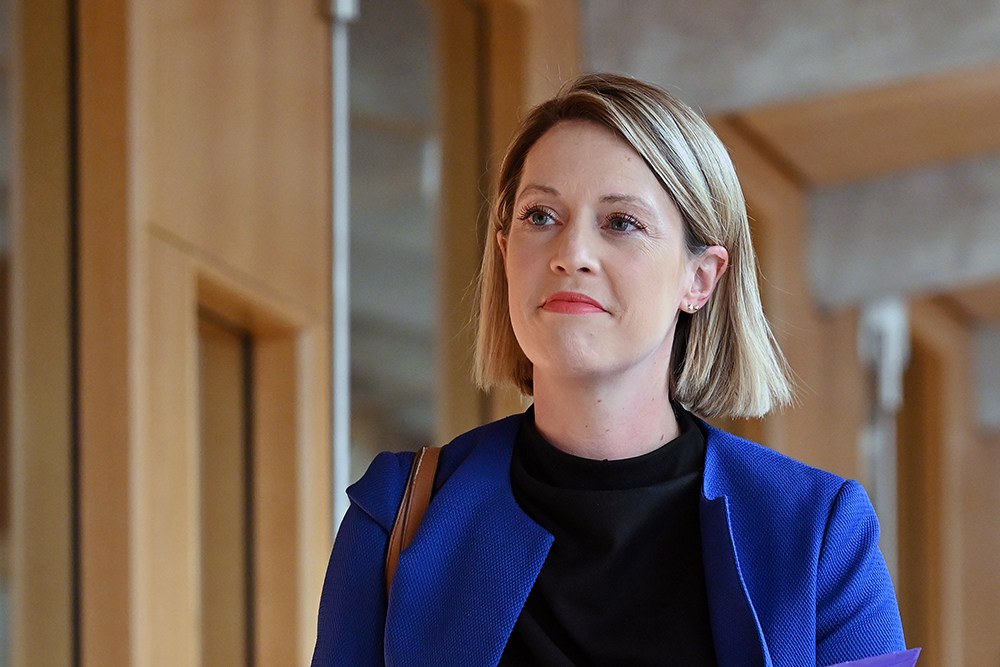


When I heard that a civil service insider had made bullying allegations against Scotland’s deputy first minister, Jenny Gilruth, I was not surprised. I’ve been at the receiving end of her ire myself. Gilruth taught modern studies – politics mixed with sociology – at my Edinburgh comprehensive school. She had a reputation for being a bit of a meanie and not someone you wanted to disappoint; she was certainly a disciplinarian. Those traits seem to have stayed with her as she climbed Edinburgh’s greasy public-sector pole, leaving teaching after a stint at Education Scotland before becoming an MSP and eventually John Swinney’s deputy.
This weekend it emerged that, among other things, she allegedly sent a ‘cruel’ email which ‘named and shamed’ useless officials she’d inherited from her predecessor. The email was ‘mistakenly’ sent to everyone in the department – including the useless officials – resulting in great ‘fury and upset’. ‘Everybody is terrified of her – because she’s a bully. She was bad before this, but she is even worse now,’ one source told the Scottish Sun.

Gilruth’s hit list – the existence of which is denied by the Scottish government – allegedly included each member of the civil service team she’d inherited from the previous DFM, Kate Forbes, along with reasons why she didn’t like them. When she was told that civil service managers make staffing decisions, rather than her, she ‘went into a huff’.
And, boy, can she huff. My first brush with her fearsome temper came during an amateur theatre production she was helping to supervise. As a lowly stagehand I had been tasked with ordering a load of Domino’s pizzas. When Miss Gilruth, as I knew her, chowed down on hers, the red mist descended. ‘You’ve got me the wrong stuffed crust,’ she exploded. ‘You’re useless.’ It was unsettling and bizarre; like the Edinburgh civil servants, I felt a mixture of fury and upset.
A year or so later, she gave a pep talk to the school hockey team. ‘Look, it’s quite simple,’ she explained, ‘just go for their ankles.’ I took that as a joke though others were more taken aback.
So it doesn’t surprise me that her abrasive style has continued into high Scottish office. But let’s be clear: the stuffed crust and the ankle incidents do not add up to bullying, and nor, on the evidence so far at least, does shouting about the quality of your staff. Yet these accusations seem to have become the go-to resort of a mandarin class allergic to high standards.
Gilruth is by no means the first minister to discover this. In 2022, when stories appeared in the media that Britain’s deputy prime minister Dominic Raab had allegedly thrown a piece of tomato across a room, a KC-led inquiry was launched, more than 60 interviews were conducted and Raab was booted out of government – the second minister under Rishi Sunak to lose his job for this kind of offence within six months.
Gordon Brown, another temperamental Scot, was also rumoured to have been shouty and sweary, leading the National Bullying Helpline to breach all sorts of confidentiality and publicly claim that three members of Brown’s team had phoned them for advice.
But what Brown, Raab and Gilruth really had in common was that they demanded rigour. Adam Tolley, the KC who led the investigation into Raab, pointed out in his report that ‘legitimate, reasonable and constructive criticism’ of performance is not bullying. This is an important distinction. Serving the public should not be seen as an ordinary career – at times it will be tense and exacting. The civil service doesn’t want that.
She gave a pep talk to the school hockey team. ‘Look, it’s quite simple,’ she said, ‘just go for their ankles’
If Gilruth is to be criticised, it should be on her record. Her main function as DFM seems to be to stand menacingly behind Swinney as he lectures the Holyrood press pack like a petulant headmaster flanked by a glaring head girl. Her previous ministerial postings did not deliver much. Ironically for such a disciplinarian, as education secretary she told schools in the middle of a violence epidemic that she did not support ‘more punitive approaches’. Incidents of aggression in Scottish schools had surged. When she was asked on television about a report into the most serious incidents, she admitted she hadn’t read it.
I’m in no doubt that part of our underperforming state is a result of civil service overcorrection, though. In 2020, Dave Penman, general secretary of the First Division Association – the union for senior civil servants – claimed around 30 staff across at least five ministerial offices had raised bullying complaints. He said that was extraordinary compared with the rest of the UK civil service. The SNP did not like it.
Before journalism, I worked for a brief time as a civil servant in an arm’s-length Scottish government body; ‘wellbeing’ was at its core. Everything the then government did was focused on ‘wellbeing’ for the nation as well as ‘wellbeing’ for the ever-growing numbers of public-sector staff. It’s no wonder you can’t say boo to a goose now. In fact, so much of my time was spent at ‘weekly catch-ups’, ‘check-ins’, ‘appraisals’ and ‘informal wellbeing updates’ that barely any real work got done.
Wellbeing seems to be catching on south of the border too. A recent post on Instagram went viral when one girlboss influencer boasted that the civil service was a great career path for those who fancied working from home – or Rome. And a civil servant I crossed paths with recently became visibly upset when someone suggested a privatised funding model might be better than the NHS.
This doesn’t mean bullying is a better alternative. Brown was unable to shout himself to an election victory. Raab’s alleged tomato-slinging didn’t avert the prisons crisis. And Gilruth’s ‘cruel’ email will not necessarily improve her department either. But when public-service productivity has failed to return to its pre-Covid level, when some Scottish government offices record core staff occupancy as low as 8 per cent and failures are mounting up, we can perhaps forgive the odd burst of ministerial frustration.
Scotland’s deputy first minister may be a meanie, but we should be a lot more worried about whether she’s any good at her job.






Comments