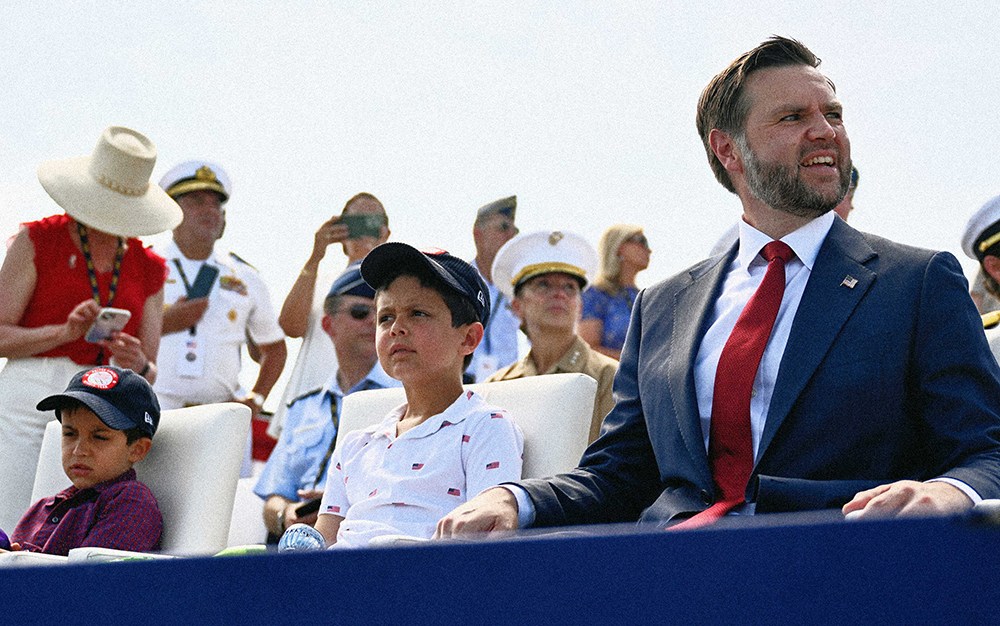



In his book Communion, J.D. Vance confesses to being a “holy terror” in school. After one incident, in which he frescoed a wall with a crayon, the school pleaded with his mother to have him diagnosed with ADHD and put on Ritalin. But she and his grandmother, his Mamaw, were skeptical: “‘He’s just a boy,’ said Mamaw. ‘That’s all that’s happening. He’s just a little shitheaded boy.’”
At the Heights – the Catholic boys’ school where Vance has just enrolled his oldest child, nine-year-old Ewan – the policy is to let boys be. If students are naturally lively, loud and energetic, then simply stifling that energy goes against the school’s stated mission: forming “men fully alive.”
The Heights is located in Maryland, on a 20-acre campus near the Potomac river and about a half-hour’s drive from DC. In “the Valley,” as the lower school for third- to fifth-graders is called, classes are held in log cabins. Boys have three recesses per day and spend time catching toads and sketching birds. Play – including roughhousing – and letting imaginations loose are considered crucial for a boy’s development.
When learning about ancient Greece, the boys fight dressed as hoplites; they read Laura Ingalls Wilder’s Farmer Boy, and sit down to a feast inspired by the novel’s sumptuous descriptions of country cooking. Presumably, they would have no trouble imagining the wild, lush otherworlds of Bridge to Terabithia and The Chronicles of Narnia.

While more structured than “the Valley,” the middle and upper Heights schools (for sixth- to 12th-graders) aim to provide boys with an environment of freedom, where they can take risks, practice self-discipline and choose to be virtuous. They study a liberal arts curriculum based on the western canon. Each boy has a faculty mentor – the teachers are all male – and punishment is rare. The upper school costs around $40,000 a year.
The woods, fields and creekbeds make a pleasant change of scenery from the suffocating impact of “the Swamp,” but the Heights remains tethered to Washington. For years, prominent figures in the capital – including former FBI director Louis J. Freeh, former secretary of defense Chuck Hagel, Missouri Senator Josh Hawley and now the Vice President – have been sending their children there. The admissions process has become highly competitive recently. One DC insider says the school is turning into “the Sidwell Friends of the right” – a reference to the elite private school which educated the children of Teddy Roosevelt, Richard Nixon, the Clintons and the Obamas.
Many parents find that the Heights is a “safe space from all that,” says Ashley McGuire, a mother of five, who has two sons, aged nine and 11, at the school. While some students may have powerful or influential parents, she says, they’ve all decided to send their kids to a place where the most important question is: what is good and worth pursuing in life? “Power for power’s sake is not good. They’re choosing an environment that is stressing higher, more noble ideals than what dominates the culture in Washington, DC,” she says.
Just because the Heights is not interested in politics, as the saying goes, doesn’t mean politics won’t be interested in it. The school’s approach, to educate boys as boys, speaks to a concern voiced by many Republicans in DC – most notably Vance and Hawley – that men’s needs are being sidelined as society turns postindustrial, progressive and feminized. Modern men struggle to graduate high school and college, get married, start families, find jobs; many are drifting without a purpose. Vance, who described the “peculiar crisis of masculinity” among the working class in his first book, Hillbilly Elegy, acted as an interpreter of these trends for the media while he was a senator.
In Of Boys and Men – a book Vance has been known to recommend – American Institute for Boys and Men founder Richard V. Reeves found that the high school graduation rate for girls in 2018 was six percentage points higher than for boys. At 82 percent, the male graduation rate was only a little higher than the 80 percent rate for poor students. (To assess what groups might be at risk of dropping out, states are required to report dropout rates by categories such as race and economic disadvantage – but not sex.)
The school asks boys to be ‘dangerously good’ – requiring an understanding of the ‘less than good’
According to Alvaro de Vicente, who has served as headmaster of the Heights since 2002, one reason why boys are falling behind is because, while educators can readily identify “toxic masculinity,” they often struggle to provide a clear vision of what healthy masculinity entails. “The fact that the prefrontal cortex of boys is not fully developed makes it all the more important that the ideal of manhood be communicated not in abstractions, but in images and examples,” De Vicente writes on his Substack, called Men in the Making. In US public schools, where less than a quarter of teachers are male, exemplars can be hard to find.
De Vicente has “structured the school in such a way that is tailored to boys’ nature,” says Kerry Gutowski, who transferred her oldest son to the Heights when he started coming back from his elementary school with “frowny faces” on his report card because he was too active in the classroom. Instead of “trying to snuff boyhood and masculinity out” of the boys, teachers at the Heights seek to cultivate those traits in constructive ways. “Just watching their teachers go to Mass and strongly uphold their faith sends just a strong message to young men,” says Kerry.
When Vance’s son Ewan was born in 2017, toxic masculinity had gone from being a little-known academic phrase to a ubiquitous, if ill-defined, term. Boys around his age have grown up in the post-#MeToo era, and many elementary schools now teach students about consent and misogyny. This kind of education is, at best, patronizing to young men; in its worst iterations, it vilifies them and turns them against their female peers.
The Heights believes education is a formation in virtue. Perhaps that sounds woolly, but when we talk about toxic men, are we not also talking about an absence of virtue? The school asks boys to be “dangerously good,” which requires an understanding of the “less than good” in this world, and a desire to fight it. The faculty often cite C.S. Lewis’s The Chronicles of Narnia, when Mr. Beaver says of Aslan: “Safe? Who said anything about safe? ‘Course he isn’t safe. But he’s good.”




Comments