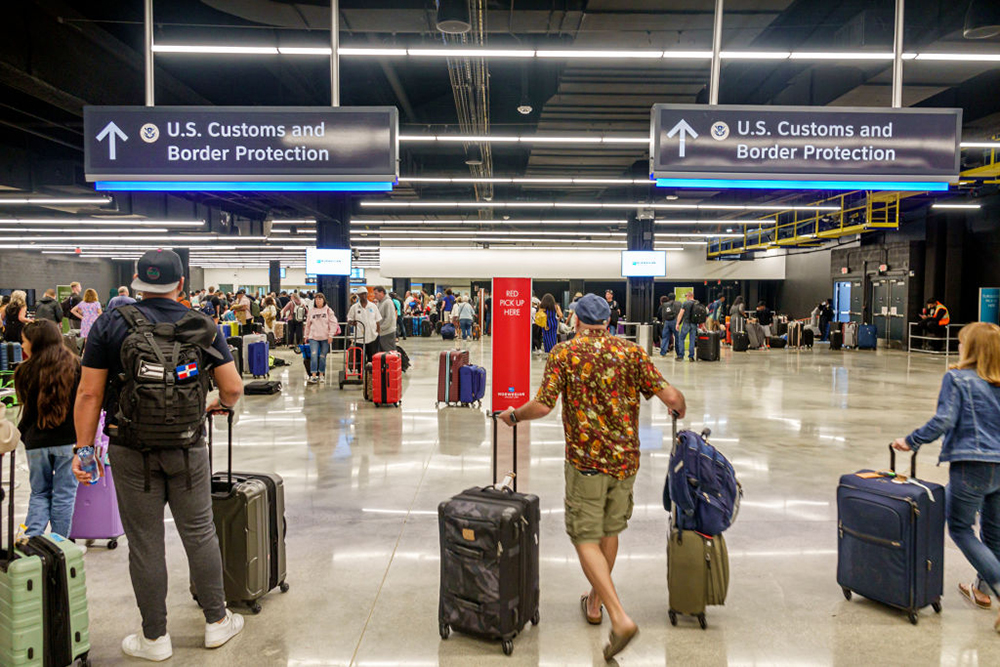
A frisson of fear tends to run through non-Americans when they face immigration in the United States. For years, young Brits have been warned prior to their first trip: “When you meet the immigration officer, don’t make jokes!” To boys cultivated to be insouciant in Britain’s posher schools, this usually means approaching the booth nervously repeating, “Don’t say bomb, don’t say bomb” – hopefully under their breath.
However, I’d say the officers guarding America’s borders are among the most welcoming, and sometimes even funny, I’ve met – I’m excluding ICE, who sound awful. It’s often a surprise given I’m usually arriving from a country firmly on America’s State Sponsors of Terrorism list: Cuba.

If American immigration is intimidating for Brits, imagine what it’s like for Cubans. My adopted home is, after all, an island from which many people have died trying to get north on small rafts. And it’s now a place to which émigrés are being returned in record numbers.
There used to be a “wet-foot/dry-foot” policy that meant any Cuban who stepped on to US soil could stay, while those picked up in the sea would be returned. That led to a situation where a raft became snagged on the stanchion of a wrecked bridge in the Florida Keys – but because it was no longer attached to land, the poor escapees were sent back.
If American immigration is intimidating for Brits, imagine what it’s like for Cubans
But “wet foot/dry foot” went out with Barack Obama and, of course, the laws have become a great deal harsher since. Despite having all the right documents, my Cuban wife goes very quiet as we approach Miami immigration. And then, as we walk away, the officer having, say, regaled us with stories about his Cuban wife, she’ll shake her head, and mutter, “Always a surprise.”
Still, you need to have your papers in order. Do something wrong, and a chill descends. Thanks to Cuba’s place on the State Sponsors of Terrorism list (which is ridiculous, by the way: Cuba’s government can’t even sponsor its electricity system), even non-Cubans flying from Havana to Miami get themselves in a terrible mess.
That’s because you are not allowed to enter the US on an ESTA, the first world’s all-but-ubiquitous visa waiver, if you’ve been to a country on the terror list. Lining up to check in for a US-bound flight, I’ll often find baffled tourists at Havana’s José Marti Airport being told by the desk clerk they can’t board because they don’t have a visa. “Go to the US Embassy,” the clerk will tell them. Then I’ll sidle up and say, “Don’t go to the embassy. Go to Mexico.”
It’s not all sunshine once you’re on US soil though; I’ve had my run-ins. There was a terrible trip into Las Vegas from Mexico City. A four-hour line led, finally, to an aging officer with a mustache like Billy Bob Thornton’s dad in Landman. He glanced up at me and asked, “What drugs are you bringing in, then?” I had to bite my tongue so hard it bled.
I decided to apply for global entry, the electronic pass that allows the citizens of 22 countries to avoid the line entirely. Get that and you only need to deal with facial-recognition software. You do need to go through a human interview to get the pass, though. Mine took place in a room in Miami Airport Cubans call the “fishbowl” – because that’s where they get sent if the officer at the booth thinks they need further questioning. “I’m not saying you will never have to speak to an immigration officer again,” said the officer who interviewed me. “And I’m not saying that officer won’t be an asshole because let’s face it some of them are – but having this should make things much easier.” I remember thinking, ah, America, how I love you. The Cubans, Haitians and Venezuelans in the room may have felt differently. This is what people mean, I think, when they talk about privilege.
My favorite thing about global entry, though, is that the Irish can’t get it (amazing given the US’s love-in with the Emerald Isle). I have a friend here, let’s call him Patrick, who has a habit of sending me photos of his enjoying seat 1A in various fancy aeroplanes. I enjoyed arriving in Miami with him and bidding him farewell at the start of the immigration line, saying: “Enjoy your next business class leg – if you make it!”
Still, I kind of miss the American immigration officers. Nothing brought this home like arriving in London with my wife and young son and being directed into the family line. In the US, this would be expedited, but in Britain it turned out to be a bureaucratic version of the phrase “seen but not heard,” a two-hour snaking hell of squalling children punctuated by the occasional single bloke who thought he’d been clever.
Finally, we reached the front and I said to the officer: “That’s quite the queue you’ve got there.” He looked over my shoulder at the Hieronymus Bosch scene behind, and said: “Yup, I’d machine gun the lot of them.” I smiled at my wife and said: “Welcome to Britain.” That being said, if a US immigration officer had uttered that phrase to me, I’d have dived to the floor.






Comments