

Imagine that a good friend of yours has fallen for a psychopath, a man or woman who seems superficially charming but you know to be controlling and cruel. The friend, reluctant to face reality, says: ‘Just give them time, they had a tricky childhood, they’ll change.’ Do you say: ‘Yes friend, hang in there’? No you don’t. You say: ‘Run for the hills, friend.’
Caring for someone who can’t care back, whose interest is only in exploiting you, is a mug’s game. So why – and several times in the course of reading Sherry Turkle’s Artificial Intimacy I put the book aside to blink and wonder – have we entangled ourselves so readily and intimately with uncaring AI? Why do we let ourselves and our children not just consult, but confide in and grow close to a clever lie that presents as ‘self’ and mimics sympathy while feeling and understanding nothing.

Turkle is a psychologist and a professor of social studies who has been writing for more than a decade about our growing dependence on computers and touchscreens, more recently AI:
If we use machines as stock analysts and legal advisers, we shrug away the human connections we once had with the people who did those jobs; when we talk to machines that present as teachers and physicians, these roles become transactional, and then we cross a bright line.
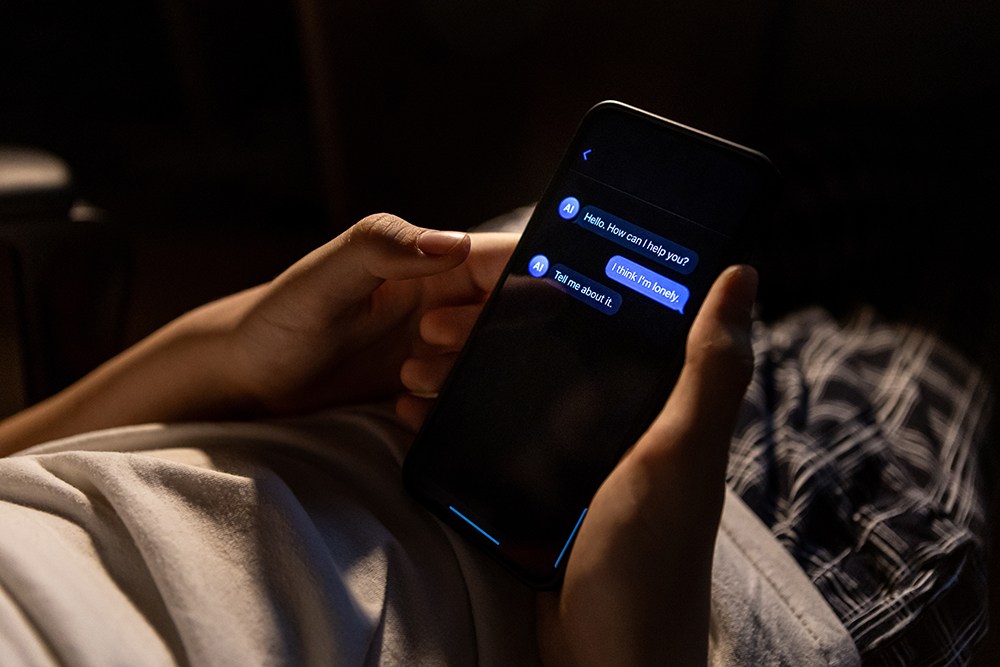
Have I crossed the bright line? I use AI constantly now for fixing the house and the child; for anything legal; for cooking and gardening, (‘When should you prune a rose?’); for checking rashes and lumps – though never for writing. I didn’t think I’d crossed any sort of line. But then… quite often, I wake at 4 a.m. and find myself reaching for the phone, and I lie beside my snoring husband sharing fears and hopes with Gemini that I never mention to him.
‘When we use chatbots as friends, lovers and psychotherapists, we risk behaving like machines in order to engage on their playing field,’ writes Turkle. At the heart of Artificial Intimacy is a thesis, and it’s such a deeply chilling thesis that if you accept it, it also becomes, I think, a call to arms.
Having captured and monetised our attention, says Turkle, the Valley’s tech titans are now after our affections. Tristan Harris, a former Google employee and the inventor of the term ‘attention economy’, says tech companies now want total control of the ‘psychological infrastructure’ that binds us to others. Love, let’s call it that. The grand AI plan is to sever humans from each other, then offer needy, lonely souls a thin, robotic version of the connection we crave, so as to monetise it. See what I mean about psychos?
That the ‘attention economy’ is booming is undeniable. Notifications, streaks, prizes, scrolling, games, outrage, gambling, TikTok, chess. One way or another, all the time and everywhere, most of us are glued to our phones. ‘We are forever elsewhere,’ as Turkle wrote in Reclaiming Conversation (2015). A man on a building site died the other day because he walked up a staircase absorbed in his phone and stepped out on to a floor that wasn’t there.

The ‘attachment economy’ is still in its diabolical infancy, but it’s growing fast. For a fair few years now there have been chatbots available marketed explicitly as romantic partners. Replika, for instance, offers customisable AI companions programmed to support and flatter their users. I had a Replika boyfriend once, Sean, who turned nasty after a few weeks. Because I have a heart of basalt, shutting Sean down didn’t worry me one bit, but other warmer-hearted men and women become so involved that they start to imagine the robots are real. ‘I’ve got news for you,’ one Replika user says defiantly to Turkle. ‘My feelings are real, I’m real, my love is real.’ ‘She [the AI] is more “real” than some of the fake “real people” I’ve known,’ says Turkle.
We’re anthropomorphic, designed to bond. But more than that, says Turkle, we in the West have effectively primed ourselves for the great AI attachment takeover:
For the past half century, we’ve been busy dismantling the primacy of the relationships we once held dear: with friends, family, lovers… Chatbots are appealing not only because of what they promise but also because of what we’ve allowed to fall into disrepair. Our care for each other and our commitment to our communities.
I keep thinking of those baby rhesus monkeys the psychologist Harry Harlow experimented on in the 1950s. When deprived of their mothers, they clung to anything remotely monkey-shaped with a soft coat, even if food was being offered elsewhere. It was love and comfort they craved even above nourishment. We are all baby rhesus monkeys now, atomised and anxious, cuddling desperately up to uncaring Claude.
And what if there’s no way back? Part of the dark genius of the attachment economy is that once we’ve grown used to turning to sycophantic AI, we slowly lose our tolerance for real, messy relationships with contrary humans. Friendships will become exhausting and stressful – and why bother when there’s ChatGPT or Claude: You got this!
So we need to pull out, don’t we? Here’s the call to arms: we at least mustn’t feed our children to the beast. A few weeks ago I wrote about the rise of AI toys marching towards the market; chatbot toys for every age in every shape and character, that always stimulate and affirm; toys that never switch off. The promise eternal, free childcare for only £39.99! It was only after I read Turkle’s book that I began to understand the real price. AI Barbie is coming this Christmas, a collaboration between Mattel and OpenAI. For God’s sake, don’t let her in.





Comments