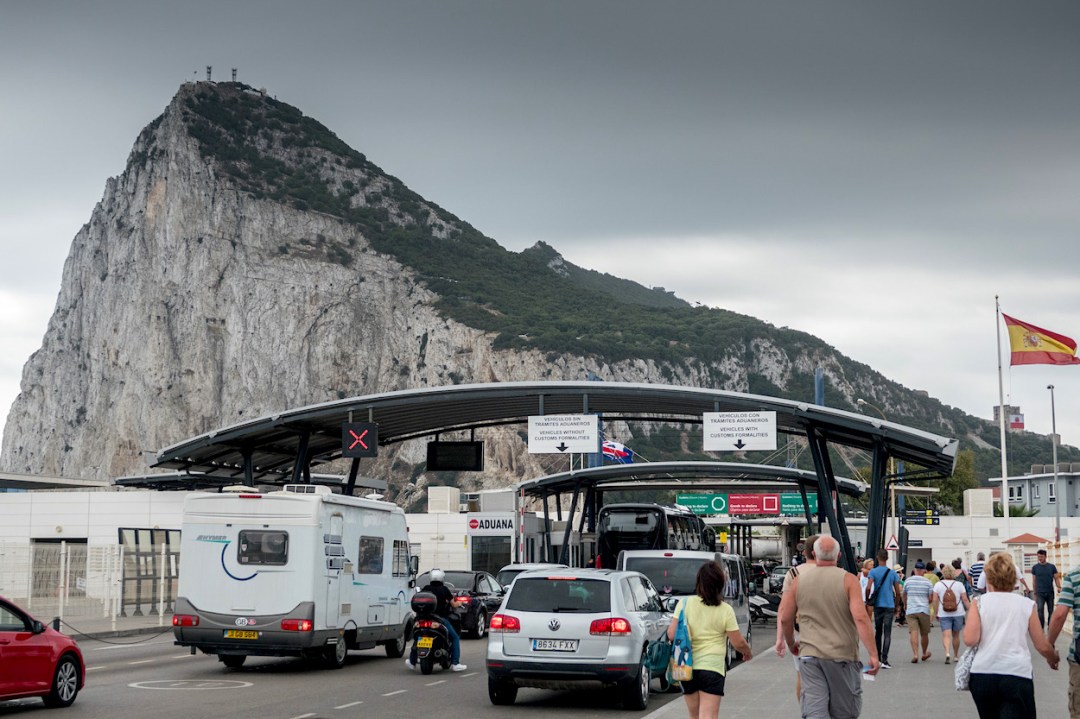
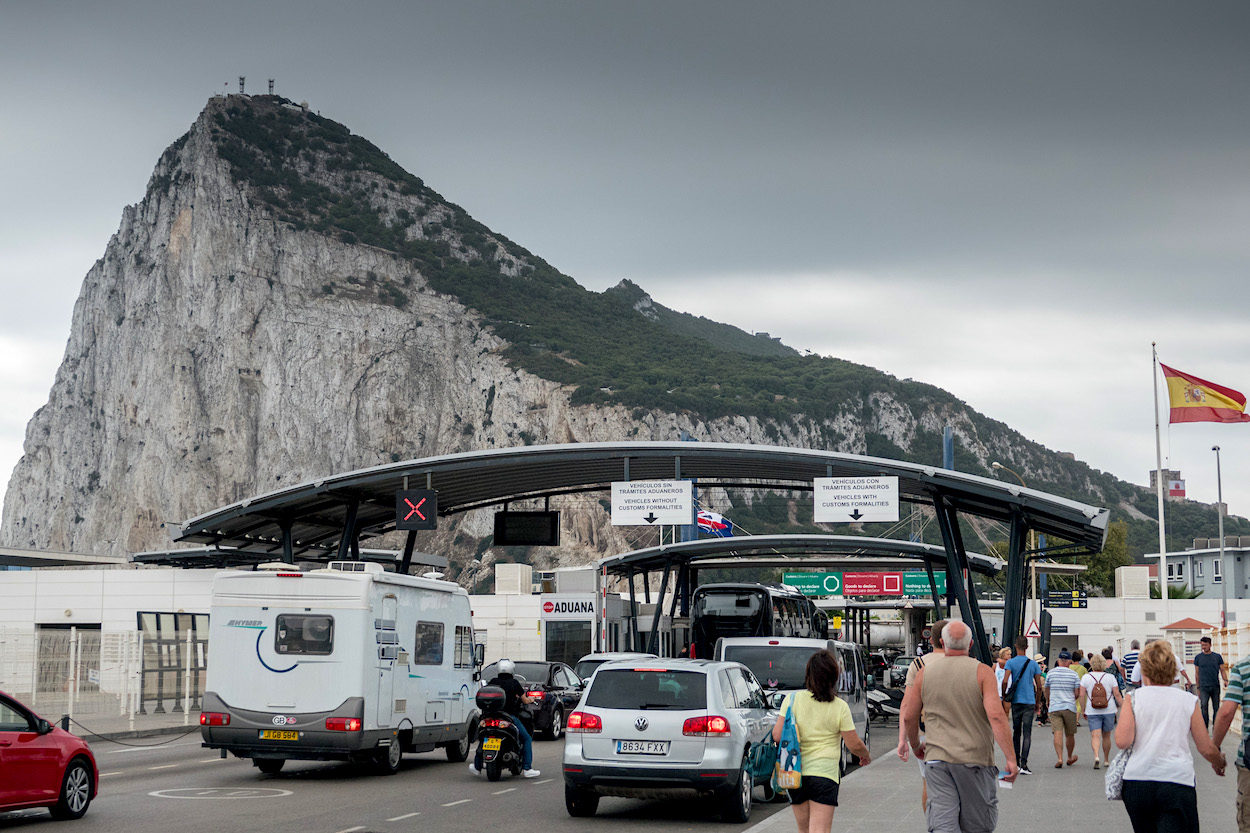
Key parts of the post-Brexit treaty that provides for a fluid border between Gibraltar and Spain will come into provisional effect today. Running to over a thousand pages, the treaty took far longer to negotiate than the entire Brexit Withdrawal Agreement. It has still to be ratified by the House of Commons and the EU parliament.
The treaty effectively makes Gibraltar part of the EU’s passport-free Schengen area. Both Spain and Gibraltar were anxious to avoid long waits at the border: the 15,000 Spaniards who cross every day are half of Gibraltar’s work force and they are also an estimated 25 percent of the wage earners in the adjacent region – one of the poorest parts of Spain.
Instead of occurring at the land crossing, immigration controls will now be centered at Gibraltar’s airport and, when necessary, the port. This shift effectively eliminates waiting at the frontier and allows for the partial removal of the 1.2 kilometers of border fence. Travelers will present their passports to both Gibraltarian and Spanish officials within a joint facility, known as the “Schengen shack.” This dual-processing model is designed to function along the same lines as the Eurostar checkpoints at London’s St. Pancras, where both British and French authorities conduct inspections before departure.
In the Brexit referendum 96 percent of Gibraltarians voted in favor of remaining in the European Union. Maintaining a connection to the EU’s single market is essential for Gibraltar: tourism, financial services and online gaming – three of Gibraltar’s four primary industries (the fourth is maritime services) – were established on the basis of such access. And now, as William Chislett of the Elcano Royal Institute, an international affairs think-tank in Madrid, points out, Gibraltar will, paradoxically, be more integrated into the EU than it was before Brexit.
Fabian Picardo, Gibraltar’s chief minister, certainly has no doubts about the treaty. “After Brexit, doing nothing would have left Gibraltar with a hard border: delays of up to six hours would have inflicted a devastating cost,” he says. “Compared to a non-negotiated outcome, this treaty could open economic value worth an estimated £200 million per year for Gibraltar, equivalent to roughly 6 percent of our GDP.”
Picardo also notes that the treaty is without prejudice to the legal position of the United Kingdom with regard to sovereignty. Gibraltarians like to point out that the Treaty of Utrecht (1713) ceded Gibraltar to Britain “to be held and enjoyed absolutely with all manner of right for ever, without any exception or impediment whatsoever.” And, in case that’s not clear enough, over 99 percent of voters chose to stay British in 1967 and almost exactly the same number explicitly dismissed a joint-sovereignty model in 2002. When, shortly after the Brexit vote, Spain submitted a proposal to the United Nations proposing shared sovereignty between the UK and Spain, dual citizenship for residents and a unique status for Gibraltar within the European Union, the offer was rejected by the Gibraltar government.
It might be worth bearing in mind, however, that the treaty is also without prejudice to the legal position of Spain. And Spain has long claimed the Rock, pointing out that the United Nations defines Gibraltar as a “non-autonomous territory that must be subjected to a process of decolonization”. Significantly, the treaty gives Spain the power to end the agreement.
Gibraltar is one subject on which almost all Spaniards are agreed
And it’s not difficult to envisage a scenario in which Spain decides to do just that. After the next general election (due by August 2027), it’s likely that a right-wing coalition of the Partido Popular and Vox will govern Spain. Both those parties have denounced the treaty. Alberto Núñez Feijóo, who would be prime minister, says that under its provisions, “The UK wins and Spain loses”, adding that “Gibraltar becomes a territory of the European Union just as the UK has decided to leave the EU.” Meanwhile, Vox says Gibraltar is “a territory illegally colonized by the United Kingdom.” Restoring Spanish sovereignty always looms large in the party’s manifesto.
That would certainly be overwhelmingly popular in Spain. Gibraltar is one subject on which almost all Spaniards are agreed: its status as a British overseas territory is an indefensible anachronism – it should be part of Spain. And since Gibraltar’s 38,000 residents depend on Spanish workers and imports of food, medicines and other supplies from Spain, the Partido Popular and Vox have always seen Brexit as a golden opportunity to make Gibraltar Spanish again. Might the temptation prove irresistible?
Picardo thinks Spain would be “foolish” to row back on the treaty, but concedes that “Nothing is impossible,” recognizing that “We need to be aware of how the dynamics of the rise of the far right might affect the composition of the European Parliament in future.”




Comments