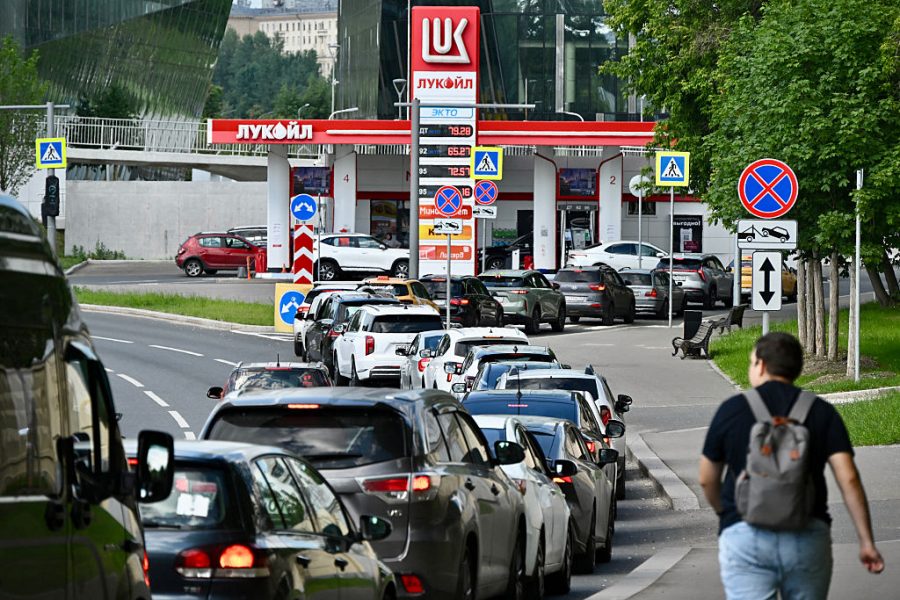
For a country that pumps roughly nine million barrels of oil a day – the third highest of any country in the world – Russia has managed to achieve something genuinely remarkable: it cannot keep its own gas stations stocked. More than half of its regions are now reporting shortages, the consequence of a Ukrainian drone campaign that has struck with increasing frequency and precision at the refinery infrastructure on which the country’s civilian economy depends. The sometimes hours-long lines that have appeared – even in Moscow, for what may be the first time in the war – carry a symbolic weight that no amount of official reassurance from the Kremlin has managed to dispel.
How this has come about is obvious enough. Since March, Ukraine has struck 26 refineries, hitting eight of the ten largest, and the damage has accumulated faster than repair crews can manage it. Moscow’s Kapotnya refinery, struck twice in June at 11-day intervals despite being surrounded by some of the densest air defenses in the country, will not return to operation until at least the end of the year.
This, in itself, demonstrates something significant: that Ukraine’s drones can now reach targets the Russian government considered off-limits. Before the strikes in June, daily refined oil output in April and May had already fallen by up to 700,000 barrels, or 13 percent. After the hits on Kapotnya and the TANECO plant, the loss of capacity may have approached 28 percent against prior years. This has left operating refineries producing roughly 85,000 tonnes of gas a day against a summer peak demand of around 110,000.
The Kremlin faces a choice between two forms of unpleasantness
The Kremlin’s response to this has been characteristically inventive in the statistical sense. Crude oil production data was classified in 2023, petroleum product data in 2024. Rosstat has also now announced that it will also stop publishing retail gas prices broken down by region. Unfortunately for Moscow, this is a decision that does not make the lines invisible or the rationing notices at forecourts any less legible.
There is, it should be said, enough fuel for the army, for key industries and for the harvest. The shortages are concentrated in the civilian economy, where the choice has become one between paying significantly more at independent stations, which are not bound by price controls, or joining the line and accepting that a half-tank may be all that is available.

What makes all of this politically awkward – in addition to the sights of people waiting for gas in the cities of an oil-rich state – is what a Gallup poll, conducted in the spring, found: that 60 percent of Russians said economic conditions were getting worse. This is the highest share recorded in two decades of polling and the first time pessimists formed an outright majority. Meanwhile, 56 percent said their living standards were deteriorating and trust in the military had fallen from 80 percent in 2022 to 66 percent today. These numbers were collected before the most recent wave of strikes, though.
The obvious response, and the one Moscow is actively pursuing, is to plug the gap with imports – buying fuel from Kazakhstan, from Belarus’s Mozyr and Novopolotsk refineries, and in quantity from India, where Russian crude is refined and the products shipped back. Draft amendments to Russia’s tax code would extend the government’s damper-payment subsidy to cover foreign-origin fuel. This sounds workable until one notices that the damper mechanism – which keeps pump prices some 20 to 30 roubles (26-36¢) per liter below market rate – is simultaneously the reason imports cannot be made competitive without state support and a mechanism that already costs the government hundreds of billions of roubles a month.
Extending it to cover Indian or Kazakh imports means paying twice: once for the shortage, and once more for whatever replaces the missing domestic production. Meanwhile, Firepoint, the Ukrainian drone manufacturer whose FP-1s struck Kapotnya, continues producing about 100 units a day with announced expansion plans, meaning the gap the imports are meant to close will in all likelihood keep widening. On top of that, neither Belarus nor Kazakhstan has enough spare capacity to fill the gap, and the logistics of importing fuel from India are unclear at best.
The deeper problem – and the reason the fuel crisis is more dangerous than the queue photographs might suggest – is not the shortage itself but what every available fix does to state finances that are already severely strained. The Bank of Russia has flagged rising gasoline prices as a key upside risk to inflation, which climbed to 6 percent in June against a central bank target of 4 percent. The inflationary pressure this creates is preventing the aggressive rate cuts that the Kremlin and the business community have been loudly demanding; Vladimir Putin himself has publicly pushed for faster easing, to no avail so far. A higher base rate makes investment in the non-defense economy harder to justify, keeps consumers cautious, and compounds a budget deficit that for the first five months of the year has reached 6 trillion roubles ($77.5 billion). This is already 60 percent above the figure planned for the entire year, even accounting for the windfall of higher oil export revenues from the Iran war premium.
The Kremlin now faces a choice between two forms of unpleasantness. It can absorb the crisis financially – importing, subsidizing, tolerating inflation, and borrowing more at the progressively worse terms that Russia’s bond markets are now offering, with long-term yields approaching 15 percent – and watch the fiscal loop of higher rates, weaker revenues, and a wider deficit tighten around the economy. Or it can move, visibly and unmistakably, toward an administered scarcity: price controls, ration cards, the explicit acknowledgment that market mechanisms have been suspended and the state is allocating resources by decree. Both options debilitate the economy, and neither addresses the underlying cause.
A different kind of government, confronted with this arithmetic, might by now be calculating the cost of continuing its war against the cost of a negotiated settlement that would, at minimum, stop the Ukrainian drones. The difficulty with Putin’s government is that the same pressure that might encourage a rational actor to seek terms tends to produce the opposite instinct in a regime that has staked its legitimacy on the narrative of an undefeated Russia — intensifying external strikes, raising the stakes high enough to force terms on the other side, seeking through force what the fiscal numbers have stopped providing. The gasoline queues will probably be managed, after a fashion and at considerable cost. What cannot be managed away is the question of where a government under that kind of pressure is likely to go next.



Comments