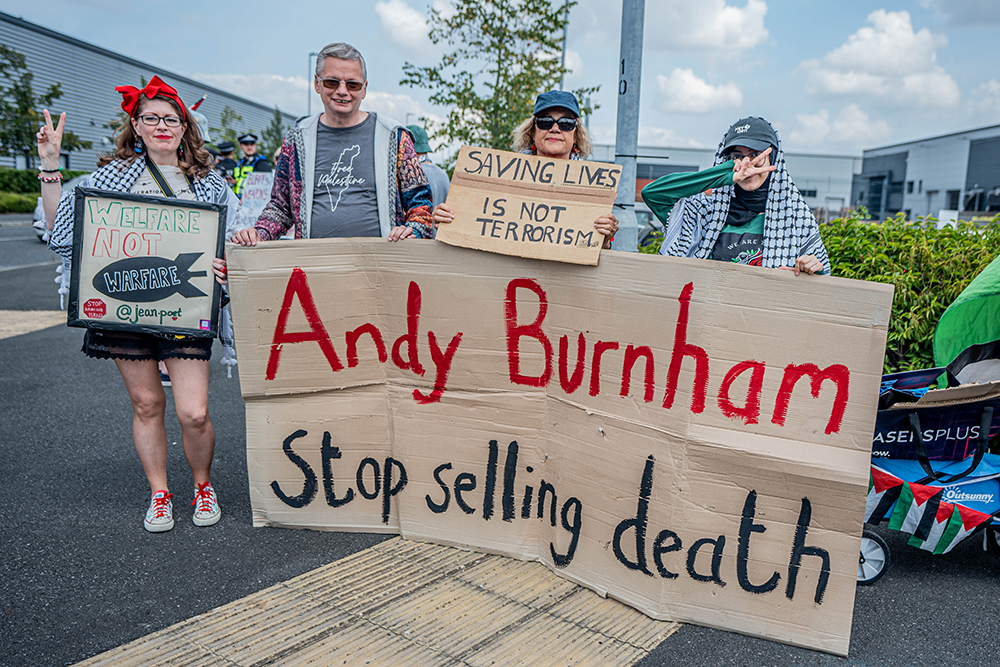
Prime Ministers usually wait until they have been in office a little while before issuing apologies. Andy Burnham made one before he even got to Downing Street – about Gaza. But whatever he’s planning, it won’t be enough to solve Labour’s Gaza problem.
After his by-election campaign, Burnham called Gaza ‘a scar on our collective conscience’ and posted a video on X saying Labour’s initial response to Israel’s actions there had caused ‘huge’ hurt. ‘We got it wrong and I am sorry for that.’ The apology did demonstrate the sure political touch that has propelled him to No. 10. It was in stark contrast to flat-footed remarks by Keir Starmer before he took office – retracted a week later – in which he said Israel had the right to cut off food and power to Gaza.
So what will Burnham do now to throw some red meat to former (or current) Labour supporters who are furious about Gaza? As a first step, there will probably be a ban on imports from settlements in the West Bank, where the government of Benjamin Netanyahu has been busy trying to redraw the map and expand Israel’s borders. Burnham has hinted at this and it was already being considered by his predecessor.
In 21 constituencies Muslims make up more than 30 per cent of the population and are deserting Labour
Doing nothing is not an option. There are 21 constituencies where Muslims make up more than 30 per cent of the population and they are deserting Labour. In the 2024 general election, Labour’s share of the vote across those constituencies collapsed from 65 to 36 per cent, a loss of more than 300,000 votes. Five pro-Gaza independents were elected.
That’s only the start of Labour’s Gaza troubles – and not because of the Muslim vote. Number crunching published by the Political Quarterly finds the Greens second to Labour in 39 constituencies. The report suggests that a five-point Labour-to-Green swing would flip 43 Labour seats to the Conservatives. In a tight election, that’s the difference between forming the next government, or not.
Some big names are at risk. Last time around, the Home Secretary, Shabana Mah-mood, saw her share of the vote in her Birmingham Ladywood constituency fall 37 points, giving her a majority of 3,421 votes. (If that still seems like a lot, Labour votes in Birmingham Ladywood used to be weighed rather than counted, as was once said about the Welsh Valleys.) Meanwhile Wes Streeting held Ilford North by 528 votes, a majority of just 1.1 per cent. His opponent was Leanne Mo-hamad, an independent running on Gaza.
The Defence Secretary’s recent criticism of Israel is, among other things, a survival strategy. Last week, Streeting said that Israel had ‘fallen short’ of British military standards. To be fair, these are also Streeting’s convictions. In text messages to Peter Mandelson – published in February – he says Israel is guilty of ‘rogue state behaviour’ and ‘talking the language’ of ethnic cleansing. ‘Israel is committing war crimes before our eyes… let them pay the price as pariahs with sanctions applied to the state.’

But there is little immediate chance of an arms embargo to satisfy the base. Streeting’s public remarks were delivered at the Farnborough air show, where several Israeli arms manufacturers had exhibits. Israeli software powers some of our weapons systems, for instance.
Streeting refused to say whether we should stop buying from Israeli defence companies: ‘Those are not my decisions alone.’ In theory, if not in practice, the Defence Secretary can decide not to buy a country’s weapons on national security grounds, though not humanitarian grounds. Then there’s the choice of what we sell to Israel. A Defence Secretary who believes Israel has committed war crimes could advise the rest of government not to issue any more export licences.
The most militarily significant things Britain supplies are parts for the F-35. Direct exports to Israel were stopped; what continues is Britain’s contribution to the global pool of spares from which Israel draws. British firms are said to build roughly 15 per cent of every F-35 by value, including the rear fuselage and the ejector seat. The defence secretary who advised that this should continue was John Healey, who said that to do otherwise would ‘undermine US confidence in the UK’.
Healey is now at the centre of government as Chancellor. If this is still his view, he may find an ally in the new Downing Street chief of staff, James Purnell, a former chair of Labour Friends of Israel. The Prime Minister himself is reportedly a member of Labour Friends of Israel and is also extremely wary of anything that would cause a breach with the United States. Burnham is continuing to allow Donald Trump to use British bases for bombing Iran.
Burnham – and now the government he leads – have been careful not to say Israel has committed genocide in Gaza. That was up to the international courts, he said before reaching Downing Street. It will be years before the International Court of Justice issues its final ruling on Gaza.
In the meantime, if Burnham feels the need to make a bigger gesture than banning imports from the West Bank, he may be surprised at how little difference that makes. The important relationship for Israel is with Washington. As one observer with good lines to the Israeli government told me: ‘The UK doesn’t register.’ This is true at the best of times, never mind in the run up to a bitterly contested Israeli election in October.
It would help Burnham if Labour’s sister party in Israel, the Democrats, end up in government. They are led by a former general, Yair Golan. Someone close to him told me that Britain could play ‘an important and in some cases unique role’ in helping Israel to make peace with the Palestinians.
But that is only one scenario and there is – always – the law of unintended consequences. Every international criticism of Israel helps far-right figures like Itamar Ben-Gvir. New sanctions on Israel by Britain would be a gift to him and others like him in the election campaign.
It would be embarrassing for the Prime Minister if taking the moral high ground gives extremists the balance of power in the next Israeli government. Burnham may find that Middle East politics are just as treacherous as those in the Labour party.






Comments