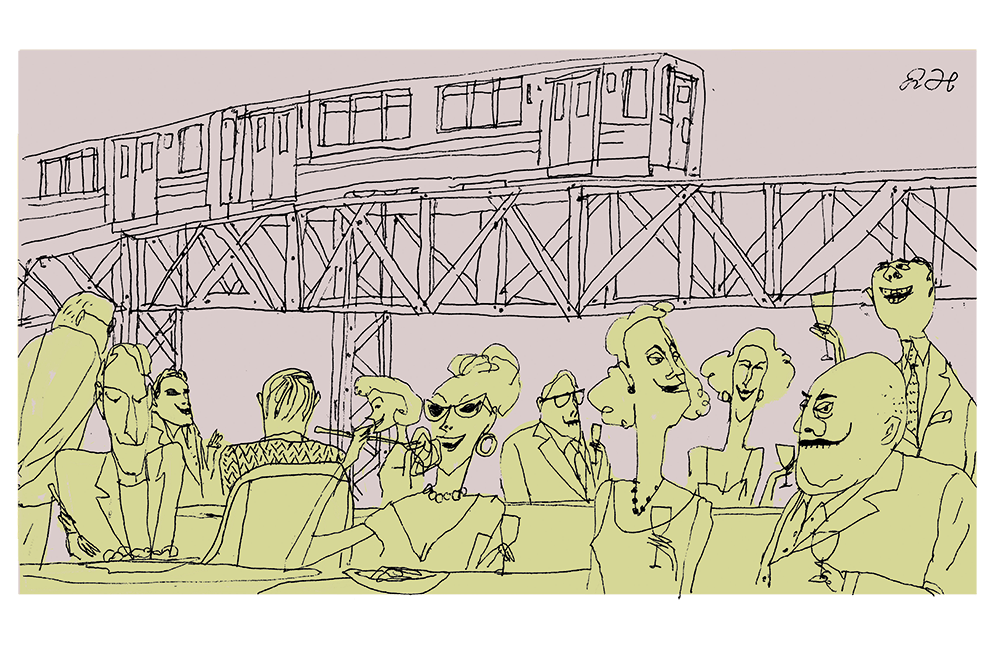

The food and drink editor was taken with my idea for a piece on the challenges of outdoor dining in the big city, specifically Chicago, the big city where I live. “Do you know when you might be able to file?” she asked.
“Ma’am,” I replied, “this morning it was 23 degrees Fahrenheit. One of the challenges of outdoor dining in Chicago is avoiding frostbite. How far can you push it out?”
The number of outdoor diners in Chicago killed by shrapnel is remarkably low
I would have preferred the Fourth of July. She gave me till the end of April. Fine, I said. Even in Chicago, two straight months of inhospitable weather would be unusual, setting aside that 43-day stretch when the mercury never got above freezing. (No joke. December 28, 1976 to February 8, 1977. Look it up.) But that was during winter. In spring, the temperature oscillates between 30 and 80.
The reporter bent on al fresco research must merely seize the day. I did. April 17. Normal high 52, observed high 81. My wife and I had a delightful evening. More on that anon.
Chicago doesn’t have a lock on bad weather. In Texas, judging from YouTube, they get hail the size of bowling balls. I’m never eating outdoors in Texas. In Chicago, this problem is unknown. Yes, we get derechos, which are sideways tornadoes. Based on one personal experience they’re freaky. Luckily, I was in the house at the window, about 100 yards off the line of travel. (Derechos are narrow.) Had I been dead center, all the trees would have been knocked over, and the power lines would have been pulled down, as occurred a block over. That would not have been a good time to be sitting outside under a Cinzano umbrella tucking into an artichoke. On the plus side, for anyone out of range and shielded from the torrential downpour a derecho inevitably drags in (said downpour is not narrow), an honest reaction would have been: “Whoa, that was cool.”
Back to our subject. Outdoor dining is strangely popular in Chicago. The weather isn’t the only challenge. The reader may interject: “Of course not! You’re in Chicago! It’s a war zone!” Please. Such views are exaggerated. The number of outdoor diners in Chicago killed by shrapnel is remarkably low, and if you’re really all that worried about it, the weight vest you can get at the CrossFit gym will double as a flak jacket. Newcomers hearing a loud noise may wonder: is that a motorcycle or a Gatling gun? But they get over it. Usually it’s fireworks. Not always. This is the US. That’s a subject for another day.
Noise in general, however… that’s a constant component of the outdoor dining experience, in Chicago as in any big city. The only possibly singular thing about Chicago is the volume. Take the local trains, known as the “L” because the tracks are elevated on steel structures. This amplifies the clatter astonishingly. It can’t be heard by orbiting astronauts only because the sound is attenuated by the vacuum of space.
You’d think the noise would discourage patronage at the many restaurants, coffee shops and brewpubs with outdoor seating unaccountably situated next to the “L” tracks. It doesn’t. These places pack in customers like the neutrons in U-238. How so? Because Chicagoans don’t register the noise. Evidence: my wife Mary, whose hearing is so sensitive that when I’m in the kitchen and she’s upstairs sleeping, she can still detect my dropping a grape. For 30 years we’ve dined periodically at a Mexican restaurant around the corner from the “L,” mostly at sidewalk tables where the sonic environment resembles the runways at O’Hare. I learned one day she didn’t realize the “L” was there. The unconscious ability to filter noise is useful in the city, she replied with some asperity, and it helps in marriage too.
Acknowledging such wisdom, I’ll skip past other irksome aspects of an extramural meal, such as fumes, dogs, animals in general (coyotes are more of a factor than they used to be), tippy tables and a suboptimal ratio of dining area to pedestrian path. Instead, I’ll focus on the positives, as exemplified by the excursion referenced above.
If you want a good day for outdoor dining in Chicago, April 17 is hard to beat, provided the weather cooperates. Your tax return is done, at any rate till the auditors get hold of it. The trees and lilacs are in bloom, enabling springtime scents to briefly overpower the car exhaust. A freak snowstorm can’t be ruled out (the latest ever in Chicago was on May 11), but at least you’re not in Milwaukee (May 27).
Best of all, the citizenry, including the restaurant owners, are prepared to pounce on opportunities. For us this meant digging out shorts, but the pros must invest in infrastructure. Chicago isn’t unique that way. In Paris when it drizzles, the staff lower large awnings to shelter the sidewalk clientele. In Chicago, where more formidable measures are required, pivoting windows enable prompt protection of those under roof, and some venues have roll-down doors of heavy-gauge metal in case things really go south.
Best of all, the citizenry, including the restaurant owners, are prepared to grab any opportunity
We’d never previously visited Il Milanese. If you like filet mignon, polenta and garlic spinach, you could do a lot worse. That was a bonus. The immediate draw was the ambience. The restaurant sat at a six-corner intersection. Three of the other corners were also occupied by outdoor cafes, all thronged. The streets were crammed with idiosyncratic vehicles and passersby owing to the p.m. rush. In short, a prime vantage for observing the urban parade.
You may say the streets of Rome are quainter and Lake Como offers superior views. The motorcyclist with the bear’s head helmet (not as in Chicago Bears, I mean a bear bear) was arresting, but no more so than the tall dude awaiting the Paris Metro in Sioux chief regalia.
But it was enough. We’d stuck out the pandemic. This was why.




Comments