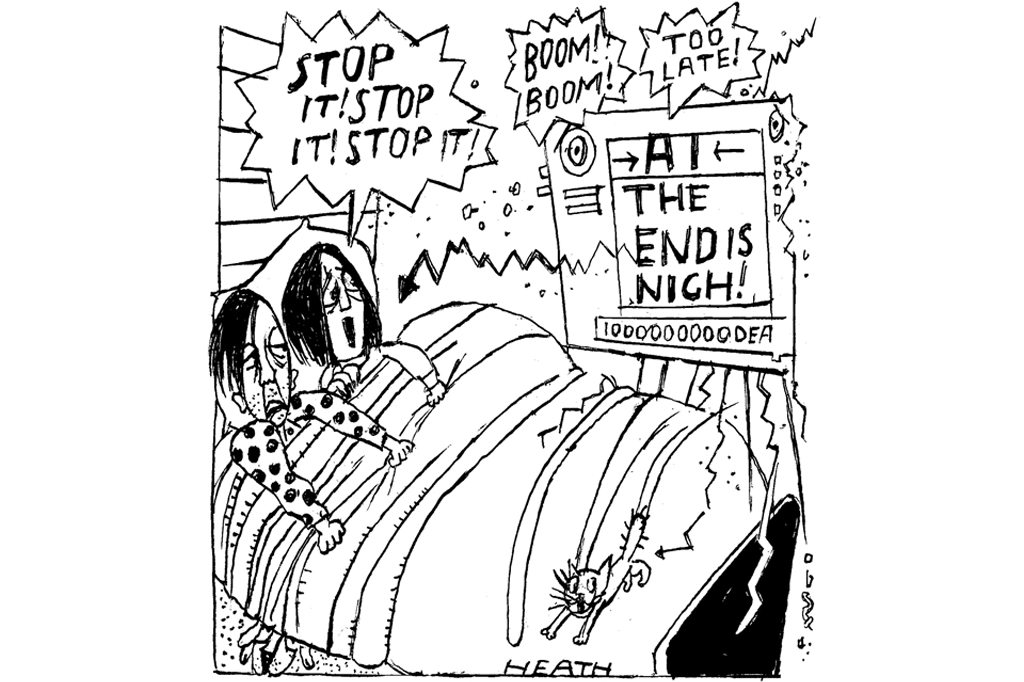
In December, I stumbled upon a new AI tool called Suno. The press release and a few fawning articles claimed that in under 30 seconds, it could a make a catchy, compelling song based on your prompt. It couldn’t.
Sure, it made songs, but they were uncomfortably awkward, the lyrics didn’t make any sense and you couldn’t listen to them without feeling deeply uncomfortable. I tried a country song about gay love, and it’s like a bad mirror of what a real song could be. I logged off Suno and didn’t think much about it again.
But this month, Rolling Stone wrote a feature on the company and some of their sample songs using Suno’s new version 3 model sounded eerily real — namely “Soul Of The Machine.” And yesterday, YouTube recommended a clip from my favorite streamer, Brandon G.H. Ewing — “Atrioc” online — where his chatter, taterade113, suggested “a bluegrass song about Putin’s reelection.” The result was hilarious; and very, very compelling.
So, it seemed about time I spend more time on it again; and my evening spent generating a Spectator-themed album was fun, revealing and deeply alarming. You can listen to the full album here by logging into Suno with your Google account, or on my Twitter thread.
For the unfamiliar, Suno works like other chatbots. It’s a simple text box, where you write an idea for the kind of song you’d like to hear, and in thirty seconds or so, it will produce a completed song for you, lyrics, vocals, instrumental and all. This can be an upbeat kids song about child labor, an opera about banning journalism schools, a “rebellious” reggae track on black tar heroin or any other song you can imagine. Though there may be some odd robotic quirks or strange lyrics, the end result is extremely convincing.
Unless told otherwise, you would think most of the songs on my Spectator album were performed by real musicians. To be fair, most weren’t the first version from my prompts, and required tweaking — with genre or with lyrics — but they’re still astonishing, and the fail rate was very low.
The only issue I found was that it would ban songs mentioning certain artists, like Taylor Swift, or wouldn’t understand a prompt, making a generic pop song that references a genre (like experimental jazz) instead of actually making a song in that genre. Similarly, it struggles when you feed it non-lyric text, such as some of the sung articles included below, as it doesn’t know how to sing them, and the vocals become very cloudy and robotic.
Behind the curtain, Suno is a deep-learning model trained on an enormous library of labeled, presumably copywritten, music, allowing it to authentically replicate the various sounds and signatures of it. The process is endlessly more complex than a sentence can summarize — getting it to understand vocals are separate from other instruments seems difficult and the lyric generation is handled by ChatGPT — but the core thing to emphasize is that the Suno team isn’t radically ahead of everyone else in their field. They’re just less careful, and are going to pay the cost. It’s just a matter of time until Suno get sued by a label like Universal Music Group.
It’s worth nothing that they put limits in place so you can’t make specific derivative music, but they’re easily bypassed. “Dreams and Sunshine” is meant to sound like the kids song channel, Cocomelon, which isn’t allowed; but simply typing it as “coco melon” got around this and created the desired result. You can also get around content flags by using homophones, such as using “heroine” to refer to the drug on “Light Up The Fire” and the limits are somewhat arbitrary. It was very skittish about gay references for my song “Demilitarized Desire,” but not “cuckhold” and songs about Jeffrey Epstein and playdates at P. Diddy’s house were totally fine.
I wouldn’t be surprised if Suno gets taken down by the end of the year; or at least, in its current form. But even if that happens, the fact that AI music is this good already — and so much better than it was only three months ago — shows it’s never going away, and the music industry is set to be utterly rocked.
If I was going to make some predictions: low-budget film and TV soundtracks will largely be made by AI, as will the backing music for every commercial and the intro theme for every podcast. Fewer artists will blow up on TikTok, as most background music for dances and memes will be AI-generated, and streaming services like Spotify are going to be in trouble. Chains such as Starbucks will be able to set up AI generating soundtracks for their stores, that can dynamically change based on customer activity — to encourage you to stay longer when it’s quiet, or get through quickly in rush hour — and nightclubs and gay bars will do the same, making bland commercial pop a thing of the past.
For your average, working musician, this looks disastrous; but there are some who will benefit. Live performance will be far more valuable, as will lyrical and musical complexity, because the AI makes definitionally generic music. Similarly, AI can assist in the creative process, allowing you to preview potential beats and hooks that you’re thinking about.
Lupe Fiasco has one of largest and most creative vocabularies in hip-hop — though not close to the GOAT, Aesop Rock — and AI can’t really compete with his penmanship. And so, he’s happy to work with Google’s AI system to help him make music faster and easier. Expect a lot of young, upcoming rappers and pop musicians to do the same, as one-man bands, backed by AI instrumentals.
And now; for our ironic, varied, Spectator album, which I made in an evening. Enjoy
A Spectator World AI Album
- “Spectator World, Your Source of Insight” — a high-energy pop advertisement for the magazine
- “In the Spotlight” — a pop rock anthem about George Santos and the Senate Bottom
- “Rigged Reality” — a grunge track from the perspective of Trump
- “Broke Generation: a Gen Z Musical” — a Hamilton-style musical about Generation Z not being able to buy a house and putting all their money in GameStop
- “Wings of Despair” — a slow soulful blues track about Boeing
- “Divine Intervention” — an uplifting gospel tune about banning TikTok
- “Russian Supermarket Run” — and old-school hiphop track about Tucker Carlson visiting a Russian supermarket
- “I Don’t Have Dementia” — a Nick Cave-inspired, psychedelic new wave rock from the perspective of Joe Biden. I wrote the lyrics, to see how well it would handle it, and the vocals are slightly more robotic and fuzzy, but it works for this style
- “Demilitarized Desire” — an raunchy gay country song about Kim Jong-un. This song had the most variations, with various lyrical adjustments, as Suno flagged the raunchier lyrics
- “The Legend of SBF” — a glam rock anthem about Sam Bankman-Fried
- “No More J-Schools” — opera about banning journalism schools.
- “Dreams and Sunshine” — a Cocomelon-inspired kids song about child labor
- “Not a Lizard” (Grime Version) — a grime rap from the perspective of Mark Zuckerberg
- “Not a Lizard” (Emo Version) — an emo version of the same song, with the same lyrics
- “Light Up The Fire” — a reggae track about not using weed, and that you should use hard drugs instead
- “The Light Inside” — an 2000s inspiring anti-suicide Christian rock track for Jeffrey Epstein
- “Shadow of the City” — “a black metal song about crime and homelessness in San Francisco” was the prompt, and this was the first result, unmodified.
- “Forever in the Sun” — a pro-Xi Jinping hyperpop song
- “Broken Glass Rebellion” — a Hunter Biden punk track
- “Wacky Adventures of Cockburn” — a Disney-inspired theme song for our gossip columnist, Cockburn
- “The UAE bid for The Spectator is finished,” A Synthwave Reading — a relaxing synthwave reading of Fraser Nelson’s article
- “Candace Owens out at the Daily Wire, An AfroBeats Reading” An afrobeats reading of our Cockburn piece on the news
- “Spectator World Bio – A Bedroom Pop Reading”
- “Suno is Going to Get Sued” — a bluegrass song about how the company responsible for making all these songs is going to get sued





Comments