
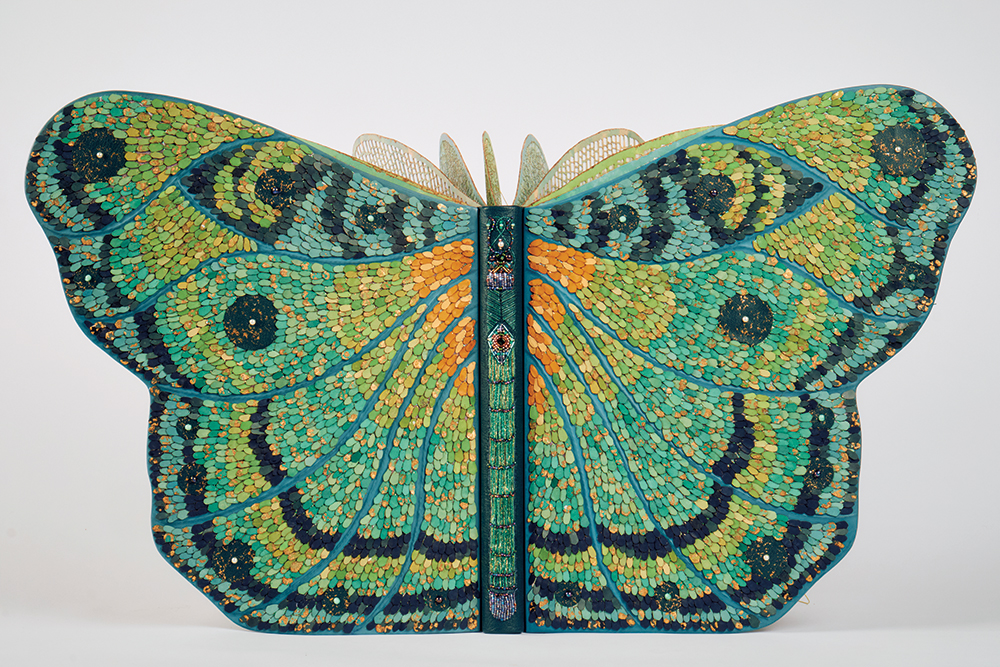
Kate Holland has what her father called a “butterfly brain”. The Somerset-based bookbinder and Homo Faber master artisan has spent three decades creating beautiful books that deftly straddle the line between novel and art piece; each is a handcrafted, artistic response to the text it houses, whether that’s a leather-and-gold-tooling interpretation of the Booker Prize nominees, or a first-edition Breakfast at Tiffany’s set with 1,000 white diamonds.
“I’m often told I have too many ideas for a book,” says Kate. “I’ve always been told to pare it back.” So, she has found it creatively freeing to allow her imagination to flourish in her latest work, ‘The Butterfly Mind,’ created as part of the Homo Faber fellowship and shown at Milan Design Week in April. The fellowship, run by the Michelangelo Foundation, pairs senior master artisans with emerging fellows for a six-month collaboration, culminating in a co-creation piece exhibited in Milan. Kate was paired with Emma Vukman, a young Danish maker who, after coming to Kate’s studio, discovered they had something in common. They both have “butterfly brains”; a flitting, hyper-associative mind that makes creative work both electric and exhausting.
‘I decided to put everything – all the ideas – on this book… as a response to every time I’ve been told to turn it down’
“We found a shared experience of living with the creative chaos of our brains, and so we decided we would make a book about butterflies,” Kate explains. “I decided to put everything – all the ideas – on this book, almost as a response to every time I’ve been told to turn it down.”
‘The Butterfly Mind’ is certainly all-in, made with an array of different craft techniques. Inspired by Linden Gledhill’s photographs of butterfly wings under high magnification, its covers are laden with laser-cut calfskin leather scales, glided and hand-colored, each one individually stitched onto iridescent organza. The pages inside are laser-cut paper with organza sandwiched between them, held together by fine threads running from the pearled covers, through the boards, and every page. When the book is opened, the pages fan outward in a shimmering figure that mirrors the tension of a butterfly brain: all that darting, brilliant chaos, pulled just taut enough to hold.
“This is more personal than anything I’ve made before,” says Kate. “It’s quite freeing to not be tied by a text. I do like the discipline of having to get your art into a restricted space, but I also really like the freedom of this project, which had no parameters at all.”
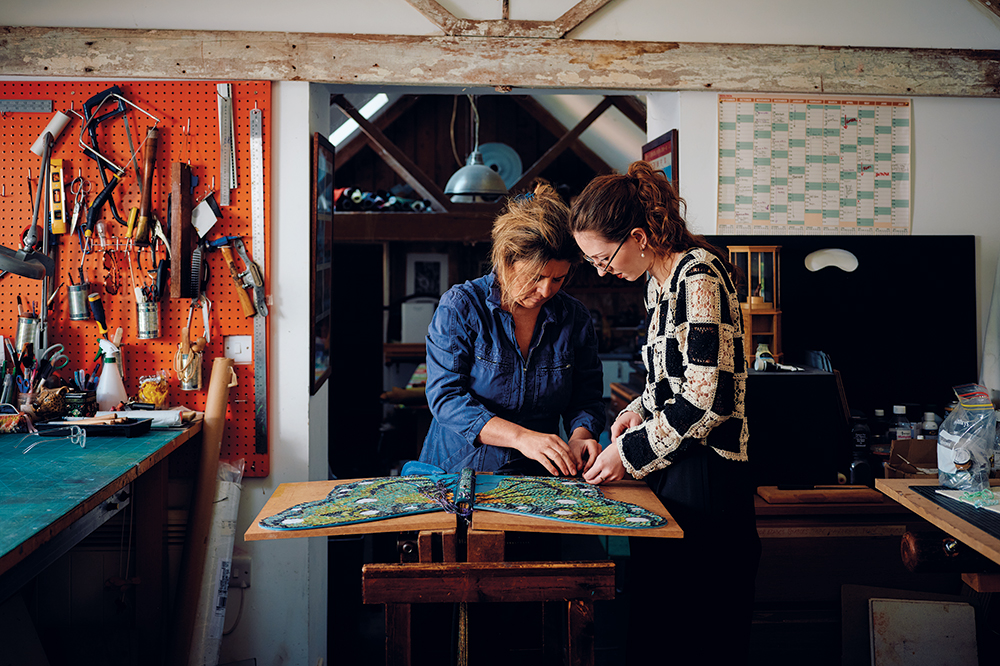
With this project, and her others, Kate’s mission is to show the world that bookbinding is still an evolving, innovative craft, even though it has used the same materials and techniques for hundreds of years. We are, she argues, in what some are calling a golden age of bookmaking. “Books are tangible and sensory,” she says. “You can hear the pages turn, feel it, smell it: it’s anti-AI, anti-information overload, and right now, people really want that.”
‘The Butterfly Mind’ will move from Milan to Denmark in June, before – Kate hopes – winging its way to Venice Design Week in October. It will also, eventually, be sold, returning it from sculpture to be admired, to a book intended to be touched, leafed through, and responded to. Even if it doesn’t have any words.






Comments