Sir Frederic Leighton was president of the Royal Academy, one of the foremost sculptors and painters of his day. And yet one imagines his neighbours may still have been taken aback when, in 1881, he added to his home, on a quiet street in Kensington, an Arab Hall three storeys tall, topped with a crescent moon.
At least they could finally see what the artist had been up to on his annual solo trips to the east: shopping. Inside, Moorish, Turkish, Byzantine and Pompeiian tiles and styles mingle like layers on a cake, and yet the effect is beautiful, perhaps because Leighton commissioned star ceramicists Walter Crane and William De Morgan to bring all his finds together. The centrepiece was a tinkling fountain and impluvium, complete with goldfish.
Today the fish are gone, but Leighton House is lovingly restored, and still a bold aesthetic gambit. Opulently fitted out with chartreuse silk walls and considered effects of light at every turn, it was Leighton’s mini-museum and his stage set, where visitors stepped into the atmosphere of his paintings. Built to Leighton’s specification by George Aitchison, it was designed for display and hospitality on the grandest scale – Queen Victoria visited in 1869. But Leighton’s bedroom, opposite his studio, was plain and monk-like, with a little single bed, as if he were married, in a sense, to art.
‘When painters depict painters, they often bring their best game’
A new show, Magic and Mess: The Artist’s Studio Revealed, which will be in the exhibition space until March next year, puts Leighton House in context, with 56 paintings, drawings and albumen photographic prints depicting artists’ studios from the long 19th-century. Although Leighton House is the only purpose-built Victorian artist’s studio-home now open to the public in London, it was once of a type, comparable with the bohemian palaces of his peers, those of G.F. Watts, Val Prinsep, Marcus Stone and J. Pettie (whose home, The Lothians, on Fitzjohns Avenue was a bold Scottish baronial) – all now lost and fabled.
Studios ranged from high to low, ‘basilica to bedsit’, as the catalogue has it. Antonio Canova’s studio and birthplace in Rome formed part of a must-see visitors’ complex, including consecrated temple. But at the other extreme, Sir Joseph Nollekens’s studio in Fitzrovia was shabby and troubled by rats, and the local brothel-keeper and supplier of life models, Mrs Lobb, kept coming in demanding money. All this was exposed in a tell-all memoir by a former employee published in 1829.
Most of the works on display in Magic and Mess come from Katrin Bellinger, who collects on the theme of ‘the artist at work’. Bellinger, formerly a dealer at Colnaghi specialising in Old Master drawings, is a benefactor of the arts, with a penchant for art about art; paintings about painting.

I say penchant, but her collection, growing since 1985, now includes 2,000 pieces. They rotate between being stored at her research facility, going on loan, and hanging on the walls of her home, not far from Leighton House. Initially she specialised in works on paper, but when her family expressed a preference for living with daylight, she started broadening her acquisitions.
‘I am fascinated by the mystique of the creative process,’ she tells me. ‘Artists on the road, artists in the studio, artists’ models – there are so many avenues to explore. That’s why I never got bored. I love the stories, the connections and finding great work by more obscure artists.’ For example, the painting of Alma-Tadema’s first London home, Townshend House, by Emily Epps Williams, the artist’s sister-in-law. It is a lovely, detailed panel painting – long and thin (82cm x 19cm), like looking through a keyhole. A sinuous blue hookah pipe hose lies negligently across the threshold, implying that the decor itself – the secret gleams of old gold in the dark corners, the daylight intensifying the red frescoed ceiling to blood – is in an altered state.
But in 1880s, when she painted this panel, Townshend House was already a memory, badly damaged when a passing barge on Regent’s Canal exploded, carrying nuts, coffee, petroleum and gunpowder: you can imagine the mess. The Alma-Tademas moved to St John’s Wood and began decorating afresh, with zeal; Emily Epps Williams completed no other known subjects.
The signifiers for a 19th-century artist included, of course, the brushes, the beret and the flaçon of wine. But also, the artist’s stove. It was a practicality, especially if a model was going to undress – and a symbol of passion and the creative spark. Once you get your eye in, you notice them in so many depictions of artists. Cézanne’s soot-black pot-boiler, grumpy, dumpy, but tenaciously alight, is on display, loaned from the National Gallery – an early work from about 1865, which he gave to Émile Zola, his childhood friend.
Successful artists’ studios were bedecked with objets: bronze jugs, feathers, rich fabrics, rugs, palms, taxidermy. There would be assorted hands, arms and casts. By the 1880s this was known as ‘Makartstil’ after the lavish interior of Hans Makart’s studio in Vienna. Leighton, though more restrained, still had a peacock (stuffed). Even the unsuccessful artist, the bohemian wannabe, had to have some objets, as we see in the satirical staged photograph ‘Glory and the Stew’ (Marie-Alexandre Alophe, 1858). Here, turning in one easy gesture from his easel to his lunch, the humble artist nevertheless has two useful treasures, hanging on the stovepipe behind him: two plaster-cast ears.
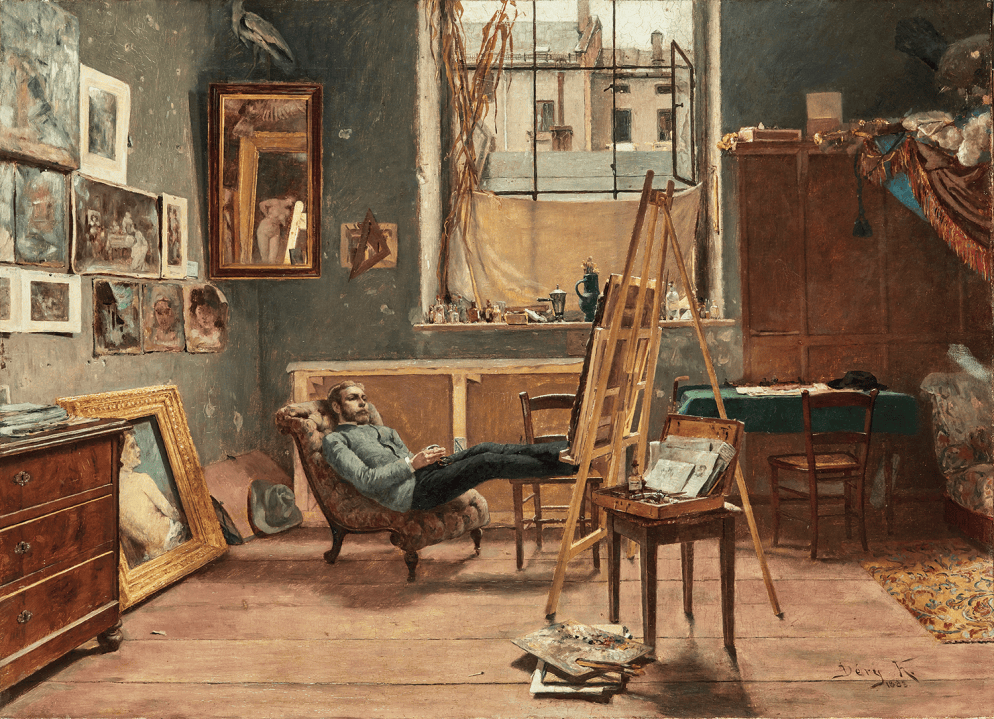
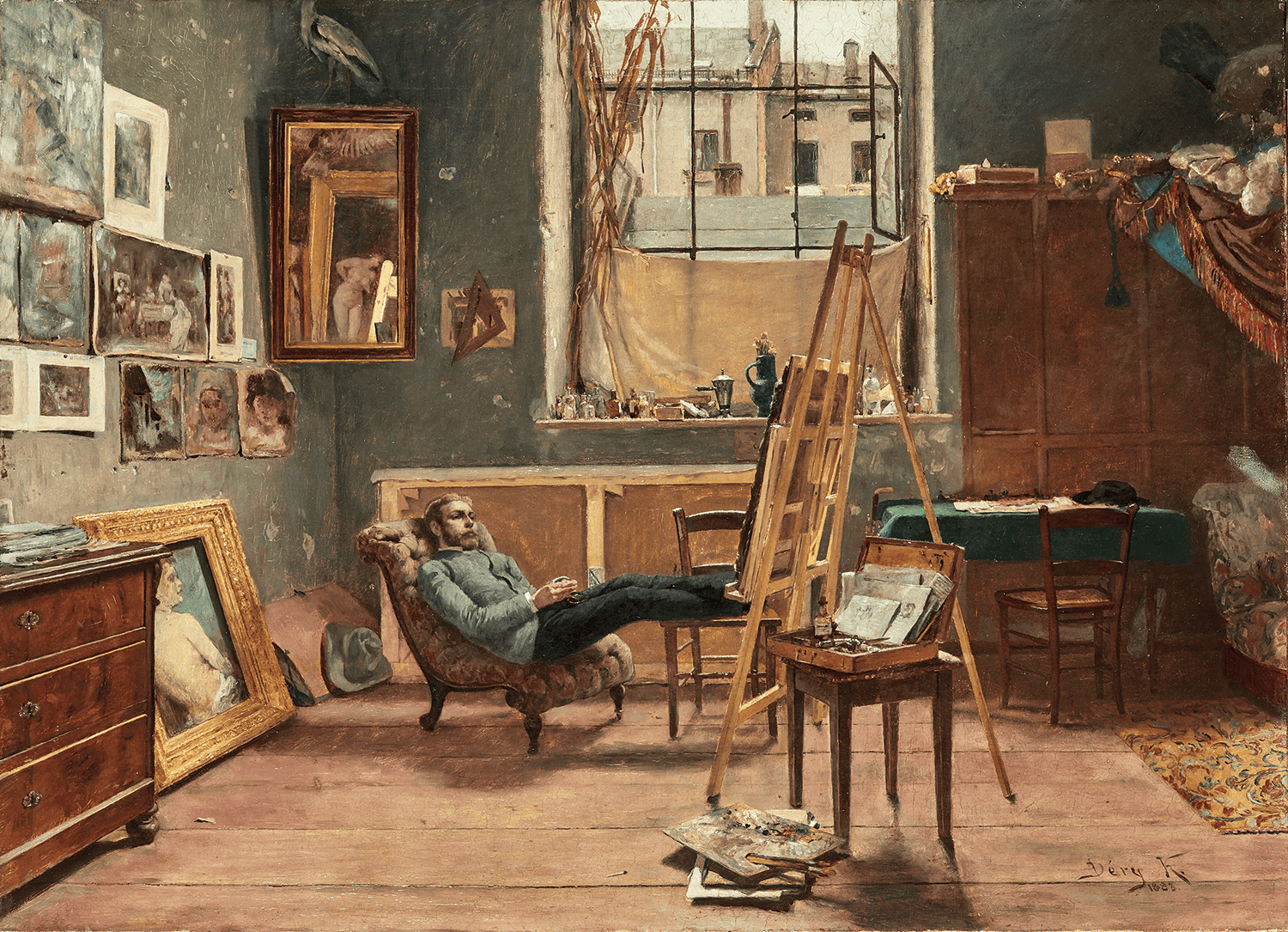
If windows were an obsession for artists, so, too, were window shades, seen here in opulent Mexican onyx (Alma-Tadema’s ‘In My Studio’, 1893) or Moorish tracery (Théodor Jacques Ralli, photographed in his Paris studio by Edmond Bénard, 1882). In ‘The Studio’, from c.1910, Sir William Orpen uses terrible light from badly controlled Venetian blinds to create a bold painterly pattern. But almost a century earlier, in Kalman Dery’s ‘The Painter’s Studio’ (1883), the struggling artist cannot yet see how to make everyday experience into art, and lies there, becalmed, with a drab improvised sheet over the window, plus some desiccated corn stalks representing, perhaps, his dried-up inspiration.
Artists’ paraphernalia range from the set squares and mahlstick that project such a calm air of mastery in ‘Caspar David Friedrich in his Studio’ (1811) by Georg Kersting, to the teetering piles of picture references and scattered pencils that surround Victor-Charles-François Mongodin’s ‘A Painter’ (1850). The last seems like chaos, but look closer and the artist is clearly in the ultimate flow state, the mountain range of mess his perfect working conditions.
The darkness of the empty attic implies that all the artist needs is the life-giving sunlight from the window
‘When painters depict painters, they often bring their best game,’ says Bellinger. ‘My parents collected expressionists because that was what you collected in Germany after the war, because the Old Masters were tainted by the Third Reich.’ She went to art school but ‘thankfully stopped after that, as I had no talent. I love to see artists at work. I enjoy the sense of peering over their shoulder, seeing how they do it.’
The artists here are often wearing slippers, hunched over, their intense concentration amplified, twinned with that of the unseen artist who is painting them. But the albumen silver photographic prints on display in the final room of this exhibition show no such intimacy, with the master artists rarely depicted at work, but posing for the camera, like Lord Leighton, dressed smartly, and performatively holding his brushes and palette.
Leighton was fastidiously respectable – the first artist to join the peerage by dint of his talent – and his models had their own off-street entrance and staircase up to his studio, with a changing area and fireplace. It was a practical working studio: the ‘picture slot’ in the wall meant his largest canvases could be posted out and winched down to the pavement without having to be removed from their stretchers. The same space became an otherworldly concert hall at night, when Bach’s Chaconne was played under the gold-painted dome in the presence of the artist and his paintings.
But the maximalist, objet-stuffed studio was not to last, as we see from Matisse’s ‘Studio Under the Eaves’ (on loan from the Fitzwilliam Museum). Painted in 1903, the darkness of the empty attic implies that all the artist needs is the life-giving sunlight from the window, its ceaselessly fascinating reflections and shadows, and one flower. Fauvism and freedom are coming! The artist, as this absorbing exhibition reveals, often provides the most incisive commentary on art.
Magic and Mess: The Artist’s Studio Revealed is at Leighton House until 21 March 2027.





Comments