Tate Modern feels vast and forlorn at the moment, as if not enough art could be found to fill it. Floors five to eight are sitting empty in the Blavatnik Building. In the Turbine Hall, Tarek Atoui’s Hyundai commission, ‘Hold’, with its self-playing Korean drums, Chinese mouth organs and 3D printed Uzbek horns, peters out midway through the Hall, refusing to fill the space, and refusing to organise sound into music or meaning. So it is a relief to fall into the embrace of Light and Magic, a big, ambitious show, in which each carefully chosen photograph is a gorgeous sufficiency, and a technical step forward.
Each carefully chosen photograph is a gorgeous sufficiency, and a technical step forward
The show seeks to present a world overview of pictorial photography 1880-1960 – pictorial being the opposite of reportage: photographs ‘as imaginative, expressive and technically considered as any painting or drawing’. Every photographer here has their own style, their eye, their métier. This is truly a celebration of the boundless possibilities of the medium, a whistlestop tour that goes from the languorous tableaux of Sharpoor N. Bhedwar, represented here by a carbon print from the 1890s, to Rodchenko’s constructivist take on a telegraph pole in the 1920s, right up to Park Young-sook’s wide-angle lens in 1964.
The biggest names in art photography are excluded: no Julia Margaret Cameron, Bill Brandt, nor Vivian Maier. No Cartier-Bresson, no Lartigue. No Beaton, no McBean. No Mapplethorpe. Instead, a host of lesser-known stars to learn and cherish. Gertrude Käsebier, genius portrait photographer of the American gilded age. Madame Yevonde, creator of high-society colour tableaux in 1930s London. Iwata Nakayama, Japanese surrealist of the 1940s, whose compositions and photograms aspired ‘to do something only photography can do’.
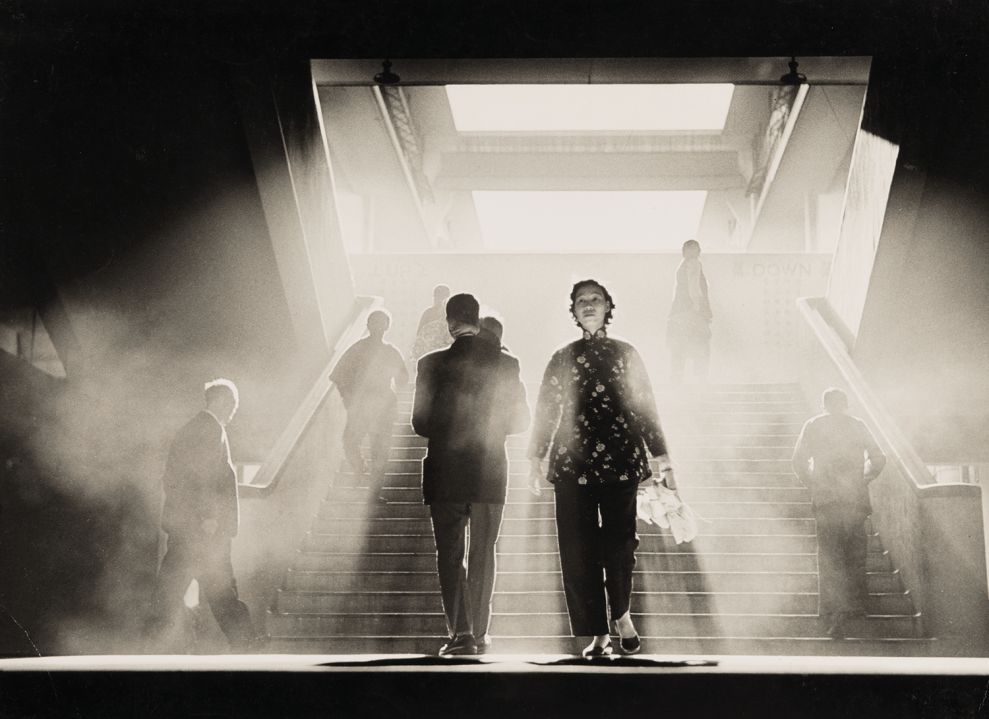
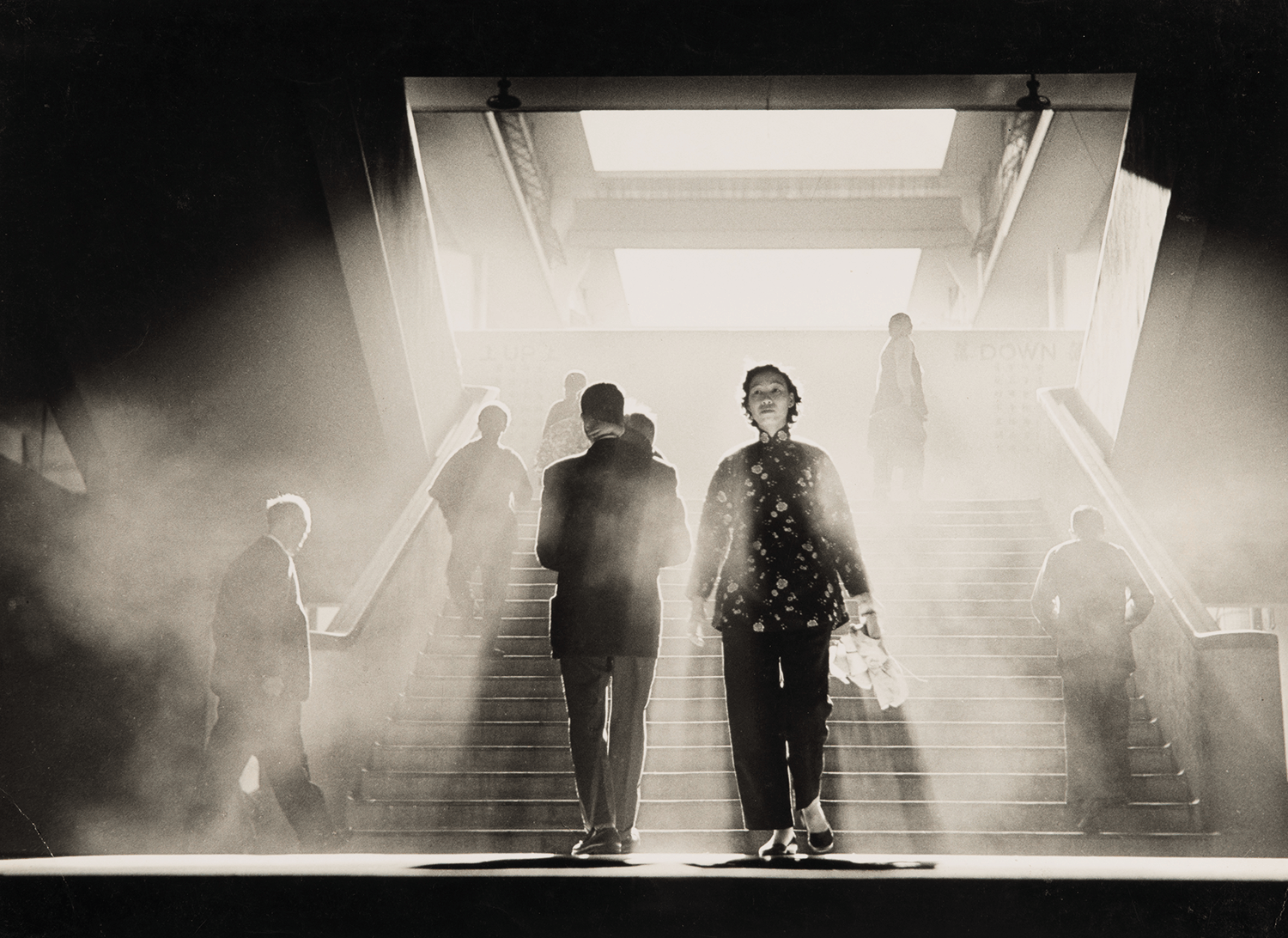
And Ho Fan, whom I’ll call Hong Kong’s Jacques Tati, because he recognises the madness of modern existence with such style and wit. His people, like Tati’s, are trapped or framed by train tracks and windows; he is sensitive to the worldview of children. His cinematic ‘Smoky World’ (1959) makes a stunning poster for this show. But when I saw it up close here in the gallery, it gained a whole new poignancy because I could see for the first time a child’s arm, reaching around the neck of the man bearing him upstairs, making new sense of the repressed emotion on the face of the woman rushing past.
In that picture, the ordinary bustle of city life becomes a stage set, and the passing people actors. Their clothes become costumes. I don’t know how Ho Fan achieved this alchemy. There’s no explanation offered in the show or catalogue. I don’t think he staged his photos, though pictorialism wouldn’t have minded if he had. Retouching, cropping, sleight of hand and advanced processing techniques are all used unrepentantly, if it serves the photographer’s vision. A simple sunlit bucket of water under a tap glimmers with post-impressionist splendour. Rural peasants with hoes look like romantic leads. It’s not the truth, it’s his or her truth. Perhaps that’s why everything here is so beautiful. Freed from the serious work of witness and the duties of objective reportage, the pictorialists had soul, poetry, style.
Even when a pictorialist photographer has something terrible to say, such as their experience of the trenches, they still made it majestic – see Cecil W. Bostock’s ‘Day Breaks: Cold, Shrieking and Bloody’ (1918-19). Elly Sougioultzoglou-Seraidari’s ‘Refugees in Attica’ (1925) look like Beckett’s as-yet unwritten Vladimir and Estragon.
Freed from the serious work of witness, the pictorialists had soul, poetry, style
The exhibition signage is generally poor, full of information about the boring stuff, but mute just when things get interesting. There seem to have been rows in every camera club about the purpose and direction of photography, with committed pictorialists usually splitting from their more literal-minded fellows to follow their own aesthetic lights. In Britain, the Linked Ring, for example, was founded in 1892 by a romantic breakaway group from the Royal Photographic Society, who used as their emblem three interlinked rings to represent the Masonic beliefs of Good, True, and Beautiful. In America, the equivalent group led by Stieglitz called themselves the photo-secession, founded in 1902. These groups were generally open to women and also had great porosity between countries, with many international connections, making this show’s story naturally, rather than wilfully, inclusive and global. But the catalogue takes things perhaps a little too far when it notes that the ‘important power figure’ Madame Mao was a pictorialist photographer, without explaining her role in the horrors of the cultural revolution.
There’s a good amount of detail about the history of photography – bromoil, photogravure and finally the Kodak dry plate in 1881, when developing photos became the work of a factory. ‘The operator need not learn anything about photography. He can “press the button” – we do the rest.’ I would have liked more commentary about the techniques in each picture – the cameras used, as well as focus, flash, darkroom tricks and long exposures, etc. For these are not quite lost arts.



Comments