

It’s a great shame that Elsa Schiaparelli is less widely known than her rival Chanel. Perhaps that’s down to how difficult her name is to pronounce. Is it “shap,” “skap” or “skyap”? Tristram Hunt, director of the V&A, answers with a quip from Schiaparelli herself: “No one knows how to say it, but everyone knows what it means.”
The V&A’s new exhibition Schiaparelli: Fashion Becomes Art traces the web of influences around one of the great couture houses of the 20th century. Like Coco Chanel (I hate to compare them), Elsa Schiaparelli created clothes for the modern, independent woman – it is now conventional to say so, but they “pushed boundaries.” Unlike Chanel, however – who is usually summed up with the idiotic word “chic” – Schiaparelli was daring, witty, difficult and strange.
She was born between a prison and an asylum and grew up under the influence of mad Italian aristocrats
“Schiap,” as she liked to refer to herself, began her career in fashion in 1927. She had found herself alone in Paris with her baby, Gogo, after separating from a failed fortune-teller. Obscure and by no means a professional seamstress – Chanel mocked Schiaparelli’s lack of training, calling her “that Italian artist who makes clothes” – she began designing knitwear. The V&A displays a trio of the adorable black-and-white jumpers – with sailor-smock and pussy-bow patterns – that shot her to fame. The style was lapped up in America but widely counterfeited, and she quickly moved on to the next thing – and, when that was copied, the next: sportswear, practical daywear and eventually eveningwear.
Her broad-shouldered suits, divided skirts and svelte, androgynous silhouettes became the uniform for socialites and intellectuals in Paris, London and New York. American Vogue’s Bettina Ballard described the Schiaparelli type as a woman “protected by an armor of amusing conversation-making smartness”; she dressed, among many others, Peggy Guggenheim, Josephine Baker, Marlene Dietrich, Katharine Hepburn and Greta Garbo. Her signature color was shocking pink: a blinding, hot, modern magenta.

Schiaparelli often played on her pet fascinations: omens, death, metamorphosis, the stars, the subconscious, our primitive impulses. A shoe might become a hat. A set of drawers would become a suit. She put Salvador Dalí’s lobster (he called them the “most erotic animals”) in an undeniably phallic position on one dress – famously worn by Wallis Simpson. Schiaparelli’s skeleton dress, which opens the exhibition, is an elegant but slightly monstrous piece, again designed with Dalí; the black fabric puckers and stretches around the quilted bones like a second skin.
She and Dalí collaborated on hats, suits and compact mirrors. He was one of several artists – including Pablo Picasso and Man Ray – who made paintings inspired by her pieces. Jean Cocteau’s drawings were embroidered on Schiaparelli jackets. Marcel Vertès illustrated ads for her Shocking perfumes, Leonor Fini designed the bottles and her salon interiors were the work of Alberto Giacometti and Jean-Michel Frank.
But can fashion ever really be on a par with capital-A Art? The exhibition’s title blurs the line between the two and aims to bolster Schiaparelli’s claim to a place within the ranks of surrealism. She must have felt a kind of insecurity about that division between fine and applied arts. In her autobiography, she wrote that her collaborations with artists made her feel “understood” beyond “the crude and boring reality of merely making a dress to sell.”
André Breton criticized other surrealists for “selling their souls to commerce,” but consumerism was in keeping with the movement. René Magritte ran an ad agency. Dalí designed logos (including the one for Chupa Chups) and dressed windows at Bonwit Teller, the New York department store. None of which should be surprising. After all, what is advertising and salesmanship but a play on our subconscious desires?
Schiaparelli is credited with inventing the walk-in boutique. The windows of her ground-floor salon in Paris’s Place Vendôme displayed ready-to-wear jumpers, skirts, blouses, and perfumes, tights and other accessories. Cocteau, writing in Harper’s Bazaar, called it a “devil’s laboratory” from which women emerged “masked, disguised, deformed, or reformed according to Schiaparelli’s whim.” At the center of Place Vendôme is a monument to Napoleon, dressed, auspiciously, like a Roman.
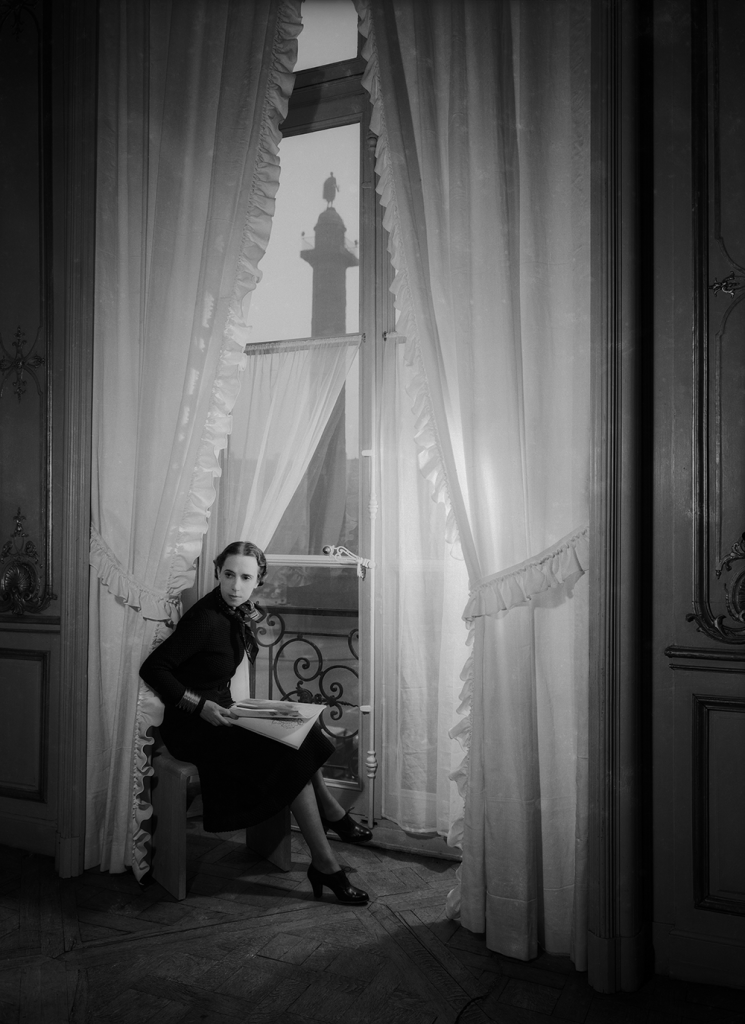
Schiaparelli was born between a prison and a lunatic asylum in Trastevere, Rome, and she grew up under the influence of slightly mad Italian aristocrats. Her father, a scholar of medieval Islam, had been appointed librarian of the Accademia dei Lincei by King Victor Emmanuel II. One uncle, a famous astronomer, discovered canals on Mars – Elsa remembers him saying he “believed that Mars was inhabited by people like ourselves” – while another relation discovered the tomb of Nefertiti in Egypt.
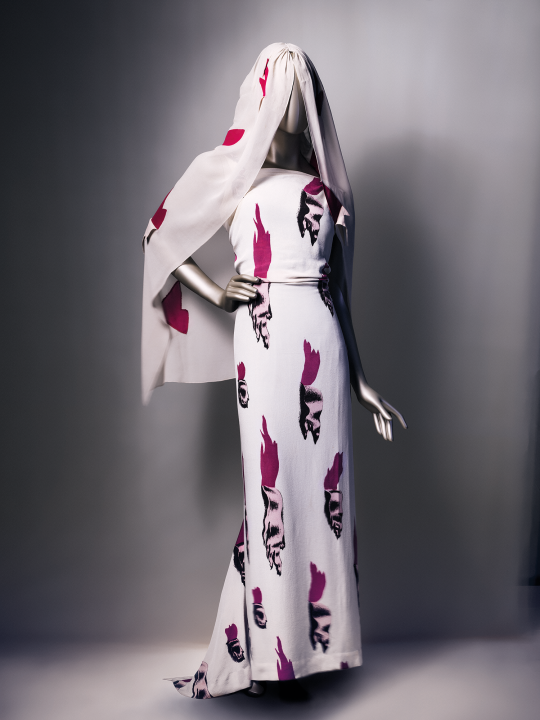
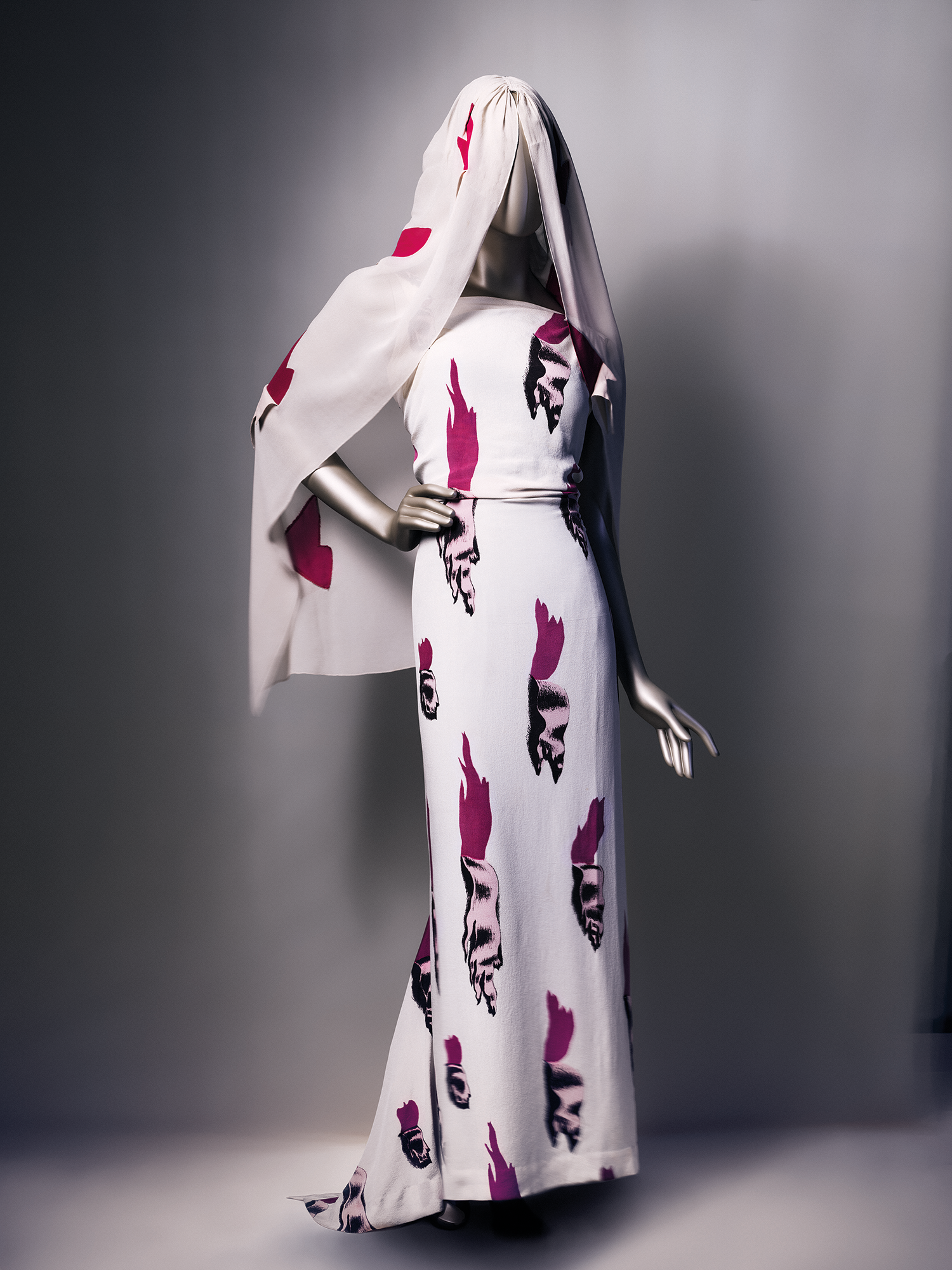
She was drawn toward mysticism from a young age, and saw in outward appearances visions of some hidden light. While preparing for her confirmation, she trembled in awe of the “magnificent blue and white robes” of nuns who, like vestals, kept the altar flame burning, “silently praying with their long trains sweeping out behind them like mystic wedding dresses.” This scene makes me think of one of her most famous pieces, the tears dress she designed with Dalí. It is white and veiled, with a pattern of trompe l’oeil rips – from a distance, they look like burning candles. Beneath the seemingly torn fabric is a deep pink. Is it another dress bursting through – a sort of chrysalis? Or a layer of flayed flesh?
Turning anatomical insides out is an idea that Schiaparelli’s current creative director, the Texas-born Daniel Roseberry, continues to play with. The V&A places his lungs dress, with its golden breastplate of dendritic pulmonary veins, next to Schiaparelli’s skeleton dress. It was worn by the model Bella Hadid on the Cannes red carpet in 2021. Schiaparelli liked to play “little jokes” that often became “big influences,” Janet Flanner wrote in her 1932 New Yorker profile of the designer. Buttons were often the victim of her delirium: she fashioned them from defunct French coins to mock the franc’s devaluation, and put carrot and radish buttons on a dinner jacket as food shortages hit German-occupied France. She made the dollar sign into a coat-fastener “just at a moment when the dollar had lost much of its power to make both ends meet,” wrote Flanner.
Roseberry, too, has a mischievous streak. The lung dress was a gesture toward Covid, he told Vogue, a “tribute to the idea of breathing.” Hmm. If less keen to épater les bourgeois than his predecessor, he can still create shockingly beautiful pieces.
She believed that a dress, once created, no longer belonged to her; another personality entered into it
Some original Schiaparelli feels almost as modern as Roseberry’s. I swore I had seen Sex and the City’s Carrie Bradshaw in Schiaparelli’s newsprint fabric – in fact Carrie’s was John Galliano-era Dior. I could hear other visitors cry “I would so wear that!” and “That could be in the windows at Liberty!”. That praise could also be a clue as to why Maison Schiaparelli closed in the 1950s. At a certain point, the avant-garde becomes the Liberty-friendly mainstream. (Her use of zippers, if you can believe it, was once controversial.)
Schiaparelli is a difficult designer to contain in a retrospective. Her pieces convey a sense of her otherworldliness and humor, but where is the struggle, dissatisfaction, defeat that she often felt? She believed that a dress, once created, no longer belonged to her; another personality entered into it, sometimes destroying it or turning it into a caricature of what she intended for it to be. Designing clothes was also, to some degree, a way of correcting her flaws. She believed she was ugly and felt that her life had begun with the disappointment of being named after a Wagnerian heroine: “Never was a name less appropriate.”
After World War Two, Christian Dior’s New Look offered women an escape back into the romance of soft, conventional femininity. The house of Schiaparelli declared bankruptcy in 1954 and its founder went into retirement. She turned away from the Place Vendôme – which “owned and claimed me too tyrannically” – to write her autobiography Shocking Life and, like a hermit or a mystic, to free herself “from the excess baggage of possessions and jealousy.”
I wonder, then, what she would make of Harrods, just down the road from the V&A. The London Schiaparelli boutique is situated in the department store, which does indeed feel like the devil’s laboratory – though not in the way Cocteau meant. Down some corridors that look like a construction site, following the signs for the loos, you will find Schiaparelli in a hall of “superbrands.” Fashion becomes art becomes superbrand. I suppose we can thank the surrealists for turning us into shopaholics.
Schiaparelli: Fashion Becomes Art is at the V&A South Kensington until November 8.






Comments