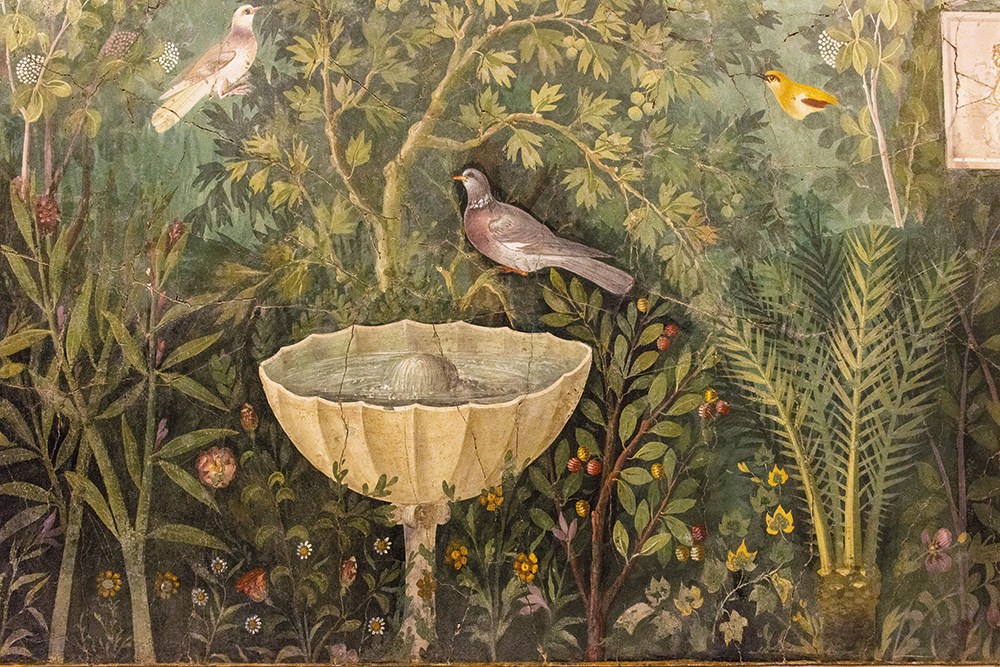
In The Garden Jonathan Bate leads us through 4,000 years of ‘green thought’, observing the interplay between literature, art and horticulture. Bate has long refused to be fenced in. His academic and biographical work ranges from Shakespeare to Wordsworth, John Clare, John Keats, F. Scott Fitzgerald and Ted Hughes. He is also an editor, poet, playwright and novelist. The Garden is the book he has waited a lifetime to write. It is both scholarly and relaxed, ambitious and kindly, bringing complicated ideas and feelings down to earth and grounding us in the humble human joy of real and imagined gardens.
The mapping of language on to gardens is a major theme from the start. Bate begins by rejecting the Oxford English Dictionary’s cautious definition of a garden: ‘A piece of ground, usually enclosed, where flowers, fruit or vegetables are cultivated.’ He favours instead Samuel Johnson’s dictionary definition of 1755: ‘A piece of ground enclosed, and cultivated with extraordinary care, planted with herbs, or fruits for food, or laid out for pleasure.’ The care and the pleasure are equally important to Bate. He takes a liberal and inclusive view, expanding Johnson’s definition further to include botanical gardens, garden cities, royal and aristocratic parks and allotments.
After visiting Italy in the early 18th century, William Kent brought back a vision of the Roman campagna
A chapter entitled ‘Arcadia Revisited’ opens with a quotation from Tom Stoppard’s play:
English landscape was invented by gardeners imitating foreign painters who were evoking classical authors. The whole thing was brought home in the luggage from the grand tour. Here, look – Capability Brown doing Claude, who was doing Virgil. Arcadia!
Bate highlights the role of William Kent, the son of a coach painter from Yorkshire, in bringing back to England a vision of the Roman campagna – rolling hills, temples, shepherds and shepherdesses – after studying the painted landscapes of Claude Lorrain and Nicolas Poussin in Vicenza early in the 18th century. At Rousham, in Oxfordshire, Kent designed a garden that ‘used topography as a storyteller uses plot: the sequence of scenes builds expectation, surprise and resolution’. In his The History of the Modern Taste in Gardening (1780), Horace Walpole considered Rousham the most engaging of all Kent’s works – ‘as elegant and antique as if the Emperor Julian had selected the most pleasing solitude about Daphne [the area around Antioch] to enjoy a philosophic retirement.’
While the English landscape garden is central to Bate’s story, he also draws attention to the walled garden on the south side of the house at Rousham with its 17th-century-style herbaceous borders, espaliered fruit trees and dovecote: ‘This older garden reminds us that English gardening had its own vernacular tradition.’ Bate evokes that tradition through Thomas Hill’s unfinished manual, posthumously published as The Gardener’s Labyrinth, by his friend Henry Dethick in 1577. Promising ‘new and rare inventions and secrets of gardening not heretofore known’, this occult-permeated book remained in print for a century and, Bate writes, ‘established a template for gardening literature that has never really been abandoned’.

Unsurprisingly, Bate’s discussion of Shakespeare’s gardening metaphors is outstanding. He reproduces the image of a waterpot from The Gardener’s Labyrinth to illustrate the Earl of Kent’s observation in King Lear that grief would make a man ‘use his eyes for garden waterpots,/ Ay, and laying autumn’s dust’, and explains:
The metaphor works because of its terrible inadequacy: human tears, however copious, are a minor irrigation when what is needed is a deluge. Kent recognises the pathos of trying to express infinite grief through finite means.
Bate traces the interest in Shakespeare and gardening back to the Revd Henry Nicholson Ellacombe’s Victorian classic The Plant-lore and Garden-craft of Shakespeare (1878), which inspired many other books on this theme. These include a dictionary of Shakespeare’s Plants and Gardens (2014), which has nearly 400 entries ‘ranging from individual plant names to kinds of apple to tools to horticultural practices like grafting’.
The Garden is not confined to England or the anglophone world. Bate quotes the passage in the Odyssey that generations of storytellers have regarded as a model for writing about green places. Rescued by Nausicaa and taken to her father King Alcinous’s court, Odysseus tells his stories in an enclosed orchard where ‘The West Wind always blows and makes it swell/ and ripen: mellowing pear on mellowing pear,/ apple on apple, grapes on grapes, and figs.’ And beyond the classical world there are the gardens and gardening traditions of Persia, China, America, Mesoamerica, Japan and the Antipodes.
Bate acknowledges the plunder, exploitation, enslavement and land clearance that were integral to many of the gardening achievements he mentions. There is a chapter on ‘Imperial Kew’, a title borrowed from Erasmus Darwin’s poem ‘The Botanic Garden’ (1789-91). At the height of the British Empire, Bate writes, ‘botany had become something like an intelligence service, gathering information from every climate zone and returning it neatly classified to the centre’. As a result, the herbarium at Kew contains more than seven million specimens, available for DNA analysis: ‘Kew embodies the height of scientific organisation, even as its backstory is a record of colonisation rendered as taxonomy.’
Much of the information Bate assembles is available elsewhere, in more narrowly focused books or online in blogs and podcasts. Some parts of the story are so well known that in less skilful hands they would be clichés – the extract from Andrew Marvell’s much quoted verse ‘a green thought in a green shade’, for example. But Bate deftly positions the poem as an extreme form of Epicurean philosophy and connects it to wider themes:
Here is a poem in which human ambition is displaced by green space. Marvell does not see the garden as a site of moral instruction or divine order; he sees it as a realm in which the mind might dissolve into the vegetal, the sapient into the sylvan.
In 1698, the lawn of Sayes Court was destroyed by the entourage of Peter the Great holding wheelbarrow races
Garden implements recur throughout the text in diverse temporal and geographical locations. Bate notes that the wheelbarrow was used in China as early as the first century. The Emperor Claudius’s wife Messalina rode through Rome in a wheelbarrow to plead her case to her husband, before she was murdered in the gardens of Lucullus in 48 AD. The lawn of Sayes Court, John Evelyn’s Deptford house, was destroyed in 1698 by the entourage of Peter of Russia holding wheelbarrow races. The lawn-mower was invented by Edwin Beard Budding in 1830 and exhibited at the Crystal Palace in 1851. Lighter models were designed in the United States in the 1870s and Bate imagines that the lawnmower which maintained the English garden at Gardencourt in Henry James’s The Portrait of a Lady was imported by Isabel Archer’s wealthy expat American uncle. The greenhouse arrived in domestic gardens in the 19th century and the repeal of the Glass Tax in 1845 helped reduce the cost of acquiring one. Bate quotes Thomas Hardy’s mournful poem ‘The Frozen Greenhouse, St Juliot’, written in 1913 after the death of his wife Emma the previous year.
The book ends on a note of determined optimism, encouraged by the sustainable gardening pioneered by the filmmaker Derek Jarman, whose gravel garden within sight of a nuclear power station inspired the plantswoman Beth Chatto to ‘nurture a botanical community that thrived on rainfall alone’. Looking forward to the year 2050, Bate predicts a peat- and pesticide-free garden full of ‘spontaneous wild flowers’ formerly known as weeds. The ethos of this futuristic garden is ‘one of gentle guidance rather than control’. It is not an isolated, enclosed Eden, but part of ‘a community-wide green network’ that extends its influence from street to street. ‘Gardening has become a form of collective environmental citizenship. One tends a garden not just for personal pleasure, but as a guardian of a tiny piece of Earth.’ This is Bate’s vision of a little paradise regained. We have four millennia questing for paradise behind us, and he gives us 24 more years to find it, if we are lucky.




Comments