Shakespeare

The monumental failure that was Henry VIII

From our UK edition

There can be virtually no aspect of Henry VIII’s life and reign, as Steven Veerapen puts it, that has not been ‘scrutinised under every available lens’. There have, of course, been any number of histories and biographies of Henry himself, and as many again of his wives and ministers to go alongside the films, plays and novels that, from Shakespeare to Hilary Mantel and (best of the lot) C.J. Sansom, show no signs of drying up. So ‘why bother writing about Henry VIII?’ Veerapen asks – and he’ll not be the only one wondering that. He is happy to concede that this is probably an exhausted seam from a narrowly English perspective, but what of other perspectives? What of Henry’s immediate neighbours, targets of the imperial pretensions suggested by this book’s title?

A funny, unorthodox Much Ado About Nothing

From our UK edition

You may need to do a spot of homework before attending Tilly No-Body at the Arcola. Acted and written by Bella Merlin, the play examines the sufferings and blunders of Tilly Newes, an actress born in 1886, who married the experimental German dramatist Frank Wedekind. At first sight the show looks like a lesson for newcomers but the content is bound to confuse anyone who lacks a working knowledge of German theatre in the early 20th century. The ideal viewer is a literary expert familiar with the whole of Wedekind’s dramatic output. Numerous lines from his plays are quoted, not always with intelligible citations. ‘Women are natural actors’, runs a typical aphorism, and ‘no woman can keep a man happy by behaving sincerely.

Reading between the lines: the power of the unsaid

From our UK edition

This is the kind of book I wish I had the chance to sit down and discuss with the author. It is accessible without sacrificing academic rigour, astute and ingenious in its close readings and balances breadth with depth admirably. But why on earth does it have a singular title, given that the whole thrust of the argument depends on silence being a multifarious phenomenon? The reader encounters the enigma of silence as rapture, failure, slyness, avoidance, challenge. Silence is both built into literature and a kind of enwrapping, enclosing ocean, out of which words will emerge and back into which they will sink, rather like the primordial chaos at the beginning of Genesis. Speaking or writing about silence is inherently paradoxical. Many years ago I interviewed A.S.

Me, myself and the i

Misuse of myself "should be a capital offence," suggests Oliver Duff, the editor of the i Paper. "As reflexive pronouns, myself and yourself require a prior subject (I, you)," he says. I applaud the prospect of a general massacre of abusers of the English language, but by Mr. Duff’s criterion, Shakespeare and Richardson, Ruskin and the great lexicographer Samuel Johnson himself should have been slaughtered. Historically, myself began not as a reflexive pronoun but as an emphatic, and as an emphatic it is often still used. Other constructions allow it too. In a letter in 1782, Johnson wrote that "both Williams, and Desmoulins and myself are very sickly." There it is used as part of a compound subject.

myself

Me, myself and the i

Misuse of myself ‘should be a capital offence’, suggests Oliver Duff, the editor of the i Paper. ‘As reflexive pronouns, myself and yourself require a prior subject (I, you),’ he says. I applaud the prospect of a general massacre of abusers of the English language, but by Mr Duff’s criterion, Shakespeare and Richardson, Ruskin and the great lexicographer Samuel Johnson himself should have been slaughtered. Historically, myself began not as a reflexive pronoun but as an emphatic, and as an emphatic it is often still used. Other constructions allow it too. In a letter in 1782, Johnson wrote that ‘both Williams, and Desmoulins and myself are very sickly’. There it is used as part of a compound subject.

Ruthlessly manipulative: Hamnet reviewed

From our UK edition

Hamnet is an imagined account of William Shakespeare’s marriage to Agnes (Anne) Hathaway, their unspeakable grief at the death of their son (the titular Hamnet) and how this may have inspired Shakespeare to write Hamlet. It stars Paul Mescal and an extraordinary Jessie Buckley, who will likely win every award going, yet be warned: it does do everything it can to make you cry. You can hold out and hold out and refuse to be emotionally manipulated, as you’re better than that, but when Max Richter’s ‘On The Nature of Daylight’ kicks in at the end you will give up the fight. Take a hanky if you do not wish to deploy your sleeve.

Shakespeare isn’t difficult

From our UK edition

Chloe Zhao may have co-written and directed Hamnet (a film about William Shakespeare’s son), but she claims that she couldn’t understand Shakespeare’s words and had to rely on the actor Paul Mescal to help her. You might have thought that Zhao, who spent her sixth form years at Brighton College (where, one hopes, she at least sniffed at some form of Shakespeare), could have bestirred herself to read one of the many editions with glossaries, or even to bone up on the CliffsNotes, but no. Instead, she is simply contributing to the enduring, frustrating idea that reading Shakespeare is ‘difficult’, as if it were on a par with analytical philosophy or Judith Butler wanging on about hegemonies.

Homage to the herring as king of the fishes

From our UK edition

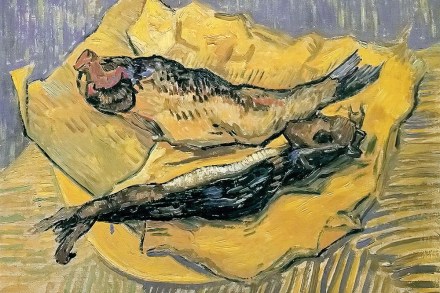
In 1755, Samuel Johnson (this was before his honorary doctorates) defined the herring as ‘a small sea-fish’, and that was it. By contrast, Graeme Rigby has spent 25 obsessive years documenting the cultural and economic importance of this creature. The resulting omnium-gatherum is like the bulging cod-end of a bumper trawl net, farctate with glistening details that embrace zooarchaeology, cooperage, otoliths, skaldic verse and Van Gogh’s ear. Clupea harengus is a highly adaptable, widely distributed marine teleost that can form shoals covering several square miles, and their milky spawning trails are so long they can be seen from space. The name may derive from the Germanic heer (army), and its nicknames include ‘Digby Chickens’.

This Othello is almost flawless

From our UK edition

Othello directed by Tom Morris opens with a stately display of scarlet costumes and gilded doorways arranged against a backdrop of black nothingness. This is Venice at night with no hint of sea or sunshine. Crimson-robed senators gather to discuss Othello’s alleged abduction of Brabantio’s daughter. And here he comes, David Harewood as the Moor, wearing a gauche two-tone suit like a tasteless guest at a wedding. The scene is stiff, arid and over-ornate but the show opens up when the location shifts to Cyprus. Warmth and light fill the stage and the costumes improve. Othello and his men wear creamy white battle fatigues that look stylishly and subtly masculine.

Letters: the Church of England still has something meaningful to say

From our UK edition

Moscow mule Sir: While visiting Russia, James Delingpole learned from the patriarchate’s press officer that under communism the Russian Church wasn’t allowed to exist (‘Letter from Moscow’, 27 September). However, that doesn’t accord with my own experience of being in the USSR during the Brezhnev era. As a student, I visited the 14th-century Zagorsk monastery complex just outside Moscow one Sunday and was spellbound by the heavenly chant of the Orthodox liturgy which lifted my soul. The church was full of babushkas as well as younger believers crossing themselves and kissing the icons. For all his faults and human-rights violations, Brezhnev, unlike Vladimir Putin, had not been indicted by the International Criminal Court for war crimes.

Shallow and silly: Born With Teeth, at Wyndham’s Theatre, reviewed

From our UK edition

Born With Teeth is a camp two-hander starring a pair of TV luminaries, Ncuti Gatwa and Edward Bluemel, as Marlowe and Shakespeare. The year is 1591 and the great dramatists are holed up in a tavern working on an early draft of Henry VI (Part 3). Not much writing gets done. It’s all rhetoric and bombast. Marlowe is a bullying egomaniac who boasts of his ‘throbbing quill’ and parades a peacock’s feather which he strokes lasciviously. Both playwrights are gay, of course, and they live in a world that views heterosexual couplings as a mystifying aberration. Marlowe prances about on the table and re-enacts his conquests of grateful gay aristocrats. He peels off his undershirt and flings himself at Shakespeare who responds with fake reluctance.

What does ‘hallmark’ have to do with cards?

From our UK edition

‘Do you know how many people Hallmark cards employs?’ asked my husband. I didn’t, and nor would he, had he not just looked it up on Wikipedia. ‘Seven?’ I replied. ‘No.’ ‘A million?’ ‘Now you’re just being silly.’ The reason that the birthday card people had come up was because James Heale began his column in last week’s Spectator: ‘If there is a hallmark of Keir Starmer’s leadership, it is a willingness to bash the left.’ I had wondered aloud whether a figurative hallmark implied something of value, like the marks on gold and silver. I thought the name of the Hallmark brand suggested as much. ‘When you care enough to send the very best,’ is the Hallmark slogan. But it turns out that the company was begun by a man called Joyce Hall.

Christopher Marlowe, the spy who changed literature for ever

From our UK edition

Stephen Greenblatt tells the story of being approached in the 1990s by a screenwriter who wanted to make a Shakespeare -biopic. Greenblatt repeatedly told him to forget Shakespeare and look instead at his predecessor Christopher Marlowe. The screenwriter knew what he was about and ignored Greenblatt’s advice – the result was Shakespeare in Love. The fact of the matter is that Marlowe’s life is the sort of thing that people assume would make a good film but in reality it was just too full of violence, passion and secret plots. By the time he was murdered at the age of 29 in 1593, Marlowe was enmeshed in far too much for a mere drama to set out. Biographies haven’t been lacking, many of them excellent. The allure is clear.

Brilliant rewrite of Shakey: Hamlet, at Buxton Opera House, reviewed

From our UK edition

‘There is good music, bad music, and music by Ambroise Thomas,’ said Emmanuel Chabrier, but then, Chabrier said a lot of things. I adore Chabrier – who couldn’t love the man who wrote España and turned Tristan und Isolde into a jaunty quadrille? – but it doesn’t do to take him too literally. Thomas ended his career as a notoriously crusty director of the Paris Conservatoire, and when the French musical establishment puts you on a pedestal younger composers invariably start hurling the merde. Scraps of Thomas’s music survive in all sorts of odd corners (a snippet from his opera Mignon crops up in The Life and Death of Colonel Blimp). I’ve always found it rather appealing.

The Merchant of Mar-a-Lago

While celebrating his signature legislative achievement, President Trump managed to wade into another ridiculous controversy this holiday weekend. In a Thursday night speech touting the benefits of the Big Beautiful Bill for family farmers, he said: “No death tax, no estate tax, no going to the banks and borrowing from, in some cases, a fine banker, and in some cases, shylocks and bad people,” Trump said. “They destroyed a lot of families, but we did the opposite.” “Shylock”, of course, refers to the Jewish character from The Merchant of Venice, who demands a pound of human flesh as repayment for a debt.

Trump shylock merchant of venice

Ingenious: the Globe’s Romeo & Juliet reviewed

From our UK edition

Cul-de-Sac feels like an ersatz sitcom of a kind that’s increasingly common on the fringe. Audiences are eager to see an unpretentious domestic comedy set in a kitchen or a sitting-room where the characters gossip, argue, fall in love, break up and so on. TV broadcasters can’t produce this sort of vernacular entertainment and they treat audiences as atomised members of racial ghettos or social tribes. And they assume that every viewer is an irascible brat who can’t bear to hear uncensored language without having a tantrum. The result is that TV comedy often feels like appeasement rather than entertainment. Theatre producers are keen to fill the gap, and the latest effort by writer-director David Shopland declares its ambitions in its title.

How tech ruined theatre

From our UK edition

Poor John Dennis. In 1709, the playwright devised a novel technology to simulate thunder to accompany his drama Appius and Virginia. The play flopped and was promptly booted out of the theatre. To add salt to the wound, Dennis’s thunder-generating technique was stolen and inserted into a staging of Macbeth. He accused the producers of ‘stealing his thunder’, birthing the phrase that has long outlived his work. Stage technology has come a long way since. Directors have a toy box of high-tech smoke and mirrors at their disposal. Perhaps it’s more of a Pandora’s box. Live on-stage cameras are particularly in vogue. Watch them crawling all over Jamie Lloyd’s monotone Romeo and Juliet and Ivo van Hove’s ill-fated Opening Night. They’re even parodied in Inside No.

Daniel Swift: The Making of William Shakespeare

From our UK edition

50 min listen

My guest in this week’s Book Club podcast is Daniel Swift. Daniel’s new book, The Dream Factory: London’s First Playhouse and the Making of William Shakespeare, tells the fascinating story of a theatrical innovation that transformed Elizabethan drama – and set the stage, as it were, for the rise of our greatest playwright.

Devastating: WNO’s Peter Grimes reviewed

From our UK edition

Britten’s Peter Grimes turns 80 this June, and it’s still hard to credit it. The whole phenomenon, that is – the sudden emergence of the brilliant, all-too-facile 31-year-old Britten as a fully formed musical dramatist of unignorable force. W.H. Auden had urged him to risk everything – to step outside his admirers’ ‘warm nest of love’ – and in the first moments of Peter Grimes, Britten does precisely that. The folk-opera bustle of the opening tribunal scene dissolves into the desolate bird cry of the first Sea Interlude and straight away, you’re in the presence of something unimaginably vaster and more true. It pins you to your seat. That was certainly the impression I had from Tomas Hanus, conducting the orchestra and chorus of Welsh National Opera.

What if Trump is just bonkers?

From our UK edition

‘I wonder what he meant by that,’ King Louis Philippe of France supposedly remarked on the death of the conspiratorial politician Talleyrand. Whenever a person behaves in ways we had not anticipated, it is a Darwinian and often useful human instinct to suspect a rational motive, and seek it out. So it’s unsurprising that in the world of commentary a whole industry has now arisen in search of an ‘explanation’ of Donald Trump’s various démarches concerning, for instance, Gaza, Greenland and Canada. And now he’s trying to wreck world trade.