
Even if you’re far from being a classicist and loved Christopher Nolan’s The Odyssey, it hardly paints an enticing picture of Greece as a holiday destination. But perhaps we can all admit that, lovely though they are, the Greek islands are becoming a little predictable.
A Greece that is lesser known, and far more exciting (dare I say, Homeric) is the Peloponnese. This is a dark and swarthy Greece – a better setting for parched shipwrecks and violent feudalism, as well as hidden hotels and good food. Haunted by Lord Byron and once home to the great travel writer Patrick Leigh Fermor, the Peloponnese is a region to get lost in.
And when the temperatures begin to roll away from the highs of August and Europe’s school-holiday tourists have gone home, you can go hours without seeing a soul. Driving down to the southernmost tip of continental Europe at Cape Tainaron, I spotted only two bored boys herding goats and one other lost tourist car as I spun the hired Škoda along some hair-raising roads.
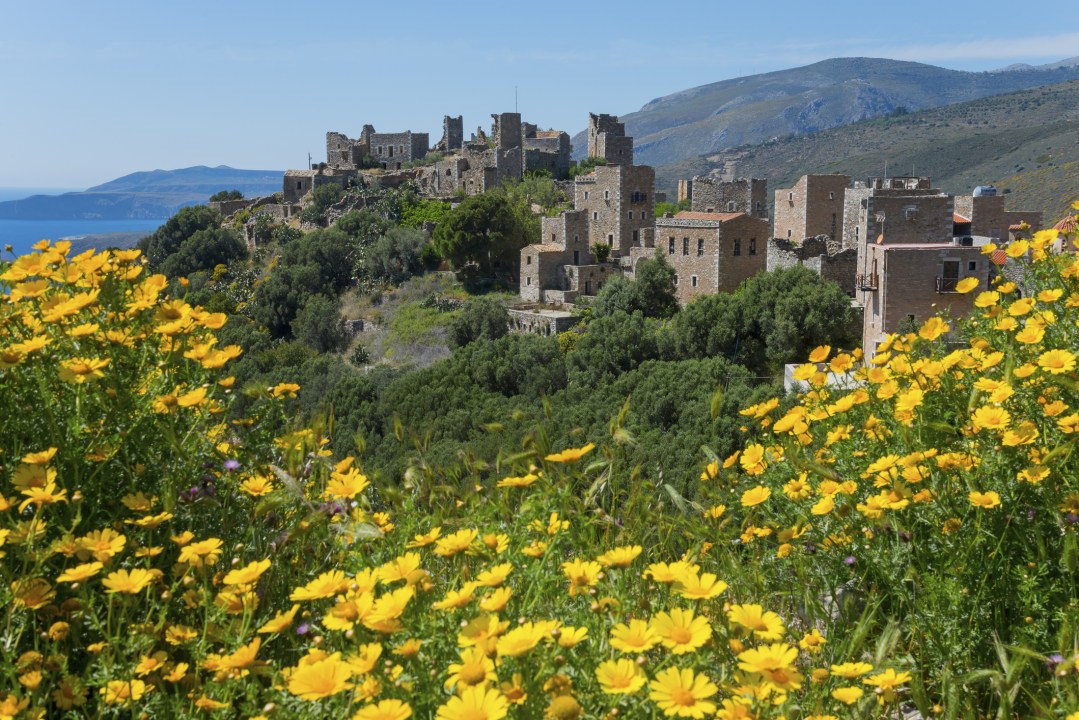
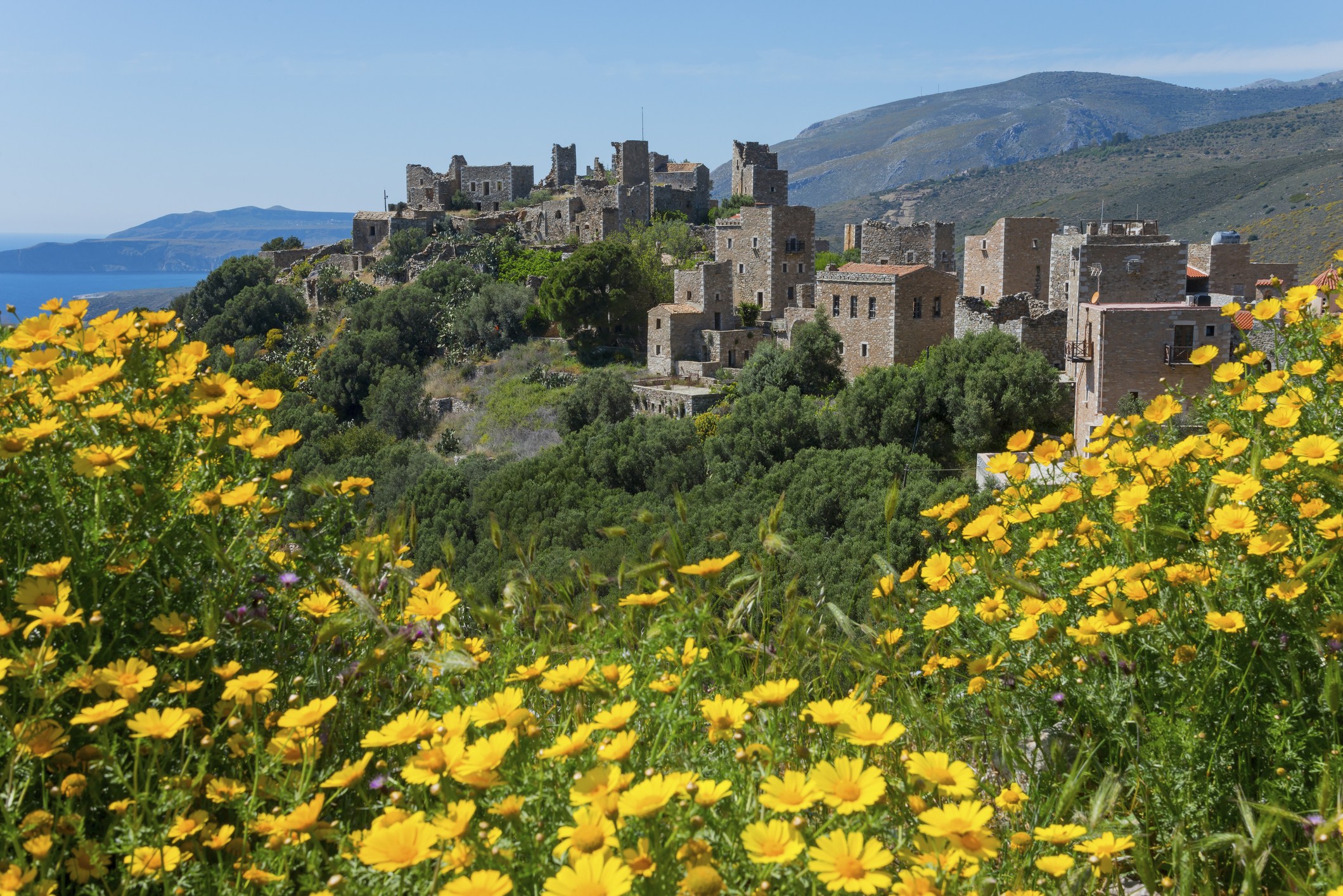
Mostly you will find yourself alone among the crumbling golden stones
“This was not occupied by the Ottomans. This is where real Greeks come from – where the revolution started,” explained Panagiota Athanassa, a local of the Mani peninsula. On a map, Mani is the second finger of the Peloponnesian coast and perhaps the most remote. Tourism is the biggest employer here and the population is clearly getting old. Athanassa was one of several locals who said that it is only in the last three to four years that tourists have begun to make the journey to the jagged Peloponnesian coast and Arcadia, the mountainous region to its north. Another local said American tourists have only recently discovered the peninsula: they have been arriving only since 2024 and are mostly Greek-Americans visiting the land of their ancestors.
Getting to the Peloponnese is relatively easy: a flight to Athens followed by a toll road (upgraded recently to a full motorway) which can speed you to the heart of the Peloponnese in a couple of hours if you travel at Greek speed. In the 1970s, some parts of Mani were only accessible by boat and foot. You can also – as I decided to – take back roads from Athens to Cave of the Seal, a magisterial arch carved in the cliff that faces into the Gulf of Corinth. It is worth a stop if you can manage the acutely steep path.
I also paused at the Corinth Canal – a narrow tranche of water cut into the rock in 1893 to connect the Ionian and Aegean seas – and then stopped overnight in Nafplio. It is easily the most pleasant of the larger Peloponnesian towns thanks to its colorful Venetian architecture and short stint as the capital of the first independent state of Greece.
Beyond Nafplio, the Peloponnese opens out into vast remoteness. Wind turbines gaze over ruins from all the eras of Peloponnese rule: Spartan, Byzantine, Roman. I visited ancient Mycenae, home of Agamemnon, whose citadel was once wedged on to a plateau among imposing mountains. And Mystras, an important Byzantine city, now a romantic ruin strung over a spur of the Taygetus mountains. It is almost on a par with Pompeii in its completeness, but with far fewer tourists. Mostly you will find yourself alone among the crumbling golden stones with just a few stray cats for company.
I stayed at two places in Mani. Both were built in the typical architectural style of “deep” Mani: squat towers with three or so floors and small windows for defense. At the Aria Estate, built in recent years but in this old Mani style, each room has a terrace overlooking the Ionian sea. The rooms are surrounded by a garden filled with rosemary, lavender and thyme, as well as a vineyard beyond. The pool is cut into the hill with a view of the headland of Messina.
Citta dei Nicliani is a smaller, more familial place. Tanya and Ilias Sepsas, Athenians by origin who lived briefly in the Balkans before settling in Mani more than a decade ago, have passed most of the running of the hotel to their son. They continue to oversee the food though, much of which appears from their garden or the local surrounds – a bounty of oranges, pink pepper, dill and olives, some lemon-scented Ionian fish.
You could spend a week in Mani. Take in Limeni, an enticing village strung around a cove that in summer attracts more of the Instagram crowd. Or commit to a day hiking out to Cape Tainaron. After a hot walk to the continent’s southern point, the reward is a swim in the quiet cove, followed by cured anchovies from the Akron Tenaro taverna above it. Worth knowing about, too, is the village of Vatheia, deserted for reasons that are unclear, and Gerolimenas, perfect for an evening cocktail and a swim. I also spent a happy morning stocking up in the main town of Areopoli, a place with plenty of churches and an overabundance of cafés.
Determined to hike in the Arcadian mountains – and breathe some mountain air before returning home – I cut Mani short and drove up to Manna (via more grandiose ruins at Messini). Once a sanatorium for tuberculosis sufferers, the hotel was founded by Anna Mela-Papadopoulou, a pioneering nurse who died of the disease herself in 1938. It is now an upmarket hotel with a Scandinavian vibe.
Stratis Bayatas, its owner, used to play in the ruined building as a kid and oversaw the conversion. The lighting was designed by the same woman who illuminated the Acropolis. But it is far from pretentious. Even Odysseus might have been happy to pause his travels at Manna, to dine on local honey and scented lamb’s shoulder after an all-day hike. Surrounded by pine forests, I felt – unlike our hero – that I would really rather not go home.





Comments