


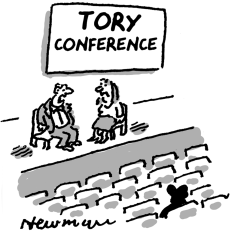
The old jokes are the best. When I arrived in Birmingham on Sunday evening for the Tory party conference, I immediately ran into a former Downing Street bigwig. ‘The Conservative party has two modes – panic and complacency,’ he noted. ‘Last year was panic. This year it’s complacency.’
Twelve months ago, everyone was miserable. Kemi Badenoch’s leadership was on the line and the Tories were on between 17 and 22 per cent in the polls. This year, everyone was delirious at having survived and congratulating themselves on having located a vast political battleground vacated by the leftward-lurching Andy Burnham and the rightward-lurching Reform UK. Badenoch’s personal ratings have soared and the Tories poll… er, between 17 and 22 per cent.
A previously impeccable source inside Conservative campaign HQ says that the party membership has dropped below 100,000 for the first time in as long as anyone can remember. Badenoch’s team deny this but won’t comment. However, the insider says attempts to artificially inflate the number by not striking off people who haven’t paid their subs, or whose card details have changed, have failed to keep the numbers in six figures.
‘We used to be the baddies in town but now it’s Reform. People don’t feel guilty about voting for us’
The reason for the optimism, though, is that Badenoch’s team finally has a strategy, as mapped out by Stephen Gilbert, the veteran politico, at an away day in Westminster just before the conference recess. Counter-intuitively, it involves winning back centre-left voters in order to persuade Reform voters to return to the fold – and doing so not by hugging huskies or hoodies, but with right-wing economics.
The theory is that by focusing on economic competence, fiscal rectitude and a common-sense approach to taxes, the Tories can win back some of those wealthy southern voters who abandoned the Conservatives for the Lib Dems and Labour in 2024.
‘They feel overtaxed,’ says a member of the shadow cabinet. ‘We used to be the baddies for these voters, but Reform means there’s a new baddie in town so they don’t need to feel guilty about voting for us and they will have an economic reason to do it. If we get some of them back, we can get ahead of Reform and then we will get a chunk of Reform people who are just backing whoever the strongest party is on the right. There are enough of us to get us into a good place.’ Think of it as Sgt-Maj Badenoch on the parade ground yelling: ‘Right, left, right…’

That is why Badenoch spent a good part of her bravura, largely self-written, speech talking about the economy. ‘Our country is running out of money,’ she said. ‘Almost every other problem flows from this.’
Burnham’s 1970s socialism would ‘make every single person in this country poorer… Just because these ideas are delivered on TikTok… doesn’t make them any less dangerous than they have always been’.
When you understand the strategy, the policies make sense. Removing the cliff- edge on childcare for people earning over £100,000 will benefit the middle-class southern families who feel squeezed. Their children, who can’t get a job or buy a home, are the implied beneficiaries of the plan to halve employer’s national insurance on jobs for the under-25s to encourage them to hire young people.
Badenoch said she could not yet afford to scrap inheritance tax altogether, but she pledged to legislate so no one ever pays it on their family home.
In addition, couples will be able to leave £1 million in cash tax-free. This southern-focused policy will slash the number of those paying inheritance tax in half.
The interesting bit of the strategy is that it doesn’t involve chasing Reform to the right. Shadow ministers are pleasantly surprised that Nigel Farage and his rhetorical outrider Zia Yusuf seem so fanatically consumed with not being outflanked to the right that Yusuf and Suella Braverman are echoing the ethno-nationalist sentiments of Restore Britain that no non-white can legitimately call themselves ‘English’.
A former cabinet minister with a by-election on his patch, an area where Reform did well in local elections, says: ‘I’m knocking on doors and I can tell you we are much less toxic than Reform all of a sudden. I was having doors slammed in my face in the general election and local elections by people who are now saying, “We’ll vote for you because we don’t like Reform.” It’s the ethno-nationalist thing which has made the difference.’
Badenoch’s fury at such ideas was plain to see: ‘I don’t want to live in a country run by people who… debate whether my mixed-race children are English… I don’t know whether you’ve noticed, but I am black. I am British. I’m proud of my country.’
The Tories launched a concerted effort to get more public recognition for her top team – but so unknown are most of her shadow cabinet that when Sky News threw its conference party, they had cupcakes emblazoned with the faces of Mel Stride and Priti Patel, who were sacked months ago. ‘We had to scoff the lot,’ a source confides.
In truth, Badenoch will have to carry the burden herself. Her personal approval rating is 13 points higher than a year ago, but polling by More in Common shows that of all those who believe Badenoch is doing a good job, only a third (34 per cent) say they would vote Conservative in an election. ‘People are looking through the shop window,’ Badenoch said. ‘They like what they see but let’s be honest not enough of them are buying yet.’
So there is opportunity, but also risk. This was Schrodinger’s conference: the Conservative cat is still in the box, potentially both dead and alive, and the truth is that no one has a clue which cat will emerge.
Internal polling suggests that at a snap election, they could win anywhere between 65 and 160 seats, still worse than the wipeouts of 1997 and 2001 and potentially worse than the all-time low of 2024. If the Tories get ahead of Reform then the hope might be justified. But if they remain marooned in the same poll range this time next year, questions about Badenoch’s future will return.
As she put it, when criticising Andy Burnham: ‘Hope is not a strategy.’ It is necessary but not sufficient for revival. It is also, sometimes, the thing that kills you.





Comments