
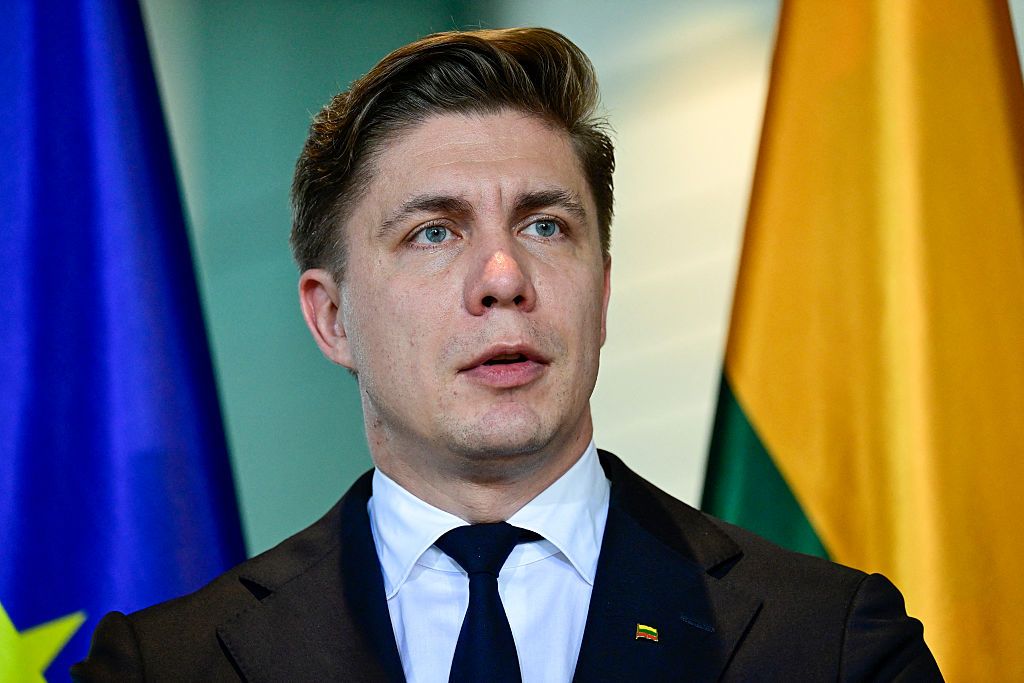
On Monday, President Trump was asked whether the US would consider a permanent military base in Lithuania. “They are friends of mine. They are great people. So we will certainly look at it.”
That was enough encouragement for Lithuanian’s Prime Minister Mindaugas Sinkevičius, who then announced Lithuania would cover its cost. “@POTUS only needs to make a political decision and Lithuania is ready to cover the associated costs. ”, he announced on X.
This is not simply another smaller European country keen on more American security guarantees. In the last few days, Lithuania has completed new housing for a battalion of German troops; courted the US military, and moved closer towards removing a constitutional remnant of the security order it created after escaping the Soviet Union.
On Tuesday, the Seimas, its Parliament, overwhelmingly voted to abolish Article 137 of its constitution: “Weapons of mass destruction and foreign military bases may not be stationed on the territory of the Republic of Lithuania.” The vote is one of two required, with a second vote, and presidential approval, pending for January.
When the law was written in 1992, Lithuania had only just recovered its independence after half a century of Soviet occupation. The remaining Russian troops on its soil only left the following year.
Now, the Lithuanian strategy is shaping to be the reverse: for sovereignty’s sake, or to ward off Russia, foreign soldiers should never leave.
The Baltic nation already hosts an American battalion of almost 1,000 troops, but what worries Vilnius is that that force is “rotational.” Sinkevičius floated the idea of a permanent garrison with Trump’s envoy, John Coale, last month. The desire is for a presence that is less vulnerable to changing administrations and Pentagon priorities.
Vilnius has reason to worry. Earlier this year, as Washington reconsidered its European deployments, the Pentagon paused the next rotation to Lithuania. More than 1,000 troops left the country without their replacements arriving immediately. Eventually, Washington provided reassurance last month and President Nausėda announced a fresh rotation incoming. But the episode raised the prospect of an American absence for the first time since 2020.
For a democratic country wedged between Belarus and the militarized Russian enclave Kaliningrad, it was a reminder that rotations are not guarantees.
The Germans, meanwhile, are moving in. On Monday, as Trump said he’d “look at” a permanent US base, Lithuania announced that the first residential buildings for the permanently stationed German brigade in the new military town of Rūdninkai, had been completed. The new constructions will host 5,000 German troops and civilians by 2027.
Legally, Lithuania can host allied troops without them occupying a “foreign military base,” because Rūdninkai remains Lithuanian property.
Deleting Article 137 from its constitution does not, moreover, mean American nukes are months away from appearing outside Vilnius.
President Gitanas Nausėda has explicitly said there are no immediate plans for Lithuania to store allied nuclear weapons. But the country is looking ahead at removing any potential restrictions.
In July, Nausėda put it simply: “Our constitution was written when geopolitical circumstances were totally different.”
Lithuanian officials argue that, as part of NATO deterrence, there is little point in a nuclear alliance if the constitution rules out options for the other, mightier allies.
Moscow has noticed, of course. On Tuesday, the Kremlin paired the possible American base and Lithuania’s effort to repeal nuclear prohibition as steps toward escalation. Such a reaction, however, tends to strengthen rather than weaken Vilnius. Its approach to defense is quite simple: the louder Russia objects to a NATO deployment, the stronger the case for it.
On January 1, Lithuania will take over the rotating presidency of the Council of the European Union. Its first stated priority? “Strengthening security and defense in the EU and the Euro-Atlantic area.”
For much of western Europe, the endless kerfuffles since Trump’s return to power have played out as an ongoing choice between continuing to rely on Washington or developing a greater European “strategic autonomy.” Lithuania thinks it does not need to choose. It wants German and American troops, higher defense spending and, if circumstances require it, no constitutional obstacle to being more involved in allied nuclear deterrence.
Thirty years ago, Lithuania’s security weighed on the exit of a foreign army. Today, the mission is to make the allied ones stay.





Comments