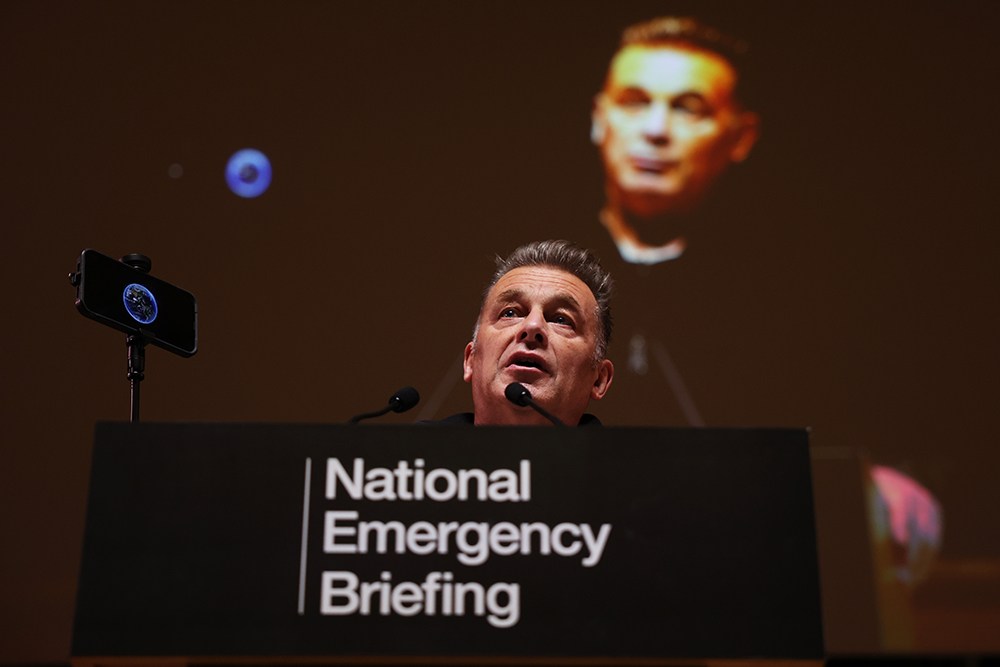


The podium is out, what looks like a government logo fixed in the corner: we are watching the People’s Emergency Briefing, introduced by… Chris Packham. Trying to emulate the Covid conferences, he explains in this government-style briefing that the world is being destroyed by climate change and it is all our fault.
The 50-minute film he introduces is based on a briefing at Westminster Central Hall, to which all MPs are invited, and consists of nine ‘experts’ lecturing its audience on how much this country must change to help the world survive, from energy to agriculture and national security – and which, according to the organisers, ‘lots of people cried’ upon hearing.
It features Lt Gen Richard Nugee (Emily Thornberry’s brother-in-law) calling climate change the ‘most insidious threat to our society’. Later, ‘tangerine’ Donald Trump gets his due. China, by contrast, is painted well: a country that gets on with implementing renewables, easy enough when nobody is asked for their views. But has anyone thought about whether we want to live like that?
‘A little bit of self-care probably needs to take place after what we’ve just watched,’ the host said
The documentary is cut Gogglebox-style: every grim projection followed by a famous person, or a selection of normal ones, pulling a face on a sofa. It feels as if we are being given ten pained minutes of Dragons’ Den’s Deborah Meaden and Ab Fab’s Jennifer Saunders tutting and shaking their heads. But it is St Christopher of Springwatch who dominates – even the welcome image before the screening starts features a black-and-white photo of him gazing stoically into the distance, only the halo missing. The film is being viewed thousands of times in events up and down the country.
The organisation behind it, the National Emergency Briefing, claims that 145 MPs want this mock-government conference televised nationally, in prime time, as a real emergency briefing – but only 95 MPs have actually signed the parliamentary Early Day Motion calling for it.
The screenings are backed by a coalition of Britain’s largest church denominations, too, urging parishes to hold events. This is how I came to attend a pretend press conference about the end of the world on a Wednesday evening in Westminster Abbey’s undercroft (other locations holding screenings include cinemas and a punk rock venue, as well as workplaces such as the BBC). On our way in, we were handed a glass of wine – thankfully – or an elderflower cordial, and a leaflet reading: ‘Whether you feel grief, numb, scared, overwhelmed, confused, anxious, upset, or none of these, remember – everything you’re feeling is completely normal.’
I belonged to the ‘none of these’ category. What I can’t get my head around is the pride in a movement where becoming mentally ill is proof you have fully understood. The leaflet also advised ‘self-compassion’ – ‘don’t expect too much of yourself over the next day or so’ – which gave me an excuse for filing late copy. Sorry, editors, but you have to take it easy on me because of the climate crisis.
The film was filled with condescension. It questioned why we aren’t helping farmers make the right crop choices, as though people who have worked their land for generations await a television naturalist’s advice; displayed a graph showing carbon dioxide concentrations climbing since the industrial revolution, as though we were meant to regret the incredible inventions that came from it and made the modern world.
Just as I thought we were past the mental health psychoses, they returned after the screening. ‘A little bit of self-care probably needs to take place after what we just watched,’ the host said, and told us we were going to be guided through ‘moral injury repair’ – a technique developed to help veterans process PTSD, now deployed on people who have watched a documentary. One of the two practitioners told the room: ‘I’m sure many of us here have felt that distress or trauma at our own participation in something that goes against our moral sensibilities.’
She went on to say she worked with lots of young people struggling with eco-anxiety, and I wonder whether an evening like this is part of the cure or the cause. We began, settled into our chairs, feet flat on the floor, breathing deeply in through the nose and out through the mouth. And again. And again.
Then came reflections from the room. One woman told a sad story about her father, who died during the recent heatwave. The coroner recorded a heart attack; she wondered whether the weather had killed him. She then complained of the ‘cock blockers’ in politics – ‘Ooh sorry, Jennifer Saunders swore so I’m going to swear as well’ – who must make way for people who will do something. Like Chris Packham, presumably.
Then a sanctimonious so-and-so stropped: ‘Why is it me sitting here? I already know this stuff.’ The film, he complained, was ‘too accessible’. Someone else said that for ‘ordinary people’ it would be like ‘getting smashed between the eyes’. Ordinary was not meant kindly. But what the room could not see is that the people who weren’t there are ordinary because they aren’t making themselves ill with climate anxiety.
None of which is to say climate change isn’t real, or that it is silly to have any worries about it. But fuelling a whole group into mental illness and giving it a new label of climate anxiety solves nothing.
The worst contribution – and this is where I felt ‘upset’ as described in the leaflet– came when a woman announced, ‘I’m going to be brave,’ before moaning that ‘people just are endemically stupid’ and solutions must be ‘forced’ upon them. She feels ‘incredibly guilty about, like, my plastic bottle of water’, but it is someone else’s job to fix it: ‘We really do need to be expecting our politicians to bring those changes on our behalf.’ Some, then, it turns out, did fancy living in a country like China. If the movement wants change, it might be worth trying to convince people of your argument rather than make them riddled with climate anxiety or stamp down on them like a dictator.
We left with instructions: host your own screening and write to your MP to get their backing for a public broadcast. I don’t think Spectator colleagues would appreciate me putting one on, but I can at least tell readers about it – if only to save them from seeing it.




Comments