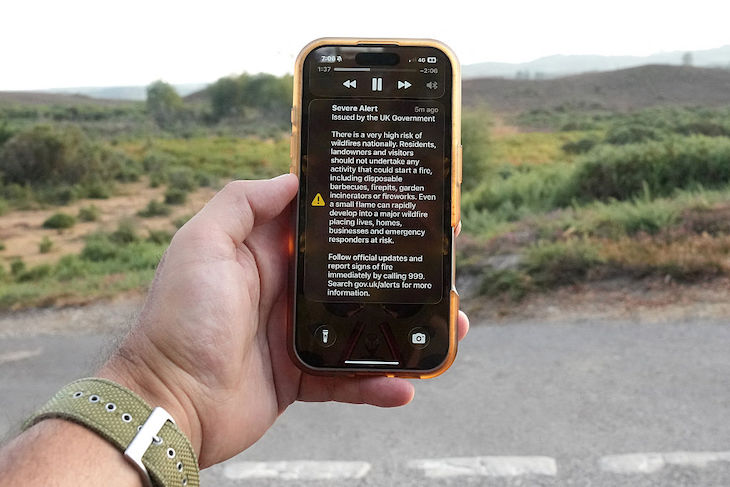
Last night, my phone, which was set to silent, erupted with the sort of siren one associates with immediately life-threatening emergencies. If you live in England or Wales, yours probably did too.
“There is a very high risk of wildfires,” read the message that appeared, once I’d fumbled the cacophonous phone out of my pocket. My lawn is brown and crunchy and we are living through the hottest summer of our lifetimes. I’ve just finished a twelve-day stretch working in a hospital with no air conditioning, and had finally sat down to consider a glass of chilled rosé, so it was useful to be brought up to speed with the fact that it’s been a trifle warm.
The alert didn’t warn us of an emergency at all; it warned us not to cause one
“Residents, landowners and visitors should not undertake any activity that could start a fire,” the message continued, “including disposable barbecues, fire pits, garden incinerators or fireworks.”
These details, I think, are essential. I had ruled out my gas barbecue on the grounds of a fire risk, decided against lighting the kamado and spending the next hundred hours slow-cooking a brisket offset over maple wood, before whacking the heat up to 400°C for a decent char. But I’d been seriously considering knocking up a quick DIY garden incinerator. The pub two doors down contains visitors, possibly even a landowner, and they might have thought themselves exceptions.
The alert didn’t warn us of an emergency at all; it warned us not to cause one. Our Cold War warning system was designed to give us four minutes’ notice of nuclear attack, since four minutes made all the difference. The modern system – its development more a case of supply than demand – put a national siren in almost everybody’s pocket, a direct route from the government’s mouth to your ear. How could they resist?
Sadly, not to mention predictably, they couldn’t. An opt-in system was avoided because the government thought we wouldn’t want to opt-in. Very thoughtful, really.
An attempt to warn us all about covid was a technical failure, the messages dribbling out over a couple of days, but in retrospect it did seem as though many citizens managed to hear about the virus all the same.
Rather than being something we needed to know this second, something the government couldn’t communicate through the ever-present news cycle, the alert was pre-planned. Andy Burnham, fresh from the invigorating self-importance of chairing his first COBRA meeting, authorised the alert; those titans of British administration, Angela Rayner and Louise Haigh and the Cabinet Office, did the rest. The urgency was so great that the government issued a press release on Friday morning, giving us a full day’s warning that, come the evening, we’d be urgently notified.
Homes were destroyed in Stourbridge in the West Midlands; the damage and the continuing danger are real. The question is whether the benefits are sufficient to justify the intrusion and the psychological capital the alert spends. Emergency sirens work only as long as people presume they communicate something both real and urgent. Will Friday’s alert change the behaviour of those so perplexed by life that it hadn’t occurred to them a tray with fire in it placed on parched grass might set it alight? Or open the eyes of those who hadn’t yet noticed that it’s been a trifle warm?
Some barbecues will be prevented, but whether that justifies converting our national emergency siren into the government’s public-information service is another question – and one the North Wales Police might answer. The alert suggested mentioned 999, and the force was so flooded with calls it asked the public to consider whether they were getting in touch about actual emergencies.
Once the national siren becomes a tool for making us safer, the possibilities are endless
Louise Haigh, Minister for the Cabinet Office, said the fact the alert was sent out “reflects the seriousness with which the government is acting”, and you can’t say fairer than that. They’re serious people, you see, and they’ve proved it by making all our phones buzz and yell. Any fires which start in the days to come will be proof that extra alerts were needed, perhaps on a regular basis, and that they need to continue until we come out onto our doorsteps whenever they happen and applaud the government for the seriousness with which they are acting. And the next time Louise Haigh reports her phone stolen, Burnham can sound a national alert and listen out.
When I left my hospital, the Emergency Department was heaving. Five people die each day in this country from road traffic accidents: we need frequent alerts, at unexpected times of day and night. Once the national siren becomes a tool for making us safer, the possibilities are endless. Many of my patients are the frail elderly, felled by slips and trips. They deserve better. An alert now and again seems the least we can try. I don’t wish to live in a world where we care more about burnt woodlands and houses than old people. I don’t think Burnham and Haigh and Rayner should either.






Comments