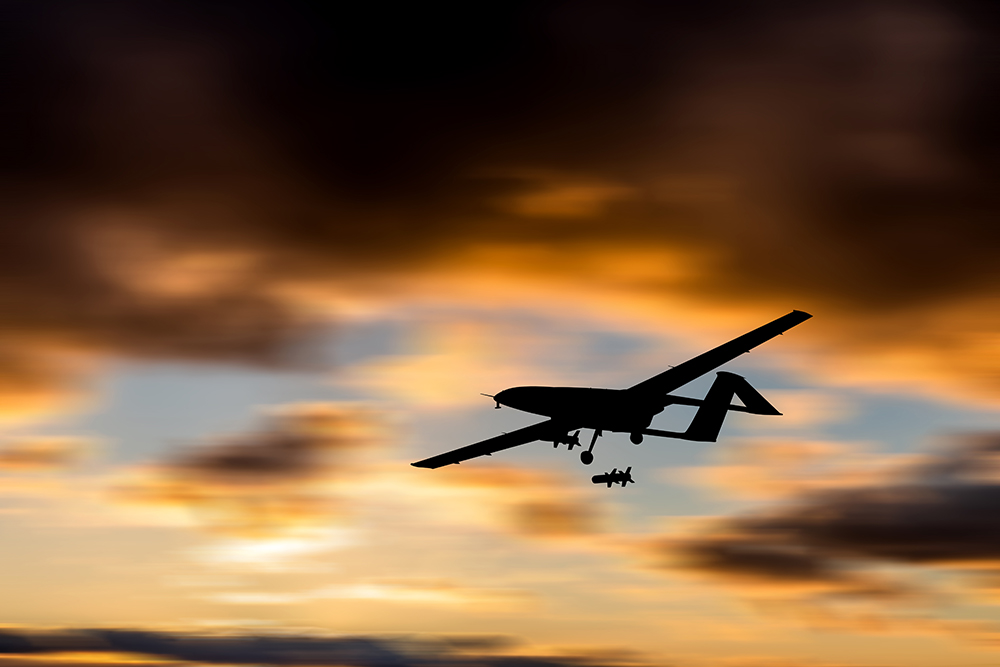
On 27 January 2024, Iranian-backed militants launched a one-way attack drone at the US base known as Tower 22 in the Syria-Iraq borderlands. It hit and killed three American soldiers and injured many other members of the 350-strong garrison. The attack was a pivotal moment. Before it, no US ground troops had been killed by an enemy aircraft since the Korean War. But they had been now, and would be again. Two years later, a similar attack, this time by Iran itself, evaded US air defences, hit a US command centre in Kuwait and killed six personnel. It was the deadliest Iranian strike of the recent conflict.
Steve Feldstein is a senior fellow at the Carnegie Endowment for International Peace, an expert on technology, democracy and national security and an award-winning author. His first book, The Rise of Digital Repression, explored how authoritarian leaders use technology to strengthen their power. Now, in his timely, challenging and ambitious Bytes and Bullets, he turns his attention to the way technology is transforming how nations compete and wage war, increasing instability and threatening to disrupt the old hierarchy of nations.

At the end of the Cold War, the United States emerged ‘sitting alone’ atop the international pecking order. Globalisation and free trade had seemingly delivered relative peace and prosperity to the world, while further entrenching US power. But, Feldstein argues, after an extensive programme of research in various geopolitical hotspots, including Lebanon, Turkey and Ukraine as well as Silicon Valley, the US government did something that few, if any, great powers had done before or are likely to do again: it shared its Cold-War-winning innovations with the world.
While this radical new policy of ‘open innovation’ bound more countries to its new world order, it also empowered the states and insurgents that opposed it. Technologies that had been developed for nuclear war, such as GPS, integrated circuits and the precursor to the internet, made both the iPhone and the attack on Tower 22 possible. Consequently, the author believes, the West is in a ‘new technology Cold War’ with China, Russia and other rising tech powers such as Iran that few of its leaders want to acknowledge or do anything about – a war that it risks losing if it doesn’t act quickly.
Feldstein powerfully and succinctly captures milestone moments to illustrate how the West’s rivals are not only rapidly, cheaply and successfully adapting western military technology to their own purposes, but also how they try to negate its advantages. These moments range from the 2020 Azerbaijan-Armenia war, during which the former’s cheap drones devastated the latter’s conventionally armed military – when Armenian soldiers heard the ‘shrill scream’ of an Israeli Harop attack drone ‘they knew they had seven seconds’ to take cover; to Ukraine’s audacious Operation Spider’s Web, which launched waves of AI-equipped drones from shipping containers near Russian airbases to destroy its nuclear bomber fleet; to the fall from grace of Jack Ma, the celebrity founder of the Chinese e-commerce site Alibaba, and his unexpected resurrection as an AI pioneer.
Feldstein even captures the moment Russia effectively took over Morocco’s state-owned Tanger Med port complex to evade sanctions. He also explores how – worse for the West – such adversaries are independently developing their own destructive technological innovations using AI systems, satellite internet or advanced semiconductors from private companies, not government labs, which the West is failing to look for, creating a fatal ‘blind spot’.
Bytes and Bullets is certainly compelling. Feldstein combines a deft turn of phrase with in-depth research, convincing illustrative vignettes and some of the most effective tables I have seen in a book to tell a very technical story in a manner that reads like a thriller.






Comments