Cold war

How America enfeebled Europe

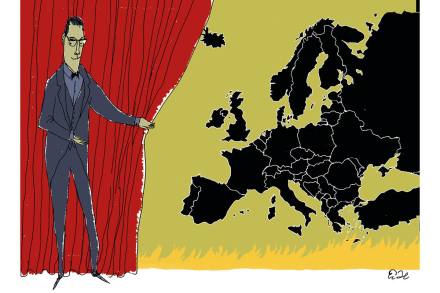
Fighting to “rebalance” NATO, American leaders now look on the old continent with dismay. Europe cannot seem to muster the physical resources — and, still more, the cultural ones — to provide for its own defense. Even American liberals now mark this down to a late social democratic decadence, or civilizational ennui. To a certain kind of Elon Musk outrider, “Europe is cooked,” or, “Europe is a museum.” The go-to explanation is that America has spoiled these countries rotten for too long. Sheltering under Article 5 of NATO, European nations were able to run down military budgets and use the dividend to pay for generous welfare states. US overspending had allowed Europe to live in a post-historical dreamworld, but reality would have to intervene sooner or later.

europe museum america
putin

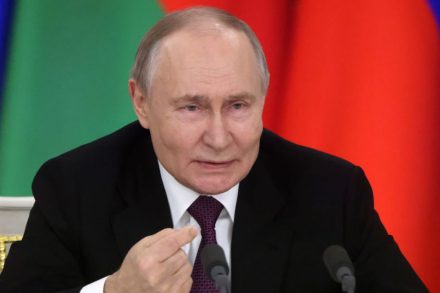
Will Putin give peace a chance?

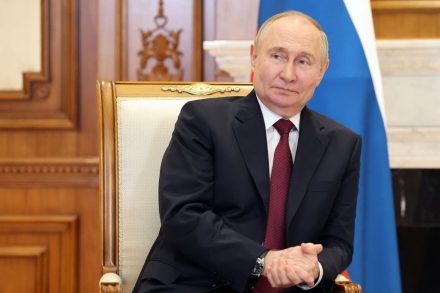
At a summit meeting in Moscow, Ronald Reagan was asked about his basic approach. He famously answered, “Here’s my strategy on the Cold War: we win, they lose.” Vladimir Putin has the same strategy for Ukraine. That is certainly his first response to President Trump’s offer to mediate an end to the war and bring a reluctant Ukraine to the negotiating table. If “we win, they lose” is Putin’s final response, then the war cannot end without Ukraine’s surrender or Russia’s collapse. Putin’s initial reply, filled with his maximalist demands, indicates he is still committed to the conquest of his neighbor, whose independence and sovereignty he has long rejected.

Europe learns the facts of MAGA life

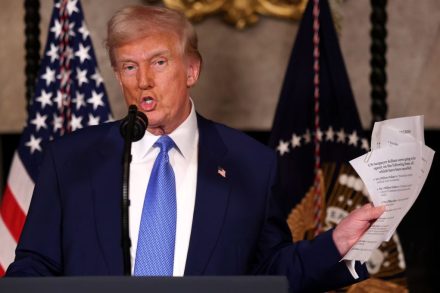
Panic, even hysteria, has swept Europe. Its leaders realize that in their case Trump should be taken literally as well as seriously, and he seems prepared to trade the transatlantic alliance for détente with Russia. Eight decades of good times for the continent might be coming to a dramatic end. Trump demonstrated contempt for Europe during his first term; however, his top aides moderated his antagonism, carrying on policy as normal. While out of office he evidently decided never again. Today he is firmly driving American foreign policy. As ever, Trump’s tactics are often dubious, even counterproductive. However, only shock treatment is likely to cause Europe to take its own defense seriously.

europe

Panama celebrates a quarter-century’s ownership of its greatest asset

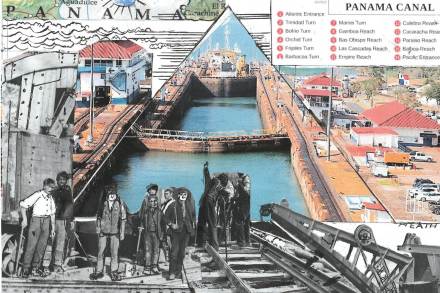
New Year’s marked the twenty-fifth anniversary of the collective freakout known as Y2K, when overwrought tech aficionados joined forces with Luddites to warn the world of the pending apocalypse of computer infrastructure that could run the global economy but was evidently incapable of resetting to “00” in date codes. Those chiliastic projections obviously did not come to pass, which is why we can spend 2025 reflecting on the twenty-fifth anniversary of the day’s other Chicken Little situation — consternation over the transition that would, some skeptical parties feared, have catastrophic consequences for infrastructure central to the daily functioning of global markets, the final turnover of the Panama Canal.

Panama

RNC ends on a high note

The Republican National Committee’s memorable four-day convention came to an end in Milwaukee last night. With an unusual performance from Kid Rock, a shirt-ripping Hulk Hogan and dozens of Trump-humanizing speeches, the RNC managed to throw a party that drew some attention, some laughs and certainly some tears — from worried Democratic strategists and enamored Trump-fans alike.It was, as The Spectator’s James Heale put it, “the first convention in twenty years where polls suggest the Republicans are on course to win the White House, producing an air of expectation and excitement.

Why Russia is flaunting its ships in the Caribbean

Two Russian ships docked Tuesday in Venezuela’s La Guaira port, twenty miles away from Caracas. The stop comes after military exercises were conducted in the Atlantic, with four vessels stopping in Havana late last month. This is all part of a decades-long “look-at-us” operation, also known as a “show the flag” move, as Russia’s defense ministry puts it. While Russia’s presence in Cuba and Venezuela is not a new phenomenon, conflict in the East has only accelerated their muscle-flexing in the West. These movements mark Russia’s first extensive military exercises in the hemisphere in five years, as well as their first deployment of a nuclear submarine in close proximity to the US since the Cold War.

Russia

The Americans who defected to North Korea

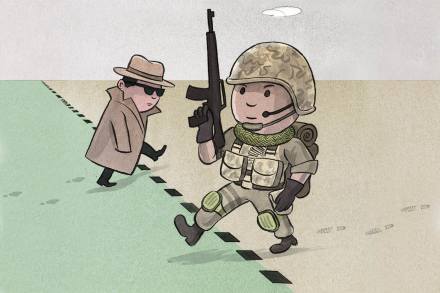
Last summer, US Army soldier Travis King ran across the Korean Demilitarized Zone into the arms of the North Koreans. It wasn’t because of some mental break or as part of a spy operation. North Korean state media claims he was motivated by racism and mistreatment — of course they would. The DPRK’s outlets have previously criticized the US for its treatment of African Americans, around the same time they compared former president Barack Obama to a “wicked black monkey.” Like the six American servicemen who crossed the DMZ before him, King probably had a mixture of reasons for his flight. Unlike in the previous cases, however, King’s detention was a short one.

North Korea

The man who made Reagan

Ronald Reagan has been dead for nearly twenty years, but sometimes it still feels like he’s still the head of the Republican Party. The fortieth US president has been etched in American folklore as one of the country’s most effective and historic statesman, the man who stared down the Soviet Union and pursued policies that ultimately brought down the so-called “Evil Empire” in December 1991. Republican politicians of all stripes, from presidential aspirants to local councilmembers, utter his name at every opportunity. The first GOP presidential debate took place at the Reagan Library in Simi Valley, California, where multiple candidates looked back at the 1980s as a time when the mighty US shook off the cobwebs from the Vietnam War and rediscovered its self-confidence.

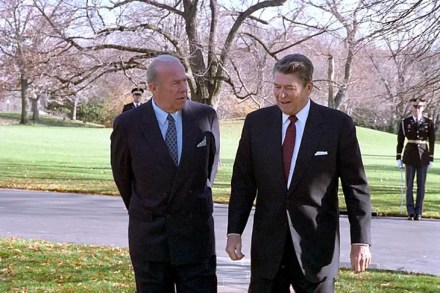
President Reagan walking with George P. Shultz outside the Oval Office (Wikimedia Commons)

How the CIA interfered in the Congo

As everybody knows, as soon as you start to talk to any historian of postwar life in any Latin American or African or Southeast Asian country, the discussion quickly turns to the role of the CIA in subverting democracy. From the Truman-era coups in Syria and Egypt, through regime change in Guatemala, assassination in the Dominican Republic, the fomenting of industrial unrest in Guyana, and both the military and covert US involvement in Vietnam, it seems overseas intrigue was the rule and long periods of benign neglect the exception.

congo

Reminders of the Cold War in Vienna and Budapest

Apparently an acquaintance has dubbed me the “Kremlinologist of the right.” Redolent as it is of the Cold War-era drama surrounding the Kremlin, when the West was desperately trying to suss out what Winston Churchill called a riddle wrapped in a mystery inside an enigma, I could hardly object to this quip upon learning of it. Indeed, I recently traveled to two hot spots of the Cold War, Vienna and Budapest. I went full immersion in Vienna, where I attended a screening of Orson Welles’s The Third Man, a humdinger of a movie if there ever was one. Graham Greene set it in postwar Vienna, which was divided between the four occupying powers, France, Great Britain, America and the Soviet Union.

Cold War

Following the seam of the Iron Curtain

Just before the pandemic, I spent several months traveling through Europe, from the north of Norway to Istanbul and beyond to Azerbaijan. I saw unforgettable sights: the endless daylight of the Arctic summer; the vast Hammershus castle on the Danish island of Bornholm; Vienna’s ornate Prunksaal library; and the sandy beaches of Corfu. But the focus of my journey was precisely those things that most travelers to these places often ignore. I was following the route of the Iron Curtain. My aim was to visit every part of that old great divide, all the places where NATO once abutted the Warsaw Pact, where overwhelming military might stood constantly primed for apocalypse.

How to win the war that everyone is losing

Russia is losing the war in Ukraine. So is Ukraine. And so are we. Imagine the good guys win tomorrow. What exactly will we have won? Ukraine was the poorest country in Europe even before the war. Afterward it will remain as dependent on American dollars as it is now — and on American arms. Russia will not have disappeared, after all. The last war-torn and impoverished country that required open-ended American support was Afghanistan. Yet all the weapons and funds we lavished on Hamid Karzai and Ashraf Ghani failed to keep the Taliban at bay after we left. The money also didn’t help with Afghanistan’s corruption problem. Will it help with Ukraine’s? In 2021, Transparency International ranked Ukraine second only to Russia as the most corrupt country in Europe.

war

Why South Africa is cozying up to Russia and China

Vladimir Putin’s invasion of Ukraine opened the most dramatic divide between East and West since the Cold War. Most of these divisions were clear beforehand — Hungary and Turkey were longtime thorns in the side of NATO, for example. Yet South Africa’s warming ties with Russia and China seemed to come out of nowhere. South Africa's initial reaction to the invasion was the same as much of the Western world, demanding that Russia leave Ukraine. That did not last, however. South African President Cyril Ramaphosa said on March 17 that “The war could have been avoided if NATO had heeded the warnings from amongst its own leaders and officials over the years that its eastward expansion would lead to greater, not less, instability in the region.

When the moon brought America together

The Artemis rocket is back from the moon. Within a couple of years, if all goes to plan, it will bring men to the moon’s surface. It is a great loss that a bigger deal hasn’t been made of this expedition. I was only three when John F. Kennedy died, and his famous 1962 pronouncement that we would go to the moon not because it was easy but because it was hard was already history. The picture books I got on birthdays always included him in the history of space exploration. Those books made sure every kid knew how “we” were going to get to the moon. They changed us, and with us, America. We started with Mercury, baby steps mostly proving we could launch men into space. Then Gemini, a long proof-of-concept program to try out the technology of docking.

South Korea toys with developing nuclear weapons

Yoon Suk-yeol isn’t a household name in the United States, but his comments this week have put him in the international spotlight. Speaking at a press briefing on Wednesday, the South Korean president openly surmised that if North Korea’s nuclear weapons program continued unabated, Seoul may have to explore an option the United States wouldn’t like: producing nuclear weapons of its own. Referring to Pyongyang’s weapons programs, Yoon said, "It’s possible that the problem gets worse and our country will introduce tactical nuclear weapons or build them on our own. If that’s the case, we can have our own nuclear weapons pretty quickly, given our scientific and technological capabilities.” The remarks generated immediate pushback from nuclear security experts.

The myth that Hiroshima was necessary

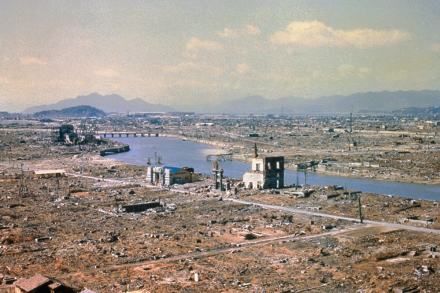
If you think the falsehoods spilling out of Ukraine about casualties and atrocities are shocking, meet the greatest lie of modern history. August 6 marks the seventy-seventh anniversary of the nuclear destruction of Hiroshima and death of some 140,000 non-combatants. Yet the only nation in history to employ a weapon of mass destruction on an epic scale, against an undefended civilian population, shrugs off the significance of an act of immorality. Beyond the destruction lies the myth of the atomic bombings, the post-war creation of a mass memory of things that did not happen. This myth has become the underpinning of American policy ever since, and carries forward the horrors of Hiroshima as generations pass.

Berlin as the unreal city

"Berlin has too much [history]." Sinclair McKay cites this rueful observation in the preface to his new book about the city. Given that he is not simply discussing Berlin between the wars, or during the second of those wars, or in the Cold War that followed, but all of it, this may come off as a cry for help. History may — in those words attributed to, well, take your pick — be “one damned thing after another,” but when it came to Berlin, those things hurtled through time in a horde, colliding, overlapping and refusing to form an orderly line. And, in Berlin’s case, they had a way of mattering. Not for nothing does this book’s subtitle refer to Berlin as “the city at the center of the world.” Bad news for a writer aiming, presumably, at a degree of concision.

berlin

Springtime for Cold War nostalgics

My favorite spy movie cliché of all time is the secret agent stuck in the 1980s. The threats have gone asymmetrical, terrorists slip across borders, but our hero longs for the simple days when the world was divided between good Westerners and bad Russians. “You’re a fossil!” sneer his girlboss department administrator, his vegan drone pilot, his tech whiz who has just hunted down a non-state actor by crosschecking the latest SIGINT with a Yelp! review of an Iraqi yoga studio. Cut to him muttering under his breath à la Judi Dench in Casino Royale: “Christ, I miss the Cold War.” Now, suddenly, those who miss the Cold War are having a moment.

Cold War

How to turn the tide against Russia

The abrupt eruption of the worst military conflict in Europe since World War Two has naturally left the world in a state of shock, perhaps only comparable in living memory to that felt on 9/11. But as responses are considered and argued over, there will be more blows to come — as well as recriminations over how this could have been avoided. Naturally, much depends on which side emerges victorious, and at the time of writing the end result has yet to be determined. Certainly any assumption that the might of Russia's military machine would roll into Ukraine and quickly overwhelm the defenders has been categorically proven wrong; Russia's Blitzkrieg-style offensive failed to achieve its first-day objectives in the face of fierce Ukrainian defense.

vlad invader empire

No, China isn’t about to invade Taiwan

I have a medal for winning the Cold War. And I'm not alone — they were awarded to all members of the military and federal civilian employees who served during the Cold War. That included me, at the tail end, with the State Department. Ironically, my so-called Cold War service was in Taiwan. I probably should return the thing; the Cold War is far from over. Part of the Cold War's real conclusion is playing out in Ukraine in real time. Is Taiwan, another hanging chad from that era, next? Is President Xi watching a weakened America giving in to the Russians and seeing his chance to seize Taiwan? Nope. Taiwan is not Ukraine is not Taiwan. The two places only exist next to each other in articles like this one because both are the results of American policy.